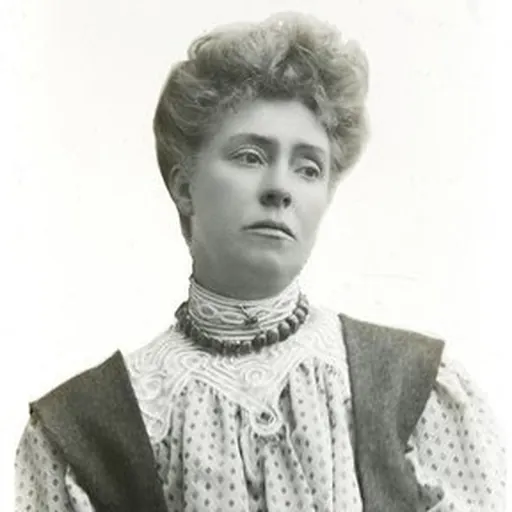
About Minnie Baldock
Lived 1864 – 1954 (aged 90). Minnie Baldock was a British suffragette.
Lucy Minnie Baldock (née Rogers; 20 November 1864 – 10 December 1954) was a British suffragette. Along with Annie Kenney, she co-founded the first branch in London of the Women's Social and Political Union (WSPU). The East End of London was known for its poor conditions and the Baldocks joined the Independent Labour Party (ILP) after the socialist Keir Hardie became their local Member of Parliament (M.P.) in 1892. She took charge of the local unemployment fund that was used to mitigate extreme hardship. Women were not then allowed to be Members of Parliament, but the ILP chose her as their candidate to sit on the West Ham Board of Guardians in 1905. Baldock was arrested on 23 October 1906 (along with Nellie Martel and Anne Cobden Sanderson) for disorderly conduct during the opening of Parliament.
In 1907, she reported to the group on her visit to Jane Sbarborough in Holloway Prison when she heard about signalling between suffragettes, imprisoned at the same time, but not allowed to talk to each other. Baldock was also at the prison gate with Christabel Pankhurst to support Flora Drummond and others released to have a celebratory hotel breakfast. She also spoke in June 1907 at a Knightsbridge home event at the request of Louise Eates, Kensington WSPU and in August at a home in Kensington with Emmeline Pankhurst as noted by Sara Jessie Stephenson in her pamphlet No Other Way.
In November 1907, Baldock was recording being ejected from a Liberal MP's event on the Isle of Dogs but stood on a chair outside a window calling out "Votes for Women". In summer 1908 she was in Nottingham with Elsa Gye to build up its WSPU. In April 1909 she was with around 500 suffragettes at breakfast in Picadiily for Mrs Pethick-Lawrence's release from custody. "to present a petition from the Conference at Caxton Hall, and to the refusal of the authorities to treat suffragist offenders as first-class misdemeanants." Baldock was arrested along with Mrs Pankhurst and others and was charged with resisting and obstructing the police. "Mrs. Pankhurst, Miss Annie Kenney, and the eight other women suffragists who were arrested on Thursday in attempting to make their way to the Houses of Parliament were yesterday brought before Mr. Horace Smith at the Westminster Police Court. They were charged with resisting and obstructing the police.
...
Miss Kenney and Mrs. Baldock, against whom there were previous convictions, were each fined £5, with the alternative of one month's imprisonment in the second division. Mrs. Pankhurst and the other defendants were each ordered to find sureties of £20 to be of good behaviour for twelve months, or to go to prison for six weeks in the second division. All the ten women chose to go to prison." In April that year, Emily Cobb, WSPU, offered to sponsor the cost of a house help so that Baldock could be 'set free to do work you can do [ for the Cause] and many of us can not', and in May Baldock was with Annie Kenney in Bristol, renting a house near the venue Augustine Birrell Liberal MP and Irish secretary of state, was to be speaking at, to help Elsie Howey and Vera Holme who hid overnight in the Hall to get into the event. In October 1909, Baldock was arrested again with Flora Drummond and the Pankhursts back at Clement's Inn. The following year, Baldock spoke on Wimbledon Common, and had her travel paid by Minnie Turner, to support Mary Clarke campaigning in Brighton for a week in the summer. Later in 1911, Baldock was diagnosed with cancer and underwent surgery performed by Louisa Aldrich-Blake. Baldock recovered but broke contact with the increasingly militant WSPU. She did keep in contact with Edith How-Martyn and she was still a member of the Church League for Women's Suffrage. At the start of 1913 she and her family had to move to Liverpool for her sons to seek work in shipyards, although she and husband were also reported to be in Southampton in 1914.
She died at age 90 in Poole in 1954. In 2011, Poole Museum and the National Lottery funds sponsored a short film on Baldock's life called The Right to Vote by Kate O'Malley starring Michelle O'Brien.
Don’t just read it —
keep it.
Full-length biographies made to live with: read them, listen on the way to work, watch them tonight.
- E-book
- Audio
- Video
Instant download · yours to keep · every purchase keeps this site free
Important facts
People in Minnie Baldock's life
Named in this biography and alive at the same time




Related people
Same field, nearest in time


Contemporaries
People whose lives overlapped Minnie Baldock's




Frequently asked questions
Who was Minnie Baldock?
UK suffragette (1864-1954)
When was Minnie Baldock born?
Minnie Baldock was born on 20 November 1864 in Bromley.
When did Minnie Baldock die?
Minnie Baldock died on 10 December 1954 in Poole.
What was Minnie Baldock's occupation?
Minnie Baldock was a suffragette.
What nationality was Minnie Baldock?
Minnie Baldock was British.
Sources & further reading
Cite this page
APA: Biography.guide. (2026). Minnie Baldock. https://biography.guide/minnie-baldock/
MLA: "Minnie Baldock." Biography.guide, https://biography.guide/minnie-baldock/.
Chicago: "Minnie Baldock." Biography.guide. https://biography.guide/minnie-baldock/.
Data last updated: 2026-09-23 · Spot an error? Report a correction.
Portrait: Wikimedia Commons · author & licence
Page generated 2026-09-27 05:05 UTC