
About Minard Lafever
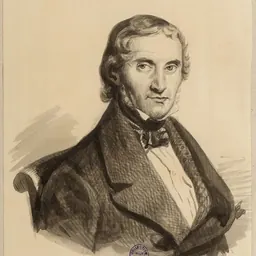
Lived 1798 – 1854 (aged 56). Minard Lafever was an American architect.
Life and career Lafever began life as a carpenter around 1820. At this period in the United States there were no professional schools of architecture and few who claimed the title architect. Most structures were designed and put up by builders, and architects and builders were trained by working under master builders.
Pattern books
Lafever wrote five pattern books that were influential in spreading his Greek Revival style, most notably "The Modern Builder's Guide" (1833) and "The Beauties of Modern Architecture" (1835). The Greek Revival Government Street Presbyterian Church in Mobile, Alabama is a National Historic Landmark that was designed using many of the latter book's detailed guidelines. That church's tall steeple, like the steeple of Lafever's First Presbyterian Church in Sag Harbor, was destroyed in a hurricane.
Other historic structures built using Lafever's designs include Rose Hill Mansion, a National Historic Landmark in western New York, which was built in the style of a two-story Greek temple with Ionic columns in 1837. Two mansions in the Boston Post Road Historic District— the 1838 Peter Augustus Jay House and Lounsberry— were built using Lafever's designs, and greatly resemble illustrated plates found within Lafever's books. Rose Glen, an antebellum plantation house near Sevierville, Tennessee, was modeled after Lafever's "Design for a Country Villa," which appeared as the frontispiece in both The Modern Builder's Guide and The Beauties of Modern Architecture.
Lafever did not confine himself to a single style. His St. James' Church, New York on James Street near Madison Street in Manhattan (1837) is Greek Revival as is his building for Sailors' Snug Harbor, his First Presbyterian Church (Sag Harbor) (1844) is Egyptian Revival, his brownstone St. Ann and the Holy Trinity Church at Montague and Clinton Streets in Brooklyn Heights (1847) is Gothic Revival and his Church of the Holy Apostles at Ninth Avenue and 28th Street in Manhattan (1848–1854) is Romanesque/Italianate.
Books by Minard Lafever The Young Builder's General Instructor,1829 The Modern Builder's Guide,1833 The Beauties of Modern Architecture, 1835 The Modern Practice of Staircase and Handrail Construction,1838 The Architectural Instructor,1856
Don’t just read it —
keep it.
Full-length biographies made to live with: read them, listen on the way to work, watch them tonight.
- E-book
- Audio
- Video
Instant download · yours to keep · every purchase keeps this site free
Important facts
People in Minard Lafever's life
Named in this biography and alive at the same time



Related people
Same field, nearest in time



Contemporaries
People whose lives overlapped Minard Lafever's





Frequently asked questions
Who was Minard Lafever?
American architect
When was Minard Lafever born?
Minard Lafever was born on 10 August 1798 in Morristown.
When did Minard Lafever die?
Minard Lafever died on 26 September 1854.
What was Minard Lafever's occupation?
Minard Lafever was an architect.
What nationality was Minard Lafever?
Minard Lafever was American.
Sources & further reading
Cite this page
APA: Biography.guide. (2026). Minard Lafever. https://biography.guide/minard-lafever/
MLA: "Minard Lafever." Biography.guide, https://biography.guide/minard-lafever/.
Chicago: "Minard Lafever." Biography.guide. https://biography.guide/minard-lafever/.
Data last updated: 2026-09-20 · Spot an error? Report a correction.
Page generated 2026-09-27 05:00 UTC