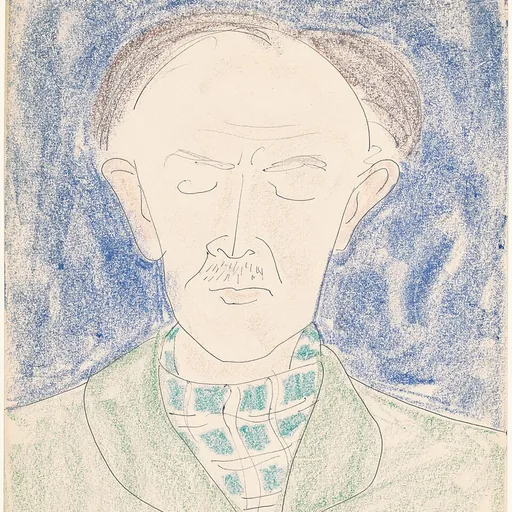
About Milton Avery
Lived 1885 – 1965 (aged 79). Milton Avery was an American painter and illustrator.
Milton Clark Avery (; March 7, 1885 – January 3, 1965 ) was an American modern painter. Born in Altmar, New York, he moved to Connecticut in 1898 and later to New York City. He was the husband of artist Sally Michel Avery and the father of artist March Avery.
Early life The son of a tanner, Avery began working at a local factory at the age of 16 and supported himself for decades with a succession of blue-collar jobs. The death of his brother-in-law in 1915 left Avery, as the sole remaining adult male in his household, responsible for the support of nine female relatives. His interest in art led him to attend classes at the Connecticut League of Art Students in Hartford, and over a period of years, he painted in obscurity while receiving a conservative art education.
Career For several years in the late 1920s through the late 1930s, Avery practiced painting and drawing at the Art Students League of New York. Roy Neuberger saw his work and thought he deserved recognition. Determined to get the world to know and respect Avery's work, Neuberger bought over 100 of his paintings, starting with Gaspé Landscape, and lent or donated them to museums all over the world. With Avery's work rotating through high-profile museums, he came to be a highly respected and successful painter.
In the 1930s, he was befriended by Adolph Gottlieb and Mark Rothko among many other artists living in New York City in the 1930s–40s. Avery's use of glowing color and simplified forms was an influence on the younger artists. He was elected a Fellow of the American Academy of Arts and Sciences in 1963.
Avery had a serious heart attack in 1949. and is buried in the Artist's Cemetery in Woodstock, Ulster County, New York. After his passing his widow, Sally Avery, donated his personal papers to the Archives of American Art, a research center of the Smithsonian Institution.
Style and influence Avery's work is seminal to American abstract painting—while his work is clearly representational, it focuses on color relations and is not concerned with creating the illusion of depth as most conventional Western painting since the Renaissance has. Avery was often thought of as an American Matisse, especially because of his colorful and innovative landscape paintings. His poetic, bold and creative use of drawing and color set him apart from more conventional painting of his era. Early in his career, his work was considered too radical for being too abstract; when Abstract Expressionism became dominant his work was overlooked, as being too representational.
French Fauvism and German Expressionism influenced the style of Avery's early work, and his paintings from the 1930s are similar to those of Ernst Ludwig Kirchner. By the 1940s, Avery's painting style had become more similar to Henri Matisse, and his later works use color with great subtlety. According to art historian Barbara Haskell, "serenity and harmony" characterized all of Avery's work, especially his late work, which, "more than ever, exuded a world of low-key emotions from which anger and anxiety were absent."
About Avery's art According to painter Mark Rothko, What was Avery's repertoire? His living room, Central Park, his wife Sally, his daughter March, the beaches and mountains where they summered; cows, fish heads, the flight of birds; his friends and whatever world strayed through his studio: a domestic, unheroic cast. But from these there have been fashioned great canvases, that far from the casual and transitory implications of the subjects, have always a gripping lyricism, and often achieve the permanence and monumentality of Egypt.
Art critic Hilton Kramer said, in his review of Grad's book with its sumptuous illustrations,He was, without question, our greatest colorist. ... Among his European contemporaries, only Matisse—to whose art he owed much, of course—produced a greater achievement in this respect.
Public collections
Ackland Art Museum, University of North Carolina at Chapel Hill Addison Gallery of American Art, Andover, Mass. Albright-Knox Art Gallery, Buffalo, N.Y. Binghamton University Art Museum, New York Birmingham Museum of Art, Alabama Block Museum of Art, Northwestern University, Evanston, Ill. Brooklyn Museum of Art, New York City Butler Institute of American Art, Youngstown, Ohio Cape Ann Museum, Gloucester, Mass. Castellani Art Museum, Niagara Falls, New York Cleveland Museum of Art Columbia Museum of Art, South Carolina Crystal Bridges Museum of American Art, Bentonville, Ark. Davistown Museum, Liberty, Maine Leigh Yawkey Woodson Art Museum, Wausau, WI Maier Museum of Art, Randolph College, Lynchburg Va. Maitland Art Center, Florida Memorial Art Gallery of the University of Rochester, New York Metropolitan Museum of Art, New York City Milwaukee Art Museum Minneapolis Institute of Art Modern Art Museum of Fort Worth, Texas Montana Museum of Art and Culture, Missoula Montclair Art Museum, New Jersey Museum of Fine Arts, Boston Museum of Modern Art, New York City National Gallery of Art, Washington, D.C. National Gallery of Australia, Canberra National Portrait Gallery, Washington, D.C. Neuberger Museum of Art, Purchase, N.Y. New Britain Museum of American Art, Connecticut New Jersey State Museum, Trenton North Carolina Museum of Art, Raleigh, NC Oklahoma City Museum of Art Pennsylvania Academy of the Fine Arts, Philadelphia Philadelphia Museum of Art Phillips Collection, Washington, D.C. Portland Art Museum, Oregon Reading Public Museum, Pennsylvania San Antonio Art League Museum, Texas San Diego Museum of Art, California Santa Barbara Museum of Art, California San Francisco Museum of Art, California Sheldon Museum of Art, Lincoln, Neb, Smithsonian American Art Museum, Washington, D.C. Tate Modern, London, England University of Kentucky Art Museum, Lexington Vanderbilt University Fine Arts Gallery, Nashville, Tennessee Vero Beach Museum of Art, Florida Virginia Museum of Fine Arts, Richmond Wadsworth Atheneum, Hartford, Conn. Walker Art Center, Minneapolis Westmoreland Museum of American Art, Greensburg, Penn. Woodstock Artists Association and Museum, New York Bruce Museum, Greenwich, Connecticut
Don’t just read it —
keep it.
Full-length biographies made to live with: read them, listen on the way to work, watch them tonight.
- E-book
- Audio
- Video
Instant download · yours to keep · every purchase keeps this site free
Important facts
Family & relationships
People in Milton Avery's life
Named in this biography and alive at the same time




Related people
Same field, nearest in time


Contemporaries
People whose lives overlapped Milton Avery's



Frequently asked questions
Who was Milton Avery?
American artist (1885–1965)
When was Milton Avery born?
Milton Avery was born on 7 March 1885 in Altmar.
When did Milton Avery die?
Milton Avery died on 3 January 1965 in New York City.
What was Milton Avery's occupation?
Milton Avery was a painter and illustrator.
What nationality was Milton Avery?
Milton Avery was American.
Sources & further reading
Cite this page
APA: Biography.guide. (2026). Milton Avery. https://biography.guide/milton-avery/
MLA: "Milton Avery." Biography.guide, https://biography.guide/milton-avery/.
Chicago: "Milton Avery." Biography.guide. https://biography.guide/milton-avery/.
Data last updated: 2026-09-21 · Spot an error? Report a correction.
Portrait: Wikimedia Commons · author & licence
Page generated 2026-09-27 04:59 UTC