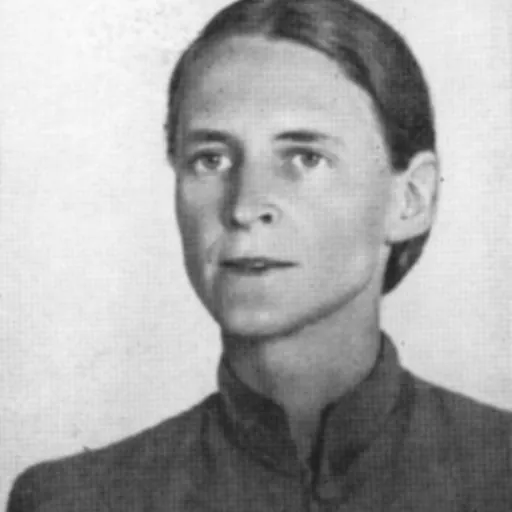
Mildred Harnack
American-German literary historian, professor, translator; Resistance fighter and anti-Nazi activist, who was executed during WWII in Germany
About Mildred Harnack
Lived 1902 – 1943 (aged 40). Mildred Harnack was an American writer, translator, literary critic, literary historian, resistance fighter and lector, known for Red Orchestra (espionage).
Mildred Elizabeth Harnack (; September 16, 1902 – February 16, 1943) was an American literary historian, translator, and member of the German resistance against the Nazi regime. After marrying Arvid Harnack, she moved to Germany in 1929, where she began her career as an academic. Mildred Harnack spent a year at the University of Jena and the University of Giessen working on her doctoral thesis. At Giessen, she witnessed the beginnings of Nazism. Mildred Harnack became an assistant lecturer in English and American literature at the University of Berlin in 1931.
In 1932, Harnack and her husband Arvid began to resist Nazism. Harnack nicknamed the underground resistance group they established "the Circle." Mildred and Arvid became friends with Louise and Donald Heath, who was First Secretary at the U.S. Embassy in Berlin, and to whom Mildred and Arvid passed intelligence from Arvid's position at the Reich Economics Ministry. Between 1935 and 1940, the couple's group intersected with three other anti-fascist resistance groups. The most important of these was run by Luftwaffe lieutenant Harro Schulze-Boysen. Like numerous groups in other parts of the world, the undercover political factions led by Harnack and Schulze-Boysen later developed into an espionage network that collaborated with Soviet intelligence to defeat Hitler. This Berlin anti-fascist espionage group "the Circle" was later named the Red Orchestra (Rote Kapelle) by the Abwehr. The couple were arrested in September 1942 and executed shortly after.
Life Mildred Elizabeth Fish was born and raised on the west side of Milwaukee, Wisconsin. Her parents were William Cook Fish, who was frequently unemployed between work as an insurance salesman, butcher, and horse trader, and Georgina Fish ( Hesketh), a self-taught stenographer and typist. Mildred had three siblings, Harriette (the eldest), and twins Marbeau (aka "Bob") and Marion. She attended West Division High School (now Milwaukee High School of the Arts). After the death of her father, Harnack and her mother moved to Chevy Chase, Maryland where Harnack's eldest sister lived. There she attended Western High School her senior year. She played on the basketball and baseball teams, served as editor for The Trailblazer, and played the role of Princess Angelica in William Makepeace Thackeray's The Rose and the Ring, the senior class play. She finished her last year at Western High School. In 1919, she began studying at George Washington University, then enrolled in 1921 at the University of Wisconsin. During her first year, she worked for the Wisconsin State Journal as a film and drama critic to support herself. She stayed at a rooming house popular with journalists and writers, but left after facing some mild prejudice, which caused her to change her major from journalism to humanities, then later to English literature. In 1922, she became a staff writer for the Wisconsin Literary Magazine.
On June 22, 1925, she was awarded a Bachelor of Arts in Humanities. Her senior thesis was "A Comparison of Chapman's and Pope's Translations of the Iliad with the Original". She stayed for further study and was awarded a Master of Arts degree in English on August 6, 1925.
While Mildred was a graduate student at the University of Wisconsin, she met Arvid Harnack, a graduate student from Germany who was studying under a Rockefeller Fellowship. After a brief love affair, they were engaged on June 6, 1926, and wed on August 7, 1926 in a ceremony at her brother's farm near the village of Brooklyn, Wisconsin. On September 28, 1928, Arvid Harnack returned to Germany. Between 1928 and 1929, Mildred Fish-Harnack taught English and American literature at Goucher College in Baltimore, Maryland.
A fellow student of Harnack's at the University of Wisconsin was Clara Leiser. A professor who exerted an influence over her was William Ellery Leonard, who advised her when she was writing her senior thesis. Leonard was a non-conformist who believed in the Emersonian principle that "nothing at last is sacred but the integrity of [one's] own mind". He subjected Fish-Harnack to a grueling scrutiny that shaped her intellectual outlook. For Fish-Harnack, Ralph Waldo Emerson and Walt Whitman were the two greatest advocates of American literature. While at Madison, the couple met Margaretha "Greta" Lorke, a German student of sociology who had been invited to study in the U.S. A lifelong friendship developed between Mildred and Greta. Lorke later married Adam Kuckhoff. Leiser found Fish-Harnack changed, from the open and trusting person she had known into someone who seemed distant and superior, a side-effect of the deceit necessary to hide her true feelings in Germany. Fish-Harnack's high school friend Mady Emmerling found Fish-Harnack to be overly cautious, frightened, and reserved, all indicative of having lived in the Nazi state for four years. Fish-Harnack had become used to assuming a persona, or passing, to fool the Nazi state. Many of her friends assumed from her bearing that she had become a Nazi. Immediately after staying with Leiser, Fish-Harnack went on a campus lecture tour that included Haverford College, New York University, University of Chicago, and University of Wisconsin, whose theme was "The German Relation to Current American Literature". Leonard attended the lecture at Madison and was unwilling to endorse Fish-Harnack's lecture when she asked for a written recommendation. However, at Haverford, Douglas V. Steere, who did not know her, found her presentation to be "vivid and full of charm". She visited her relatives during the tour and left in the spring to return to Berlin.
Later in 1938, Fish-Harnack worked on her doctoral dissertation, entitled "Die Entwicklung der amerikanischen Literatur der Gegenwart in einigen Hauptvertretern des Romans und der Kurzgeschicht" , and was awarded her doctorate at the University of Giessen on November 20, 1941. In 1938 she received a job offer from the Rütten & Loening publishing house in Berlin as a consultant for American novels. The same year, Fish-Harnack joined the Daughters of the American Revolution and became a local representative in Berlin. In October 1939, she applied for the Guggenheim and Rockefeller fellowships but was refused. In 1941 she was hired as an English-language professor at the Foreign Studies Department of the Friedrich Wilhelm University, which was run by SS Major Franz Six.
Resistance
Leading up to and during the war, Red Orchestra tried to recruit new members, which was difficult due to the ratio of informers to proper recruits in the general populace. The group devised a method to vet potential recruits that would start with inviting them to a meeting, with the approach of making the potential recruit believe the group were Nazis, and lead the person to reveal their political attitude to Nazism through conversation. Harnack lent books to the potential recruit as a test of their intellect, as there was little chance of winning such people over if they did not understand politics. At one meeting, Fish-Harnack held a lecture on Kim by Rudyard Kipling to help the recruits understand colonialism.
On March 3, 1938, William Dodd was replaced by Hugh Wilson. Joining him as First Secretary and monetary attaché at the U.S. Embassy was Donald Heath. In 1937, Fish-Harnack met Louise Heath, Donald Heath's wife, at the American Women's Club in Bellevuestraße. The Harnacks became friends with the Heaths. When the war started the Heaths fled to Norway, but when they returned, Louise requested that Fish-Harnack tutor her son, Donald Heath, Jr., in American literature. The two couples spent weekends and occasional holidays together. At times Harnack and Donald would meet in the countryside to exchange intelligence, but it became increasingly dangerous. Between December 1939 and March 1941, Donald Jr., couriered between Fish-Harnack and the U.S. Embassy in Berlin.
During the 1930s, the Harnacks came into contact with other resistance groups and began to cooperate with them. The most important of these was a group run by Harro Schulze-Boysen, a Luftwaffe lieutenant and descendant of an old German military family who had known Harnack since 1935, but was reintroduced to him sometime in late 1939 or early 1940 through Greta Kuckhoff; the Kuckhoffs had known the Schulz-Boysens since 1938 and started to engage them socially in late 1939 or early 1940 by bringing Fish-Harnack and Libertas Schulze-Boysen together while on holiday in Saxony. Of the meeting Greta Kuckhoff wrote,I saw it clearly before my eyes. From then on our work not only implies the risk of losing our freedom, from now on death was a possibility.Harro and Libertas were part of a bohemian group of friends that met twice a month in fun meetings in contrast to the Harnacks' austere study meetings. The initial meeting of the women gave rise to a licentious image of the group that persisted for decades after the war, based primarily on Gestapo and Abwehr reports. In his 1967 book, L'orchestre rouge, Gilles Perrault states that Fish-Harnack and Libertas were lesbians. However, industrialist Hugo Buschmann, who was an informant and Harro's close friend, stated that the group lived dangerously, but there was no evidence for Perrault's conclusion.
On September 17, 1940, the Harnacks met the third secretary member of the Soviet embassy, Alexander Korotkov, and Arvid Harnack decided to resume passing classified information about Hitler's regime to the Soviet Union in order to undermine it. According to lawyer Wolfgang Havemann, from that point forward Fish-Harnack endured a persistent fear of being discovered.
Discovery The discovery of illegal radio transmissions by the German radio counterintelligence organization Funkabwehr in 1942 eventually revealed the members of the group and led to the Harnacks' arrest. The exposure of the radio codes enabled Referat 12, the cipher bureau of the Funkabwehr that had been tracking Red Orchestra radio transmissions since June 1941, to decipher Red Orchestra message traffic. Wenzel's apartment in Brussels was found to contain a large number of coded messages. When Wilhelm Vauck, principal cryptographer of the Funkabwehr, received the ciphers from Wenzel, he was able to decipher some of the older messages. On 15 July 1942, Vauck decrypted a message dated 10 October 1941 that gave the locations of the Kuckhoffs' and Schulze-Boysens' apartments.
Arrest and death On September 7, 1942, the Harnacks were arrested by the Gestapo in Nazi-occupied Lithuania at the seaside village of Preila on the Curonian Spit.
On December 19, after a four-day trial before the Reichskriegsgericht ("Reich Military Tribunal"), Mildred Harnack was initially sentenced to six years in prison, but Adolf Hitler refused to endorse the sentence and ordered a new trial, which resulted in a death sentence on January 16, 1943. She was beheaded by guillotine on February 16, 1943. While she was imprisoned, Fish-Harnack translated the poem Vermächtnis by Johann Wolfgang von Goethe. Her last words were purported to have been "Und ich habe Deutschland auch so geliebt" ("And I, too, so loved Germany"). She was the only American executed on the direct orders of Adolf Hitler.
After her execution, her body was released to the Charité Anatomical Institute and Humboldt University anatomy professor Hermann Stieve to be dissected for his research into the effects of stress, caused by awaiting execution, on the menstrual cycle. After he was finished, he gave what was left to a friend of hers, who had the remains buried in Berlin's Zehlendorf Cemetery. She is the only member of the Berlin-based anti-Nazis whose burial site is known.
When she learned of the execution, Clara Leiser wrote the unfinished poem "To and from the guillotine" in remembrance of her friend.
Arvid's brother Falk Harnack, also a resistance fighter, was able to escape and survived the Second World War as an ELAS partisan in Greece.
In 2021, Canadian-born writer Rebecca Donner published in 2021 a book "All the Frequent Troubles of Our Days: The True Story of the American Woman at the Heart of the German Resistance to Hitler" on Harnack’s life. Donner who is the great-niece of Mildred Harnack wrote the book largely on information taken from the letters that her grandmother had given her when she was sixteen, with the aim of making a book out of them.
U.S. government response While newspapers learned about the execution shortly after the war, the U.S. government concealed additional information about Harnack's story. The Counterintelligence Corps (CIC) of the U.S. Army began to investigate her execution as a possible war crime. They acknowledged her work leading a large group secretly fighting the Nazi regime and described her actions as "laudable". However, investigators concluded that since Harnack was actually guilty of espionage and had received a trial, her execution did not constitute a violation of international law. The case was closed.
Gallery
Memorials A cenotaph for the Harnacks stands in the Zehlendorf cemetery in Berlin, Germany. Mildred Fish Harnack Day is observed by schools in the U.S. state of Wisconsin. In 2006, a street in Berlin's Friedrichshain neighborhood was renamed Mildred Harnack Street (Mildred-Harnack-Straße) A school named in honor of Harnack in Berlin is located on Schulze-Boysen-Straße, a street named for fellow members of the Red Orchestra, Libertas and Harro Schulze-Boysen. A public school complex in her hometown of Milwaukee was named in honor of Mildred Fish-Harnack in 2013. Mildred's alma mater, the University of Wisconsin-Madison, hosts the annual Mildred Fish-Harnack Human Rights and Democracy Lecture in her memory, which was established in 1994. In 2019, the city of Madison, Wisconsin, dedicated a sculpture to Harnack in Madison's Marshall Park. In 2013, Stolpersteins for the Harnacks were laid in front of 14 Genthiner Straße in the Tiergarten, Berlin, on September 20.
Works
Translations . .
Don’t just read it —
keep it.
Full-length biographies made to live with: read them, listen on the way to work, watch them tonight.
- E-book
- Audio
- Video
Instant download · yours to keep · every purchase keeps this site free
Important facts
more
Mildred Elizabeth Fish-HarnackPeople in Mildred Harnack's life
Named in this biography and alive at the same time




Related people
Same field, nearest in time




Contemporaries
People whose lives overlapped Mildred Harnack's




Frequently asked questions
Who was Mildred Harnack?
American-German literary historian, professor, translator; Resistance fighter and anti-Nazi activist, who was executed during WWII in Germany
When was Mildred Harnack born?
Mildred Harnack was born on 16 September 1902 in Milwaukee.
When did Mildred Harnack die?
Mildred Harnack died on 16 February 1943 in Plötzensee Prison.
What was Mildred Harnack's occupation?
Mildred Harnack was a writer, translator, literary critic, literary historian, resistance fighter and lector.
What was Mildred Harnack known for?
Mildred Harnack was known for Red Orchestra (espionage).
What nationality was Mildred Harnack?
Mildred Harnack was American.
Sources & further reading
Cite this page
APA: Biography.guide. (2026). Mildred Harnack. https://biography.guide/mildred-harnack/
MLA: "Mildred Harnack." Biography.guide, https://biography.guide/mildred-harnack/.
Chicago: "Mildred Harnack." Biography.guide. https://biography.guide/mildred-harnack/.
Data last updated: 2026-09-23 · Spot an error? Report a correction.
Portrait: Wikimedia Commons · author & licence
Page generated 2026-09-27 05:05 UTC