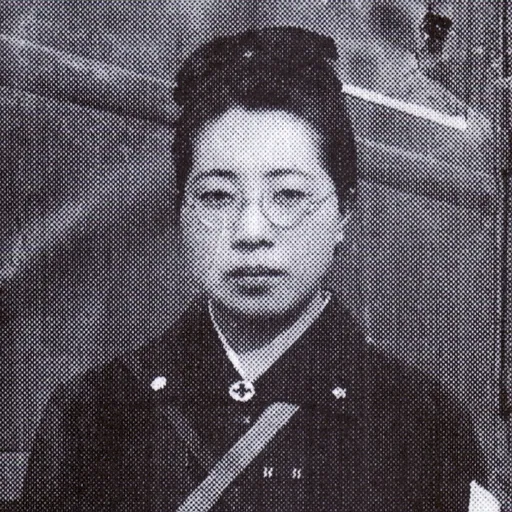
About Miki Hanada
Lived 1914 – 2006 (aged 91). Miki Hanada was a Japanese nurse and teacher.
was a Japanese researcher of health nursing and health advisor.
She devoted herself to saving lives and health of people in Aomori Prefecture after the World War II, making efforts in building the educational institute for nurses, resolving towns and villages without health nurses from the standpoint of health administration, and establishing the system of rescue and nursing in remote areas. Her attitude has been handed down to a number of people who engage in nursing in Aomori even in Heisei period. Having worked as a military nurse during the war, she is known as a person who kept on telling her experiences during the war through self-published books because of an unwavering belief that "everything that stands against life is evil". After gaining her career in Japanese Red Cross Society (JRCS) and Morioka Nursing School, she started to work for Aomori Branch of JRCS in 1934. She was called up as a military nurse after the Second Sino-Japanese War broke out in 1937, thus she spent almost all her youth in the battlefields.
In 1942, she suffered from tuberculosis and typhoid fever on the hospital ships then went into the Hiroshima Military Hospital (later Hiroshima Red Cross Hospital & Atomic-bomb Survivors Hospital). Although she had not chosen to be a nurse due to humanitarianism, she was impressed with devoted nursing by a nurse while hospitalized there, which greatly changed her thought of health nursing.
She returned to the military after recovering from the typhoid fever. Gradually she agonized herself with the death of many soldiers and the reality that soldiers who recovered from wounds in the hospital go to their death again, she harbored her resentment against war itself finally concluding that "everything that stands against life is evil". At least by way of resisting the war, she continued to send the wills of soldiers dying in bed to their families without being noticed by the inspectors.
The following year, 1943, she returned home because her tuberculosis was not cured. After studying hard, she got the certifications of a teacher of nursing and of a health nurse. ), who was in Japan as a head nurse of the department of public health in GHQ, gave her a tremendous boost in it. Within the year, their hard work reached fruition and The Association of Japanese Midwives, Nurses, and Health Nurses in Aomori (later Aomori Prefectural Association of Nursing. ) was established The following words from Alt to Hanada greatly encouraged her while struggling with the hardship because of postwar shortage in hospitals and in the education of nurses. In 1949, the outbreak of polio occurred in Hachinohe. The vaccine had not been developed in those days, and newspapers reported that phenomenon was a rare case in the world. Hanada, receiving the request from the doctor who was in charge of it, went to Tokyo for studying the treatment. She got the information materials of Kenny Method which was effective in Australia from GHQ with the help for JRCS. Curing people in Hachinohe Red Cross Hospital every day, she introduced the method to the public through newspaper articles.
In the reform of nursing at the postwar time, Hanada continued to studying American style nursing to find that education of nurses in Japan is far behind America. In order to have the society recognize nurses as a profession, she tried to establish an educational institute of nursing, following the Florence Nightingale Faculty of Nursing and Midwifery in London. Her desire was achieved by opening the Aomori-ken Koto Kango Gakuin (later Aomori University of Health and Welfare). However, there was only one applicant at first, which proved that Hanada's thought had hardly been accepted to the public yet. A newspaper article titled "Hated Prefectural College of Nursing" denounced her building an unnecessary, nonurgent school. She visited high schools around Aomori in order to attract students by introducing Florence Nightingale with her handmade picture-story shows and to explain the importance of nursing education.
Actions in the Prefectural Government Accompanying the establishment of this prefectural institute, the Nursing Unite of Medical Department was founded in Aomori Prefectural Government. Hanada was asked to be the unit chief because she was the very person who proposed to establish the educational institute. In 1950, a year before the College of Nursing opened, she quit the Hachinohe Red Cross Hospital and started to work in the Government. This post was the top hierarchy in the educational system of nursing in Aomori. The fact that a woman from outside of the Prefectural Government got the position of a unit chief for the first time attracted tremendous interest amongst mass media at that time, not only because women in those days rarely had a position title but also because even male officers with more than 10 years' experiences had difficulty in getting the position like hers.
In 1955, Hanada visited Iwate Prefecture to study the health action by Iwate National Health Insurance Organization regarding Society-Managed Health Insurance had been active for a long time outstandingly in Tohoku Area. After returning, she cooperated with the same organization in Aomori to contribute to spreading their actions. While working on it, she discussed the health problems with the residents to realize the need to send health nurses around Aomori, following the examples like Kochi where the problems had successfully been resolved.
In 1964, in order to resolve the infant mortality rate of Aomori that was the highest in Japan those days, Hanada started a campaign called "Mottara Korosuna Undo (the Never Kill If You Get Pregnant Campaign)" together with health nurses and midwives. She gave mothers bleached cotton to support their wombs if they notify their pregnancy to the Prefectural Government early for the purpose of raising awareness of not having fetuses die. This community-based campaign enabled health nurses to build relationships while visiting households steadily and honestly. This system allowed graduates from Prefectural College of Nursing to be employed as officials of Aomori Prefecture and sent to each town or village with traveling expenses paid by the government. This system increased the number of health nurses who accepted to work for remote areas as their period of toleration for some years before going back to cities. Moreover, some of them married and settled in their places of appointment to keep working there. It is said that the maintenance of this system of health nursing was impossible without the leadership of both Hanada and Takeuchi Shunkichi, who was the local governor in those days and had similar experiences to Hanada as a war correspondent.
Actions as a Health Nursing Researcher After retiring the local government, Hanada worked as a freelance researcher of health nursing. In 1950, she got the position of the head of Aogiri-kai in Japan Red Cross in Aomori (hereafter Aogiri-kai),
In order to counter the threat from aging society, Hanada started Kango Ginko (Nursing Bank) organized by Aogiri-kai in 1980. The system was to have elderly people help work each other through the special tickets instead of money, where Hanada announced herself as the president. Although it was a pioneering system, it did not take its root in the society. In the following year, Aogiri-kai, the Association of Social Workers in Health Services of Aomori, and the Federation of Regional Women's Organization in Aomori cooperated starting telephone counseling services for senior citizens called "Koreisha 110 ban (number 110 for senior citizens)". This system developed later, resulting in organizing "Volunteer Ajisai", where the three organizations and the branch office of Japanese Nursing Association collaborate with each other. Hanada also worked as its caretaker.
In 1994, Hanada was nominated for Florence Nightingale Medal. Even though this is the most prestigious award in the world as a nurse, she rejected to receive it. She told the reason in the bulletin of Aogiri-kai titled Aogiri-kai Dayori as a previous military nurse and a person who experienced the WWII as below;
In 2006, Hanada died for the liver cancer at the age of 91. She was unmarried throughout her life because she lost the chance because of the war. Based on her will, her body was given to the Faculty of Medicine in Hirosaki University and the funeral was not held. Her last words as a pacifist, which was sent to her younger brother, was published in her obituary in To-o Daily Press and impressed the readers.
Evaluation Hanada and Satoe Kamimura, who led health nursing in Kochi Prefecture in Showa era, were called "Miki Hanada in Aomori for the East, Satoe Kamimura in Kochi for the West".
On the other hand, since she regarded the residents and labors seriously, she often clashed not only with the administration when working for the hospital but also with the top management and the government when working for Aomori Prefectural Government. When she tried to improve the working condition of nurses in the hospital, the doctors taunted her to be so Americanized. When the innovative councilors criticized the way of governing health nursing in Aomori prefectural assembly, the false rumor that Hanada stirred them to do it flew. She also clashed with her boss when tackling on the health nursing in remote areas, which made her write resignation letters several times. However, there were contrary opinions that the word "Korosuna (Never kill)" was too direct and shocking for a slogan. Additionally, some criticized distributing bleached cotton as bribing women with stuff they want, others insisted that Aomori Prefecture was regarded as the representative of backward prefecture because the bleached cotton was thought to be out of date. ", whose predecessor is "Koreisha 110 ban" run by Hanada.
Don’t just read it —
keep it.
Full-length biographies made to live with: read them, listen on the way to work, watch them tonight.
- E-book
- Audio
- Video
Instant download · yours to keep · every purchase keeps this site free
Important facts
Related people
Same field, nearest in time


Contemporaries
People whose lives overlapped Miki Hanada's



Frequently asked questions
Who was Miki Hanada?
Japanese researcher and health reformist (1914-2006)
When was Miki Hanada born?
Miki Hanada was born on 9 September 1914 in Shimizu.
When did Miki Hanada die?
Miki Hanada died on 1 August 2006.
What was Miki Hanada's occupation?
Miki Hanada was a nurse and teacher.
What nationality was Miki Hanada?
Miki Hanada was Japanese.
Sources & further reading
Cite this page
APA: Biography.guide. (2026). Miki Hanada. https://biography.guide/miki-hanada/
MLA: "Miki Hanada." Biography.guide, https://biography.guide/miki-hanada/.
Chicago: "Miki Hanada." Biography.guide. https://biography.guide/miki-hanada/.
Data last updated: 2026-09-22 · Spot an error? Report a correction.
Portrait: Wikimedia Commons · author & licence
Page generated 2026-09-27 05:03 UTC