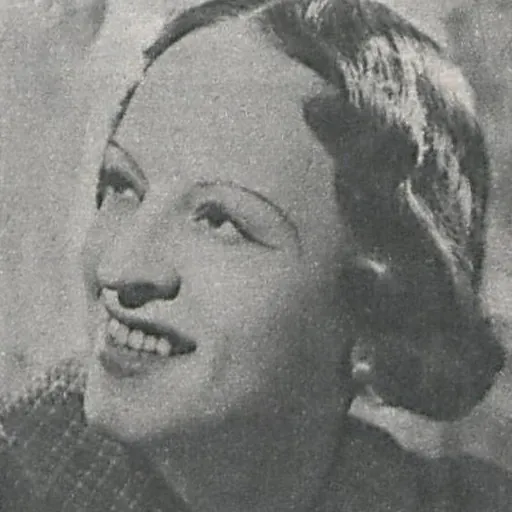
About Michel-Marie Poulain
Lived 1906 – 1991 (aged 84). Michel-Marie Poulain was a French painter, dancer and model.
Michel-Marie Poulain (born 5 December 1906, Nogent-sur-Marne, ) was a French transgender performer and self-taught painter whose work was influenced by Matisse and by Raoul and Jean Dufy,
Education and first military service Assigned male at birth, as a child Michel-Marie wore dresses at home and was sent to a girls' school before attending a boys' school (still with long hair), "a daily torment" where "schoolmates mocked and bullied 'the beautiful blonde' whom they call 'mademoiselle.' Michel-Marie, tall and strong for her age...threw a punch that sent a laughing bully tumbling to the ground...To console herself, and with the agreement of the family, she dressed as a girl every Sunday...At the age of fifteen, 'demoiselle Poulain' was taken to a jeweler who pierced her ears, and went to her first ball, not in a first tuxedo, but in a maidenly dress."
In 1926, "at the age of twenty, Michel-Marie cut her long curls for the first time," and then, to earn a living, worked in female guise as a saleswoman, a dress designer, and model, whose seamstress and dresser "never suspected my true state (mon véritable état civil)." As a model, Poulain paraded couture before the equestrian set at racetracks. As an acrobat, she debuted at the Cirque d'hiver and performed with the Texas-born female impersonator, trapeze artist, and tightrope walker Barbette, until a fall from a trapeze prompted Poulain to pursue a more down-to-earth career as an acrobatic dancer, finding success as a travesti cabaret performer under the name of Micky.
When Solange, a young woman and fellow dancer, needed a place to stay, Poulain offered to share the "bachelor pad" (garçonnière). One night, Michel-Marie "behaved like a boy" with Solange, who gave birth to their daughter, Michèle. Poulain and Solange married. Solange affectionately called Poulain "Mima". Michèle called Poulain "Papa".
Poulain also found success as a self-taught painter, at 8, rue des Colonels Renard, a short walk from the Arc de Triomphe. A reviewer described his visit: "While tasting fruit juice and listening to poets or singers, the eye falls on the paintings of the master or mistress of the house...Renée Dennsy sings Marseille songs, Wanda Basler recites avant-garde poems, Lilet London coos in several languages, and Liane Mérève recounts dreams. However, it is Poulain, or Micky, who arouses the most curiosity. Man or woman? Host or hostess?"
Meetings with Magnus Hirschfeld In the early 1930s, Poulain met with the sexologist Magnus Hirschfeld in Berlin, where Poulain was performing. According to Poulain, writing for the magazine in 1937, the meeting was at Hirschfeld's request. "He wanted to see me. No doubt he thought, at first, that I was a suitable case for treatment. He soon realized that, from travesti [in the theatrical sense] to transvestism [in the sense that Hirschfeld coined the word in the early 1900s], there was more than one step, that I was neither a repressed nor an obsessive. I explained that my way of life is only about the pursuit of pleasure, and how much I valued my male state...Having realized his mistake, Hirschfeld allowed me to witness operations. In themselves, these interventions, when justified by certain physiological conditions, are not really dangerous. We cut, we size, we sew: for ignorant me, all operations look the same.
In 1933, the Nazis destroyed Hirschfeld's Institut für Sexualwissenschaft in Berlin, and the doctor fled to France. "One day, at two o'clock in the afternoon, breakfast time for night owls, Michel-Marie was struck by a headline: 'Professor Magnus Hirschfeld, founder of the Institute of Sexual Sciences in Berlin, is in Paris.'" Poulain, who had previously declined the doctor's help, had in the meantime realized "an insurmountable need to be a woman."
After an examination, Hirschfeld told Poulain:Nature is infinitely less disciplined than men would wish; she makes a mockery of principles and traditions. Originally, the human being was, without a doubt, androgynous; the udders that adorn our breasts, the males, are proof of this. Certainly, there came a time in the depths of prehistory when the duality of the sexes intervened, but man is separated from woman only by a tiny gulf. Some humans carry within them the genesis of two sexes with a more or less precise development in one direction or another. As far as you are concerned, I think that there is more or less equality, but there is a fairly clear tendency in favor of femininity...If you wish, by a series of operations, I can make you a normal woman."
Poulain seriously considered the doctor's offer, but was daunted by the tragic fate of another painter, Lili Elbe (born Einar Wegener), a Dane who whose memoirs had been published in a weekly newspaper under the suggestive title of "Vice Versa." Elbe had also consulted Hirschfeld, and had undergone three operations to change sex from male to female. But complications resulting from a fourth operation led to Elbe's death in 1931. Poulain declined Hirschfeld's offer to operate.
World War II
The party at Le Vol de Nuit was short-lived. By the end of 1939, the war had begun and Poulain had enlisted as a non-commissioned officer of dragoons. Jean Anouilh recalled seeing him ride horses in the woods near Le Touquet. Poulain "led his men into the fire while maintaining a feminine attitude: holding the carabiner in his right hand, he could not help but push back, at times, with a graceful gesture, under his helmet, a lock of bleached hair that in spite of regulations he had allowed to grow back." While in captivity, Poulain put on shows for fellow POWs. Her feminine performances earned her the gratitude of other soldiers in need of escapism. Poulain kept as a treasured memento a "theater program" signed by comrades: "To you, for the feminine charm that you have allowed us to rediscover"; "To you, old comrade, for your kindness"; "To you, who knew how to create the illusion."
Back in German-occupied Paris, Poulain "abandoned the music hall to devote himself to painting." and in December 1943, she was on hand to discuss her art on display in the bar of the Cirque d'hiver. Poulain's persona and painting were equal parts of the presentation; a review of her post-war show at Galerie Paul Blauser in March 1945 was headlined "This Woman is a Man, This Man is a Painter!", and reported, "After the war and the stalag, the civilian costume he wears is that of the most formidable vamps in Paris."
After the transition, Poulain's daughter Michèle continued to address her as "Papa," even in public. It is unclear whether Poulain and Solange continued to live as a married couple.
Jean Anouilh, who had known Poulain as a male cavalry officer, and who found himself living next-door to Poulain after the war, was "only half-surprised...The war, the occupation, the liberation, have accustomed us to such volte-faces." Poulain in interviews tacitly accepted or even encouraged this gender portrayal.
Height of career Jean Cocteau and Poulain at a theater in Paris, c. 1951 (source: gallica.bnf.fr/BnF). At the peak of her success as a painter in the late 1940s and 1950s, Poulain exhibited as far afield as Stockholm, Madrid, New York and Rio de Janeiro,
She also practiced the art of stained glass and mural frescoes for churches in the Alpes-Maritimes department of France, producing stained glass windows for the abbey La Colle-sur-Loup; creating stained glass and eleven commissioned paintings for the Chapelle Sainte-Croix, des Pénitents Blancs in Èze, c. 1953; and decorating the chapel of Saint Sebastian in Sainte-Agnès, Alpes-Maritimes.
1954 saw the publication, in paperback, of J'ai choisi mon sexe: Confidences du peintre Michel-Marie Poulain, essentially an autobiography by Poulain as told to the author, , in which she shared details of her childhood, discussed her meetings with Hirschfeld, and revealed details of her operations.
Death
Poulain was buried in Èze, sharing a gravestone with Alice Colette Richter (1892-1961) and Jeanne Floch (1916-).
Themes and reception Renate Treydel in the Allgemeines Künstlerlexikon gives an overview of Poulain's oeuvre as a painter:The long-term process of finding her gender identity is reflected in her art and leads to a particularly subtle figurative painting style characterized by opposites. Powerful, sketchy, fleeting lines are paired with a gentle, soft brushwork, and a certain severity is mitigated by figures radiating feminine grace. Poulain paints very lively, strongly moving depictions in mostly bold colours (Au Théâtre, c. 1950), sometimes in bright colors based on Fauvist models (Marseille, le pont transbordeur, 1944). Black contoured pictorial elements and roughly hatched backgrounds lead to comparison with paintings by Bernard Buffet (Rue Norvins, Place du Tertre, Montmartre, Paris, 1967). Subjects mostly touch on her own sensitivities and living conditions; many motifs show two women (La loge, 1949) or mother and child (Mère et enfant, watercolor), as well as flashes from the theatre, variety shows and cabaret milieu (Les danseuses de cancan). In addition to other figure paintings depicting scenes of everyday life (Partie d'échec), she also created portraits (Portrait de femme au bouquet, 1959), urban views from Paris and the South of France (Saint Paul de Vence, 1951), harbor motifs (Le port de Concarneau) and still lifes, especially lavish floral arrangements (Bouquet de fleurs, 1943).
Jean Anouilh wrote that Poulain's art transcended prurient interest, as the artist transcended gender:"Scandal, which always surrounds freedom, must not reflect on his work. Poulain is not an amusing figure of the Parisian fauna who also paints canvases, he is above all an artist, or better, a robust worker conscientious before the laws of his art...Michel-Marie Poulain, dressed as a young girl in his studio in Montmartre...it was he who did the work of creator, that is to say, of man in the best sense of the word."
Exhibitions Poulain in her atelier, c. 1951 (source: gallica.bnf.fr/BnF). Individual
Collective Salon d'Hiver, Salon d'Automne, Salon des Indépendants and Salon des Tuileries, Paris, from 1931. Philippe Marie Picard/Michel-Marie Poulain/Gerard Sekoto, Galerie Heyrène, Paris, 1952.
Collections Private The Luxembourg architect , a patron of Michel-Marie Poulain, owned many paintings which, after the collector's death in 1980, were sold at auction. Most, like those depicting Bettembourg and the dancing procession of Echternach, have remained in Luxembourger hands. Charles Trenet, who said he found in Poulain's work "a reflection of his own poetic zaniness" ("un reflet de sa propre loufoquerie poétique"). Femme au châle (1953), oil on panel. Toulon, oil painting. ), oil on canvas.
Don’t just read it —
keep it.
Full-length biographies made to live with: read them, listen on the way to work, watch them tonight.
- E-book
- Audio
- Video
Instant download · yours to keep · every purchase keeps this site free
Important facts
People in Michel-Marie Poulain's life
Named in this biography and alive at the same time



Related people
Same field, nearest in time


Contemporaries
People whose lives overlapped Michel-Marie Poulain's


Frequently asked questions
Who was Michel-Marie Poulain?
French painter (1906-1991)
When was Michel-Marie Poulain born?
Michel-Marie Poulain was born on 5 December 1906 in Nogent-sur-Marne.
When did Michel-Marie Poulain die?
Michel-Marie Poulain died on 9 February 1991 in Mandelieu-la-Napoule.
What was Michel-Marie Poulain's occupation?
Michel-Marie Poulain was a painter, dancer and model.
What nationality was Michel-Marie Poulain?
Michel-Marie Poulain was French.
Sources & further reading
· Wikipedia: Michel-Marie Poulain
· DBpedia: Michel-Marie Poulain
Cite this page
APA: Biography.guide. (2026). Michel-Marie Poulain. https://biography.guide/michel-marie-poulain/
MLA: "Michel-Marie Poulain." Biography.guide, https://biography.guide/michel-marie-poulain/.
Chicago: "Michel-Marie Poulain." Biography.guide. https://biography.guide/michel-marie-poulain/.
Data last updated: 2026-09-21 · Spot an error? Report a correction.
Portrait: Wikimedia Commons · author & licence
Page generated 2026-09-27 04:59 UTC