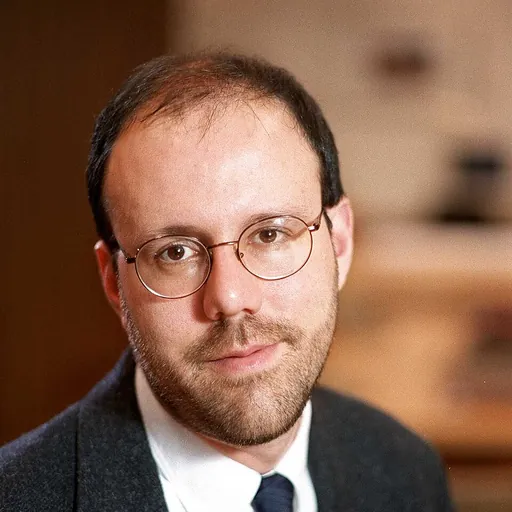
About Michael Kremer
Born 1964. Michael Kremer is an American economist and university teacher.
Michael Robert Kremer (born November 12, 1964) is an American development economist currently serving as university professor in economics at the University of Chicago and director of the Development Innovation Lab at the Becker Friedman Institute for Research in Economics. Kremer formerly served as the Gates Professor of Developing Societies at Harvard University, a role he held from 2003 to 2020. "for their experimental approach to alleviating global poverty."
In addition to his academic appointments, Kremer is the co-founder of the Bureau for Research and Economic Analysis of Development (BREAD), In 2008, he was elected a Fellow of the Econometric Society.
Early life and education Michael Robert Kremer was born on November 12, 1964 Both his mother and father were the children of Jewish immigrants, from Poland and Austria-Poland, respectively. His father taught architecture at Kansas State University, and his mother was a professor of English at the same institution, where she specialized in American Jewish and Holocaust literature. Beginning in fifth grade, he took classes at Kansas State University, taking enough credits to achieve sophomore standing by his junior year of high school.
He left high school a year early to attend Harvard University, Kremer wrote his senior thesis comparing an employment guarantee program in India with a food subsidy scheme in Sri Lanka.
After graduating from Harvard, Kremer worked for a year as a teacher and administrator at Eshisiru Secondary School in Kakamega District of Kenya. Inspired by the experience, he co-founded WorldTeach, where he currently serves as President of the Board. His PhD research was supported by a fellowship from the National Science Foundation, and won the David A. Wells Prize, awarded annually to the best dissertation in the Harvard Department of Economics.
Career Kremer began his academic career at the Massachusetts Institute of Technology (MIT), where he served as a postdoctoral fellow from 1992 to 1993. He has focused his research on economic growth and poverty alleviation, particularly as it relates to education and health. Alongside Abhijit Banerjee and Esther Duflo, Kremer has helped establish the effectiveness of randomized controlled trials to test proposed antipoverty measures. Describing Kremer's early use of pioneering experimental methods, Duflo said that Kremer "was there from the very beginning, and took enormous risks. [...] He is a visionary."
Inspired by a randomized evaluation co-authored with Edward Miguel showing substantial effects of school-based deworming programs on educational attainment and health, Kremer co-founded the Deworm the World Initiative, which has since 2014 delivered 1.8 billion treatments to children around the world. The scheme, run by non-profit Evidence Action, was ranked a GiveWell top charity from 2013 to 2022, considered among the best in the world for social impact per marginal dollar spent. Since 2009, Kremer has been a member of Giving What We Can, an effective altruism organization whose members pledge to give 10% or more of their lifetime income to effective charities.
In 2010, Kremer co-founded Development Innovation Ventures, an evidence based innovation fund administered by USAID aimed at testing and scaling new approaches to poverty alleviation. The program promotes a venture capital approach to development finance, prioritizing rapid distribution of grants and scale-up of policies successful in pilot stages. generating an estimated $17 in social benefit for each dollar invested in the program. The program increased yields by 8%, In 2020, PxD's programs had 5.7 million users, at an average cost per user of $1.61.
Kremer has also pursued research on vaccine development and financing. He developed an interest in the subject after contracting malaria while traveling in Kenya. In a 2004 book with his wife, Rachel Glennerster, Kremer advocates for the creation of advance market commitments, in which governments enter into legally binding agreements with pharmaceutical or biotechnology companies, promising to purchase given quantities of vaccines or medications provided they meet certain benchmarks for safety and efficacy. In response to Kremer's research, a consortium of donors including the Bill & Melinda Gates Foundation and national governments such as Canada, Italy, and Norway pledged $1.5 billion as an advance market commitment for pneumococcal vaccines.
Kremer's research was also widely cited during the COVID-19 pandemic as a model for how to quickly develop vaccines through public-private partnership. In response to requests for consultation by several governments, Kremer founded the Accelerating Health Technologies Group, The group advised the US government on Operation Warp Speed, Kremer's insight was that complex products (like the space shuttle) often require completing many steps correctly for the final product to have any value. Kremer suggested this would make high-skilled workers complements to each other, meaning wages for high-skilled workers will be higher in an economic environment where other workers are also highly skilled. The O-ring theory has been recognized as a leading explanation for human capital flight and cross-country wage inequality. Kremer empirically tests the hypotheses of macroeconomic models predicting a positive relationship between population levels and technological innovation because of the non-rivalry of ideas. He shows that among societies with no technological contact and similar levels of productivity, those with higher populations saw faster improvements in technology.
Species endangerment In other theoretical work, Kremer studies the optimal policy responses to species endangerment. In a paper with Charles Morcom in the American Economic Review, Kremer argues that because the price of ivory is positively associated with poachers’ incentives to kill endangered elephants, governments should accumulate stockpiles of ivory, releasing them onto the open market when elephant populations reach dangerous levels. He argues that doing so can counteract increased incentives to poach, thereby preventing species endangerment. They propose instead that stores of ivory are managed by intergovernmental conservation organizations who do not face the same incentives as governments to maximize revenues in the short-term. Kremer recommended that the scheme be implemented in a random order, such that the effects of treatment could be evaluated rigorously, as in a randomized clinical trial. The program's success sparked the Deworm the World Initiative, which has since 2014 delivered 1.8 billion deworming treatments to children around the world. showing that those who received an extra two to three years of deworming treatment as a child have consumer spending that is 14% higher than their counterparts ten years later. They also find that deworming increases the likelihood of living in an urban area, and decreases the likelihood of working in agriculture (a sector with generally lower wages and less capacity for growth). Kremer shows via unannounced visits to Indian public schools that teacher absenteeism sits at 25%, varying from 15% in Maharashtra to 42% in Jharkhand. Subsequent research has estimated the salary cost of this absenteeism at $1.5 billion per year in India.
In wider work covering Bangladesh, Ecuador, India, Indonesia, Peru, and Uganda, Kremer and co-authors show that health worker absenteeism averages 35% across countries. Their work has inspired randomized evaluations of several novel policy solutions to public sector absenteeism, such as camera and mobile phone based monitoring schemes.
Advance market commitments Kremer has also pursued research on innovation in the pharmaceutical industry. He and Rachel Glennerster have been leading proponents of advance market commitments, legally binding agreements in which governments agree to purchase a given quantity of a vaccine or other item at a profitable price, provided it meets certain standards for efficacy and safety. Kremer promoted the idea in a 2004 book,
In a 2020 working paper, Kremer, Jonathan Levin, and Christopher Tucker review the economic case for AMCs, showing theoretically that they can effectively prevent the hold-up problem that emerges when pharmaceutical firms cannot bargain on prices until after vaccines or other drugs are developed. Advance market commitments have been suggested as a means of spurring investment across a wide variety of industries, including pharmaceuticals, and renewable energy.
Recognition Kremer is among the most cited development economists, ranking in the top 130 economists in the world by total research output according to Research Papers in Economics. In 2006, he received a Scientific American 50 Award, awarded to influencers from research, business, and politics with "an interest in leading technological innovation as a force for the public good."
Nobel Memorial Prize in Economics
In 2019, Kremer was chosen as the co-winner of the Nobel Memorial Prize in Economic Sciences, along with Esther Duflo and Abhijit Banerjee of MIT Amartya Sen, a Harvard based economist and winner of the 1998 Nobel Memorial Prize in Economic Sciences, stressed that Kremer "has made an outstanding contribution in combining economic theory and sophisticated empirical techniques and applying it to critical policy issues in development economics."
Kremer's Nobel lecture, entitled "Experimentation, Innovation, and Economics" provides an overview of the experimental revolution in development economics, arguing that RCTs can be a powerful tool for influencing public policy and promoting innovation. To do this, he draws on many examples of his own work, including that on deworming and fertilizer usage. Writing of their decision to do so, Kremer noted that "Abhijit, Esther and I truly believe that our Nobel Prize is an award for the development economics community, and we wanted to invest it in a way that provides new opportunities for research."
Other awards and honors
Economics prizes David A. Wells Prize for Best Economics Dissertation (1992), Harvard University Juan Luis Londoño Prize for Best Paper Presented by Young Authors at the Latin American and Caribbean Economic Association Conference (2015)
Fellowships and invited affiliations MacArthur Fellowship (1997) Fellow of the American Academy of Arts and Sciences (Inducted 2003) Fellow of the Econometric Society (Inducted 2008) Teaching awards Llewellyn John and Harriet Manchester Quantrell Award for Excellence in Undergraduate Teaching.
Selected Publications
Books
Kremer, Michael; Glennerster, Rachel (2004). Strong Medicine: Creating Incentives for Pharmaceutical Research on Neglected Diseases. Princeton University Press.
Articles
Macroeconomics and economic growth
Public health
Education
Agriculture
Innovation
Don’t just read it —
keep it.
Full-length biographies made to live with: read them, listen on the way to work, watch them tonight.
- E-book
- Audio
- Video
Instant download · yours to keep · every purchase keeps this site free
Important facts
more
M Kremer, Kremer, Kremer M, Kremer M., Kremer M. R., Kremer MRPeople in Michael Kremer's life
Named in this biography and alive at the same time







Related people
Same field, nearest in time



Contemporaries
People whose lives overlapped Michael Kremer's

Frequently asked questions
Who is Michael Kremer?
American development economist
When was Michael Kremer born?
Michael Kremer was born on 12 November 1964 in New York City.
What is Michael Kremer's occupation?
Michael Kremer is an economist and university teacher.
What nationality is Michael Kremer?
Michael Kremer is American.
Sources & further reading
Cite this page
APA: Biography.guide. (2026). Michael Kremer. https://biography.guide/michael-kremer/
MLA: "Michael Kremer." Biography.guide, https://biography.guide/michael-kremer/.
Chicago: "Michael Kremer." Biography.guide. https://biography.guide/michael-kremer/.
Data last updated: 2026-09-21 · Spot an error? Report a correction.
Portrait: Wikimedia Commons · author & licence
Page generated 2026-09-27 05:01 UTC