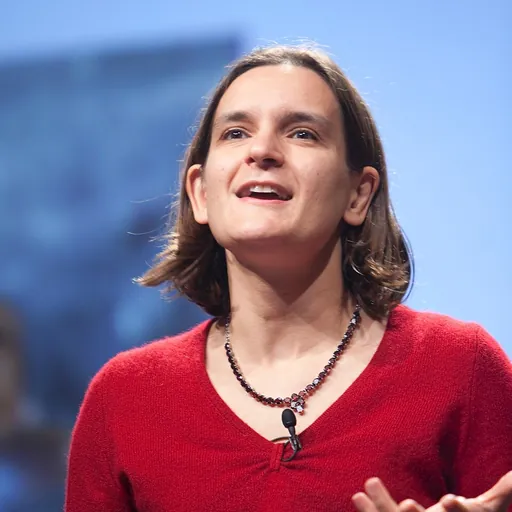
About Esther Duflo
Born 1972. Esther Duflo is a French and American economist, university teacher and researcher.
Esther Caroline Duflo, FBA (; born 25 October 1972) is a French-American economist, and the Abdul Latif Jameel Professor of Poverty Alleviation and Development Economics at the Massachusetts Institute of Technology (MIT). In 2019, she was jointly awarded the Nobel Memorial Prize in Economic Sciences alongside her husband Abhijit Banerjee and Michael Kremer "for their experimental approach to alleviating global poverty".
In addition to her academic appointment, Duflo is the co-founder and co-director of the Abdul Latif Jameel Poverty Action Lab (J-PAL), As of 2020, more than 400 million people had been impacted by programs tested by J-PAL affiliated researchers. Since 2024, Duflo has also been the president of the Paris School of Economics alongside her appointment at MIT. In October 2025, the University of Zurich announced that Duflo and Banerjee would be joining the faculty of the UZH School of Business, Economics, and Informatics in July 2026.
Duflo is a Research Associate of the National Bureau of Economic Research (NBER), a board member of the Bureau for Research and Economic Analysis of Development (BREAD), and the director of the development economics program of the Centre for Economic Policy Research. education, financial inclusion, Prior to receiving the Nobel Memorial Prize in Economic Sciences, Duflo was awarded the Calvó-Armengol International Prize (2019), published in April 2011 and November 2019, respectively. According to the Open Syllabus Project, Duflo is the seventh most frequently cited author on college syllabi for economics courses.
Early life and education Duflo was born on 25 October 1972 to Violaine and Michel Duflo at the Port Royal Hospital in Paris, France. Her father was a mathematics professor, and her mother was a pediatrician.
Career After completing her PhD in 1999, Duflo became an assistant professor of economics at MIT, her alma mater. Economics professors are rarely hired from the PhD students in their own departments; however, following the departure of Michael Kremer to Harvard University, the department made an exception to strengthen MIT's development economics group.
In line with Duflo and Banerjee's experience in the Indian context, J-PAL's first regional office was founded in 2007 in Chennai at the Institute for Financial Management and Research. Additional regional offices have since been founded at Pontifical Catholic University of Chile, the Paris School of Economics, the University of Cape Town, American University in Cairo, and the University of Indonesia. As of 2024, the J-PAL network included 900 researchers based at 97 universities around the world. Many prominent development economists are on the board of the organization, including Marianne Bertrand, Chris Blattman, Pascaline Dupas, and Amy Finkelstein.
Alongside her work at J-PAL, Duflo is a Research Associate at the National Bureau of Economic Research, a board member at the Bureau for Research and Economic Analysis of Development (BREAD), and director of the development economics program of the Centre for Economic Policy Research. Since 2023, she has held the Poverty and Public Policy Chair at the Collège de France, and in 2024 assumed the presidency of the Paris School of Economics. She is former editor-in-chief of the American Economic Review, was the founding editor of the American Economic Journal: Applied Economics, and previously was on the editorial boards of the Annual Review of Economics, Review of Economics and Statistics, and Journal of Development Economics.
Duflo has also held several advisory appointments in government. As of 2024, she was a member of the economic advisory committee of the Indian state of Tamil Nadu. From 2012 to 2017, she was on the Global Development Council of President Barack Obama, led by economist Mohamed El-Erian.
Research Duflo's research focuses on a range of topics in the microeconomics of development, such as health, education, financial inclusion, political economy, gender, and household behavior. Much of her research leverages randomized controlled trials to evaluate the causal effects of social interventions on development outcomes of interest.
Education Duflo's dissertation research examined the labor market returns to education through analysis of a unique policy experiment: a mass school construction program in Indonesia. Their research has encouraged the proliferation of "Teaching at the Right Level (TaRL)", an educational program aimed at improving learning outcomes by providing targeted instruction to primary school pupils behind on mathematics and reading.
Gender In other early work, Duflo examines the role of gender in the intra-household allocation of resources by leveraging another unique policy shock: a large increase in the value of old-age pensions in South Africa in 1991.
Microfinance Among Duflo's most cited work leverages a randomized impact evaluation to test the effects of microfinance on household consumption and well-being. In 2019, Rachael Meager — a former PhD student of Duflo — published a meta-analysis of the literature in the American Economic Journal: Applied Economics, finding little evidence to suggest that microfinance raises consumption or encourages household small business creation.
Personal life Duflo is married to economist Abhijit Banerjee, her longtime collaborator in development economics. The couple met in 1995, when Duflo was a student in Banerjee’s development economics class at MIT, and Banerjee was still married to his previous wife. They have two children, born in 2012 and 2014, and were married in 2015.
Selected works Books In April 2011, Duflo released her book Poor Economics, co-authored with Banerjee. It documents their 15 years of experience in conducting randomized control trials to alleviate poverty.
Papers Duflo has published numerous papers, receiving 6,200 citations in 2017. Most of them have appeared in the top five economic journals.
Awards Nobel prize in Economic Sciences Duflo was awarded the Sveriges Riksbank Prize in Economic Sciences in Memory of Alfred Nobel in 2019 along with her two co-researchers Abhijit Banerjee and Michael Kremer "for their experimental approach to alleviating global poverty". Duflo is the youngest person (at age 46) and the second woman to win this award (after Elinor Ostrom in 2009).
The press release from the Royal Swedish Academy of Sciences noted: "Their experimental research methods now entirely dominate development economics." The Nobel committee commented:
Banerjee, Duflo and their co-authors concluded that students appeared to learn nothing from additional days at school. Neither did spending on textbooks seem to boost learning, even though the schools in Kenya lacked many essential inputs. Moreover, in the Indian context Banerjee and Duflo intended to study, many children appeared to learn little: in results from field tests in the city of Vadodara fewer than one in five third-grade students could correctly answer first-grade curriculum math test questions. She also revealed that she wanted to use the award as a "megaphone" in her fighting efforts to tackle poverty and to improve children's education.
French President Emmanuel Macron offered his congratulations: "Duflo's magnificent Nobel Prize is a reminder that French economists are currently among the best in the world and shows that research in that field can have concrete impact on human welfare."
Much of the discussion related to the prize shared by Duflo and her co-laureates focused on their influential use of randomized controlled trials in designing their experiments. Summarizing the research approach which she had utilized along with Banerjee and Kremer, Duflo said simply, "Our goal is to make sure that the fight against poverty is based on scientific evidence."
Duflo came under criticism from the Bharatiya Janata Party, a Hindu nationalist party currently in power in India, due to the party's displeasure over her husband Abhijit Banerjee achieving the Nobel Prize. Many within the party derogatorily commented that Banerjee had been preferred by the Nobel committee over other Hindu academicians, due to him marrying a white European woman (viz Duflo), which was in violation of the Hindu preference for endogamy.
Other awards Duflo was awarded the Elaine Bennett Research Prize by the American Economic Association in 2002, which honours a female economist under 40 who has made outstanding contributions in any field of economic research. In May 2008, the American magazine Foreign Policy named her as one of the top 100 public intellectuals in the world. In 2009, she was named a MacArthur Foundation Fellow, otherwise known as a "genius" grant. She received her (first) honorary doctorate from the Université catholique de Louvain, on 2 February 2010. In 2010, Foreign Policy again named her to its list of top 100 global thinkers. She was named one of Time magazine's 100 most influential people in the world in April 2011. In 2012, Duflo was picked by Foreign Policy magazine as one of its Top 100 Global Thinkers. She shared the 2012 Gerald Loeb Award Honorable Mention for Business Book for Poor Economics with co-author Abhijit Banerjee. In 2013, Duflo was awarded the Dan David Prize for her contribution to the advancement of "Preventive Medicine" In November 2013, she was honoured as an Officer of the French Order of Merit. She received the John von Neumann Award by Rajk László College for Advanced Studies in December 2013. In 2014, she won the Infosys Prize in Social Science-Economics for leading "a major shift in development economics". She received the 2015 Princess of Asturias Social Sciences award in Spain. In 2015, she received the A.SK Social Sciences Award from the WZB Berlin Social Science Center, one of the world's largest awards in the social sciences, which is endowed with US$200,000. On 8 November 2019, she received an honorary doctorate from Erasmus University Rotterdam. In 2022, Duflo and Abhijit Banerjee received the Golden Plate Award of the American Academy of Achievement.
National honours Commandeur of the Legion of Honour (2020). Officier of the National Order of Merit (2013).
Don’t just read it —
keep it.
Full-length biographies made to live with: read them, listen on the way to work, watch them tonight.
- E-book
- Audio
- Video
Instant download · yours to keep · every purchase keeps this site free
Important facts
Family & relationships
People in Esther Duflo's life
Named in this biography and alive at the same time





Related people
Same field, nearest in time




Contemporaries
People whose lives overlapped Esther Duflo's



Frequently asked questions
Who is Esther Duflo?
French-American economist (born 1972)
When was Esther Duflo born?
Esther Duflo was born on 25 October 1972 in Paris.
What is Esther Duflo's occupation?
Esther Duflo is an economist, university teacher and researcher.
What nationality is Esther Duflo?
Esther Duflo is French and American.
Sources & further reading
Cite this page
APA: Biography.guide. (2026). Esther Duflo. https://biography.guide/esther-duflo/
MLA: "Esther Duflo." Biography.guide, https://biography.guide/esther-duflo/.
Chicago: "Esther Duflo." Biography.guide. https://biography.guide/esther-duflo/.
Data last updated: 2026-09-24 · Spot an error? Report a correction.
Portrait: Wikimedia Commons · author & licence
Page generated 2026-09-27 05:09 UTC