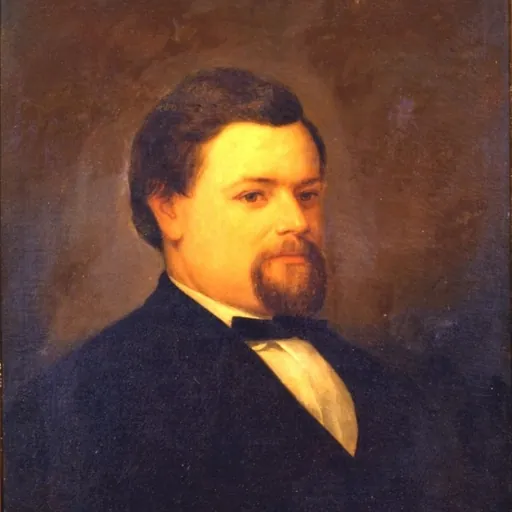
About Michael Hahn
Lived 1830 – 1886 (aged 55). Michael Hahn was an American politician, judge, lawyer, businessperson, entrepreneur and governor.
George Michael Decker Hahn (November 24, 1830 – March 15, 1886), was an attorney, politician, publisher and planter in New Orleans, Louisiana. He served twice in Congress during two widely separated periods, elected first as a Unionist to the U.S. House of Representatives in 1862, as a Republican to the U.S. Senate in 1865, and later as a Republican to the U.S. House of Representatives in 1884. He was elected as the 19th Governor of Louisiana, serving from 1864 to 1865 during the American Civil War, when the state was occupied by Union troops.
In 1865, Hahn was elected to the U.S. Senate, but Radical Republicans refused to allow him or other senators-elect from former Confederate states to be seated. Later, he was elected for several terms as a Republican to the state House during the Reconstruction era, where he was also elected as Speaker. Hahn was active as a publisher and editor, owning and operating three newspapers in succession that supported the Republican Party, its program, and its candidates in the state. He spent much of his wealth in supporting these papers. Hahn continued to be politically active, being elected to Congress from Louisiana's 2nd congressional district in 1884 with a strong majority. He served about a year before his death in office.
Early life and education
Hahn was born in 1830 as the last child in his family, in Klingenmünster, Palatinate, then part of the Kingdom of Bavaria, now of Rhineland-Palatinate, Germany. His father died before he was born. Some sources indicate that Hahn's parents were Jewish.
With his widowed mother and four older siblings, Hahn immigrated as a child to the United States, arriving in New York City. The family traveled to the Republic of Texas, before settling in New Orleans in 1840. The following year, Hahn's mother died of yellow fever and the children were orphaned.
Term as governor In March 1864 Colonel's Short Villa briefly served as the executive mansion of the newly elected Federal Governor of Louisiana, Michael Hahn.
In 1864, with almost all of Louisiana under federal occupation, General Nathaniel P. Banks, the Union Military Commander of the Department of the Gulf (responsible, among other things, for civil order in occupied Louisiana), called state elections and convened a constitutional convention. Benjamin Franklin Flanders and Thomas Jefferson Durant, prominent Unionists, opposed the moderate plan called for by General Banks. Hahn purchased a pro-slavery newspaper, the New Orleans True Delta, and used it to promote moderate Unionism supporting Banks' plan, including emancipation of slaves. He is also said to have been the first ethnic Jewish governor in the United States;
Hahn's inauguration in Lafayette Square, New Orleans, featured a huge brass band led by Patrick Gilmore. On March 4, 1864, Hahn was inaugurated as governor of Union-held Louisiana in an elaborate ceremony paid for by General Banks. As governor, Hahn supported universal education.
In his term, Hahn tried to gain suffrage for freedmen and previously free people of color, but it was too early. He approved the state's ratification of the 15th Amendment. Hahn's administration made serious attempts to ensure enfranchisement of black Louisianans, laid the foundation for a public school system for blacks, and began an aborted Reconstruction in Louisiana. Governor Hahn played a leading role in the state constitutional convention of 1864, but he was opposed by Major General Stephen A. Hurlbut, who replaced Banks as commander of the Department of the Gulf. General Hurlburt refused to recognize the state civil government of Hahn.
Hahn resigned as governor in March 1865, and was elected by the state legislature to the U.S. Senate in 1865.
Lieutenant Governor James Madison Wells succeeded Hahn as governor after his resignation.
Political editor and congressman After President Lincoln was assassinated in April 1865, Congress refused to seat any Representatives or Senators from the former Confederacy until a reconstruction plan could be carried out. Senator-elect Hahn returned to New Orleans and allied with radical Republicans calling for a convention to revise Louisiana's Constitution of 1864 to include black suffrage. He was shot and severely wounded on July 30, 1866, in the New Orleans Riot.
From 1872 to 1878 Hahn served in the Louisiana State Legislature. He was elected as Chairman of the Judiciary Committee and Speaker of the Louisiana House of Representatives amid the Wheeler Compromise. In 1878 he was appointed as Superintendent of the U.S. Mint in New Orleans, serving until January 1879. At that point, Hahn was appointed Judge of the 26th state judicial district, which included Saint John the Baptist, Saint Charles, and Jefferson parishes. During the 1880 elections, Hahn established and edited the New Orleans Ledger to promote Republican candidates.
Although Democrats had regained control of the state legislature, Hahn was personally admired for his integrity and consistency of position. In 1884, Hahn was elected to Congress as the Republican candidate from Louisiana's 2nd congressional district – a race that he won handily by 3,000 votes. Serving as the only Republican Congressman from Louisiana, Hahn died on March 15, 1886, in his room at the Willard Hotel in Washington, D.C. He suffered a ruptured blood vessel near his heart. He had never married and died poor. He had spent much of his previous wealth in trying to maintain the Republican-oriented newspapers he published.
Don’t just read it —
keep it.
Full-length biographies made to live with: read them, listen on the way to work, watch them tonight.
- E-book
- Audio
- Video
Instant download · yours to keep · every purchase keeps this site free
Important facts
People in Michael Hahn's life
Named in this biography and alive at the same time




Related people
Same field, nearest in time




Contemporaries
People whose lives overlapped Michael Hahn's




Frequently asked questions
Who was Michael Hahn?
American politician (1830-1886)
When was Michael Hahn born?
Michael Hahn was born on 24 November 1830 in Klingenmünster.
When did Michael Hahn die?
Michael Hahn died on 15 March 1886 in Washington, D.C..
What was Michael Hahn's occupation?
Michael Hahn was a politician, judge, lawyer, businessperson, entrepreneur and governor.
What nationality was Michael Hahn?
Michael Hahn was American.
Sources & further reading
Cite this page
APA: Biography.guide. (2026). Michael Hahn. https://biography.guide/michael-hahn/
MLA: "Michael Hahn." Biography.guide, https://biography.guide/michael-hahn/.
Chicago: "Michael Hahn." Biography.guide. https://biography.guide/michael-hahn/.
Data last updated: 2026-09-22 · Spot an error? Report a correction.
Portrait: Wikimedia Commons · author & licence
Page generated 2026-09-27 05:03 UTC