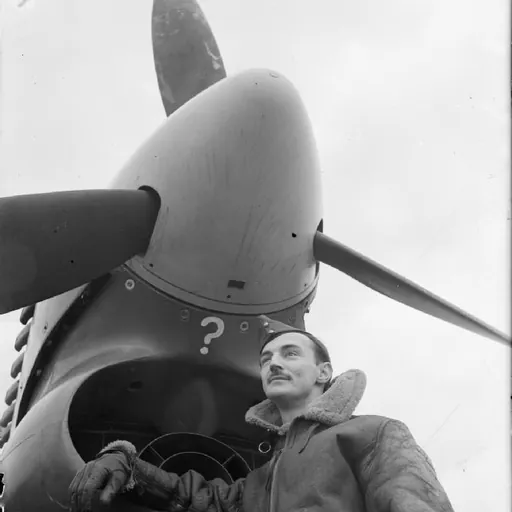
About Michael Crossley
Lived 1912 – 1987 (aged 74–75). Michael Crossley was a British flying ace.
Michael Nicholson Crossley, (29 May 1912 – 7 December 1987) was a British flying ace of the Royal Air Force (RAF) during the Second World War. He is credited with having destroyed at least 22 aircraft and for a time was the RAF's most successful fighter pilot of the Second World War.
From Halford, Crossley joined the RAF in 1935. Once his flying training was completed, he was posted to No. 32 Squadron, based at Biggin Hill. By the time of the outbreak of the Second World War, Crossley was a flight lieutenant and led one of the squadron's flights. Flying the Hawker Hurricane fighter He achieved his first aerial victories during the Battle of France, for which he was subsequently awarded the Distinguished Flying Cross. He flew extensively with the squadron for the first two months of the Battle of Britain, becoming its commander in mid-August 1940. His successes during the campaign over southeast England saw him awarded the Distinguished Service Order. He relinquished command of the squadron in April 1941 and was sent to the United States on test pilot duties. Due to a health condition, he was unable to fly on operations for the later years of the war by which time he held the rank of wing commander. Returning to civilian life in 1946, he took up agroforestry in South Africa. He died there, aged 75.
Early life Born in Halford, Warwickshire on 29 May 1912, Michael Nicholson Crossley was educated at Eton College and the College of Aeronautical Engineering in Chelsea. During his tertiary studies he was a member of the Brooklands Flying Club and once he completed his studies in 1933, he was employed by the club. He joined the Royal Air Force (RAF) in 1935 on a short service commission, commencing his training in November. He proceeded onto No. 11 Flying Training School early the following year.
Crossley was confirmed as a pilot officer on 25 November 1936, by which time he had been posted to No. 32 Squadron. For a period of time he served in the Aden Colony as aide-de-camp to the governor there but had returned to the squadron at some stage in 1939. He became a flight commander just before the outbreak of war, being promoted to acting flight lieutenant on 7 August 1939. He was nicknamed the "Red Knight" by virtue of leading No. 32 Squadron's "Red Flight". By this time, the squadron was equipped with the Hawker Hurricane fighter, having converted to the type the previous year.
Second World War Following the outbreak of the Second World War, No. 32 Squadron was scrambled several times to deal with incoming German aircraft, but were mostly unsuccessful. Following the invasion of France and Low Countries on 10 May 1940, it began patrolling the Dutch coastline. Crossley carried out a successful offensive sortie the next day, strafing German troop carrying transport aircraft at Ypenburg Airfield.
Battle of France On 18 May, the squadron was sent to France as reinforcements for the RAF fighter squadrons heavily engaged in the fighting there. An advance element was based at Abbeville and was immediately thrown into action. Crossley claimed his first aerial victory on 19 May, destroying a Messerschmitt Bf 109 fighter. He shot down another Bf 109 over Saint-Pol on 22 May and this was followed the next day with his destruction of two Bf 109s to the east of Ypres. During the evacuation of the British Expeditionary Force (BEF) from Dunkirk, the squadron, now back at Biggin Hill, assisted in providing aerial cover over the beaches. Crossley shot down a Junkers Ju 88 medium bomber near Dunkirk on 26 May. His flight lieutenant rank was made permanent at the end of the month. When the evacuation of the BEF was completed, No. 32 Squadron continued to carry out patrols to France and on 8 June, Crossley shot down two Heinkel He 111 medium bombers near Le Tréport.
As a result of his successes Crossley was awarded the Distinguished Flying Cross (DFC) on 21 June, which was presented to him by King George VI in a investiture held at Biggin Hill. The citation for his DFC, published in the London Gazette, read:
Battle of Britain
By the end of June, No. 32 Squadron was tasked with defending the English airfields and over the following weeks became heavily engaged in countering the bombing raids of the Luftwaffe. Crossley shared in the destruction of a Messerschmitt Bf 110 heavy fighter on 20 July to the southeast of Dover, also shooting down a Bf 109 just off the coast from Dover the same day. On 25 July he claimed to have destroyed a Bf 109 off Dover but this was not confirmed. He shot down one Bf 109 near Deal and another several miles from Dover on 12 August. Three days later, with the Luftwaffe escalating its operations, and Crossley destroyed two Ju 88s near Portsmouth and then in a subsequent sortie to intercept a raid on Croydon, shot down two Dornier Do 17 medium bombers, one shared with another pilot. The next day, Crossley was promoted to squadron leader and succeeded John Worrall as commander of No. 32 Squadron.
Later war service
While at Acklington, No. 32 Squadron started training in night fighting duties and at the start of 1941 it moved to Middle Wallop, from where it carried out convoy patrols over the west coast of England. Crossley in the meantime had been mentioned in despatches on 1 January. He remained with No. 32 Squadron until April, when he was sent as test pilot for the British Air Commission in the United States. Promoted to wing commander on 1 September 1942, he returned to the UK the following year, where he was made wing leader at RAF Detling. Soon after, Crossley's operational flying career ended when he contracted tuberculosis and he was restricted in his duties for the remainder of the war. Crossley was discharged from the RAF later that year and placed on the RAF Reserve of Officers. Emigrating to South Africa, Crossley took up agroforestry with the timber from the trees grown on his property used in the mining industry. He died at his home at White River in the Eastern Transvaal on 7 December 1987.
Don’t just read it —
keep it.
Full-length biographies made to live with: read them, listen on the way to work, watch them tonight.
- E-book
- Audio
- Video
Instant download · yours to keep · every purchase keeps this site free
Important facts
People in Michael Crossley's life
Named in this biography and alive at the same time


Related people
Same field, nearest in time

Contemporaries
People whose lives overlapped Michael Crossley's






Frequently asked questions
Who was Michael Crossley?
British flying ace
When was Michael Crossley born?
Michael Crossley was born on 20 May 1912 in Halford.
When did Michael Crossley die?
Michael Crossley died in 1987 in South Africa.
What was Michael Crossley's occupation?
Michael Crossley was a flying ace.
What nationality was Michael Crossley?
Michael Crossley was British.
Sources & further reading
Cite this page
APA: Biography.guide. (2026). Michael Crossley. https://biography.guide/michael-crossley/
MLA: "Michael Crossley." Biography.guide, https://biography.guide/michael-crossley/.
Chicago: "Michael Crossley." Biography.guide. https://biography.guide/michael-crossley/.
Data last updated: 2026-09-22 · Spot an error? Report a correction.
Portrait: Wikimedia Commons · author & licence
Page generated 2026-09-27 05:03 UTC