
About Michael Comyn
Lived 1871 – 1952 (aged 81). Michael Comyn was an Irish politician and barrister.
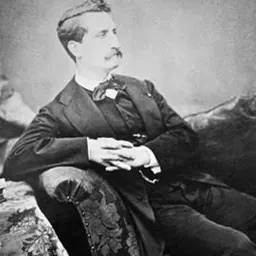
Michael Comyn (6 June 1871 – 6 October 1952) was an Irish barrister, Fianna Fáil Senator and later a judge on the Circuit Court. He was also a member of the British Civil Service, geologist, discoverer and operator of mines, and finally "litigant in one of the longest cases ever heard in the Irish courts". As a lawyer-turned litigant, he recounted that "it was his last case, and he won it: a far cry from his first case as a young barrister...it was a bad case and I did it badly".
Early life Comyn was born at Clareville, Ballyvaughan, County Clare, in 1871, the eldest son and the second of seven children of James Comyn of Kilshanny, a tenant farmer and secretary of the local branch of the Land League. His mother was Ellenora, daughter of Thomas Quin, of Fanta Glebe, Kilfenora, County Clare. In 1879, the Comyn family were evicted from their home by Lord Clanricarde's agent and the family moved to Gortnaboul in Kilshanny parish, County Clare. Comyn attended the local school and was taught by Vere Ryan, father of the republican Frank Ryan. Later he attended Hugh Brady's school in Ruan, County Clare. This school had a reputation for tutoring its students successfully for civil service examinations. He boarded with his aunt (married to Casey) in Ruan during the week. "A barrister at last, but a civil servant still. With no legal back ground, no solicitor acquaintances and no influential friends, the bar looked a particularly hazardous profession". He decided to join the Munster circuit and presented himself at quarter sessions in his home county Clare.
Initially, the application was made to the Chancery Division in Ireland. In 1920, two proclamations were announced, one by Viscount French, the Lord Lieutenant, putting certain areas including County Cork under martial law and the second by the British Commander-in-Chief in Ireland Sir Nevil Macready requiring all civilians who did not hold a permit to surrender all arms, ammunition and explosives by 27 December of that year. Failure to comply meant that any unauthorised person found in possession of arms, ammunition or explosives, would become liable to trial by Military Court and on conviction the sentence was death. General Sir E.P. Strickland was appointed by the Commander-in-Chief Macready to be military governor of the martial law area. It was his duty to establish and organise the Military Courts. In April 1921, 42 individuals, including Clifford and O'Sullivan, were arrested near Mitchelstown. On 3 May 1921, 42 civilians were tried by a military court on a charge of being in possession of arms and ammunition. They were sentenced to death "subject to confirmation".
Ten days later, 10 May 1921, Mr. Justice Powell sought a Writ of Prohibition against Sir Nevil Macready and General Strickland to prohibit them; "(1) from further proceeding the trial of applicants, (2) from pronouncing or confirming any judgment upon them, (3) from carrying any judgment upon them into execution and (4) from otherwise interfering with them". The Prohibition sought was that the Military Court was in fact illegal and therefore had no jurisdiction to try the applicants or to adjudicate in any matter related to them. Mr. Justice Powell listened to this unusual application in his division but "felt constrained to dismiss it". In the appeal to the Court of Appeal - the Crown's case was that the Preliminary objection that Mr. Justice Powell's order was "made in a criminal cause or matter within s.50 of the Supreme Court of Judicature Act, 1877, therefore no appeal lay. "This contention succeeded with O'Connor, M.R., and Lord Justices Ronan and O'Connel, and the appeal was duly dismissed". On 16 June 1921 (just six weeks after the verdict of the Military Court) the case appeared before the House of Lords in London for hearing on the Preliminary objection. Sir John Simon, KC, led Michael Comyn, James Comyn (Michael's nephew), their colleague, Joe McCarthy (later appointed a judge) and Richard O'Sullivan of the English court appeared before the House.
"In Michael Comyn's view the case had been brought to an end through the intervention of King George V, who, he said, secured a promise from the prime minister that no executions would take place and that Peace would be made". It also notes that no republican prisoner whose case Comyn took up during the "troubles" suffered the death penalty. Other notable cases included his appeal to the House of Lords on behalf of the suffragette Georgina Frost. Erskine Childers was one of the principal secretaries to the Irish mission when the Treaty was being negotiated in London. The split between the pro- and the anti-treaty factions resulted in the former becoming the government and the latter under (de Valera) engaged in the hostilities.
In the Irish Civil War in Cork in 1922, Erskine Childers operated the printing press turning out anti-Treaty propaganda. In October 1922, Éamon de Valera made Childers secretary of his shadow "government" so he returned to Dublin. He returned with his typewriter and a small Colt automatic revolver (given to him by Michael Collins). While staying with his cousin Robert Barton (one of the signatories of the treaty) in Wicklow, he was captured by the forces of the Irish Free State Government. His capture made headlines and it is reported that it was noted with satisfaction by Winston Churchill who said he was a "mischief making renegade" and added "Such as he is may all who hate us be". The charge against him was the "illegal possession of arms - the Colt revolver". Erskine Childers was due to stand trial before a Military Court on 17 November 1922. He was imprisoned in Portobello Barracks and ask his long-time friend Michael Comyn to defend him. He had often hidden in Comyn's home in Leeson Park.
At his trial, which was in camera, Childers was convicted. Then with Patrick Lynch, Comyn went to the High Court, presided over by Sir Charles O'Connor, and conducted a spirited fight based purely on technical grounds. It failed and they appealed. Before the appeal was heard, news came in an announcement from London, that Childers had been shot at dawn on 24 November at Beggar's Bush Barracks. It appears that measures to rescue him were known to the Free State authorities and thus forestalled.
The Judges of the Court of Appeal echoed this when the case was held a few days later. It had a profound impact on Comyn when Childers was executed while the case was on appeal. He said "It was a complete negation of justice, the worst I have ever known, to execute a man whose case for life or death was actually under argument and awaiting judgment". He served as senator between 1928 and 1936 and was Leas-Chathaoirleach (deputy chairperson) of the house (1934–1936). "He was a keen debater, he was a hard-working and able legislator, if unforgiving of political opponents. On de Valera's accession to power, he expected to be made attorney general but was passed over in favour of Conor Maguire." After the 1934 Seanad election, there was a contest on 12 December 1934 to decide who would be elected Cathaoirleach. Senator MacKean was absent for the vote but all other members were present. General Sir William Hickie chaired the election. The two candidates were the outgoing Cathaoirleach, Thomas Westropp Bennett, and the Fianna Fáil candidate, Comyn. Neither of the two candidates voted and so fifty-six Senators voted in the election, which resulted in a tie of twenty-eight votes each. Westropp Bennett received the votes of all twenty-one members of Fine Gael and seven independents. Comyn received the votes of his eighteen Fianna Fáil colleagues, all the votes of the seven Labour Party Senators and the votes of three independents: Sir Edward Bellingham, Thomas Linehan and Laurence O'Neill. Hickie then gave his casting vote for Westropp Bennett saying he would have done so had he had the opportunity in the division. The following week, however, Comyn defeated the outgoing Leas-Chathaoirleach, Michael F. O'Hanlon of Fine Gael, by twenty-six votes to twenty-five.
In 1932 he took a successful action against de Valera's government for the recovery of £20,000 of IRA fund. He died in 1952 aged 81 years.
Don’t just read it —
keep it.
Full-length biographies made to live with: read them, listen on the way to work, watch them tonight.
- E-book
- Audio
- Video
Instant download · yours to keep · every purchase keeps this site free
Important facts
People in Michael Comyn's life
Named in this biography and alive at the same time



Related people
Same field, nearest in time





Contemporaries
People whose lives overlapped Michael Comyn's





Frequently asked questions
Who was Michael Comyn?
Irish politician (1871-1952)
When was Michael Comyn born?
Michael Comyn was born on 6 June 1871.
When did Michael Comyn die?
Michael Comyn died on 6 October 1952.
What was Michael Comyn's occupation?
Michael Comyn was a politician and barrister.
What nationality was Michael Comyn?
Michael Comyn was Irish.
Sources & further reading
Cite this page
APA: Biography.guide. (2026). Michael Comyn. https://biography.guide/michael-comyn/
MLA: "Michael Comyn." Biography.guide, https://biography.guide/michael-comyn/.
Chicago: "Michael Comyn." Biography.guide. https://biography.guide/michael-comyn/.
Data last updated: 2026-09-20 · Spot an error? Report a correction.
Page generated 2026-09-27 05:01 UTC