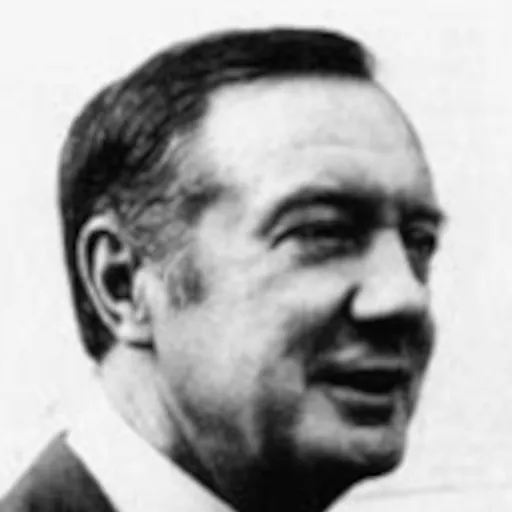
About Michael Anthony Bilandic
Lived 1923 – 2002 (aged 78). Michael Anthony Bilandic was an American judge, lawyer and politician.
Michael Anthony Bilandic (February 13, 1923 – January 15, 2002) was an American Democratic politician, judge, and attorney who served as the 49th mayor of Chicago from 1976 to 1979, after the death of his predecessor, Richard J. Daley. Bilandic practiced law in Chicago for several years, having graduated from the DePaul University College of Law. Bilandic served as an alderman in Chicago City Council, representing the eleventh ward on the south-west side (Bridgeport neighborhood) from June 1969 until he began his tenure as mayor in December 1976. After his mayoralty, Bilandic served on the Illinois Appellate Court from 1984 until being elected to the Illinois Supreme Court in 1990. He served on the state supreme court until 2000, and was the court’s chief Justice from 1994 to 1997.
Early life and career Bilandic was born in Chicago to Croatian immigrant parents. His father Mate "Matthew" Bilandžić was from Krušvar in Dalmatian Hinterland, and his mother Milka "Minnie" Bilandžić, née Lebedina from Bobovišća on the island of Brač. Bilandic studied at De La Salle High School and graduated in 1940. Bilandic joined the United States Marine Corps during World War II in 1943, serving as first lieutenant until 1945. After his time in the Marine Corps, Bilandic returned to school; receiving his bachelor's degree from St. Mary's University of Minnesota in 1947.
Acting mayoralty (1976–77) and special election victory
After Mayor Richard J. Daley died in office on December 20, 1976, Wilson Frost argued that as president pro tempore of the City Council he had automatically become the acting mayor. As such, he would have been the first African American to serve as mayor. However, much of the city council disputed Frost's claim. After nearly a week of closed-door negotiations, a compromise was struck among councilors in which the city council would vote to name Bilandic to serve as acting mayor for approximately six months until a special election could be held to choose a mayor filling out the remaining two years of Daley's unexpired term. This came with the agreed understanding that Bilandic would not run as a candidate in the special election. Other aspects of the compromise that resulted in Bilandic becoming mayor had included the council voting to name Frost the chairman of the council's powerful Finance Committee, a position with real power as opposed to the primarily ceremonial role of president pro tempore. This served to appease African American aldermen.
On December 28 (eight days after Daley's death), Bilandic was approved by the City Council to serve as acting mayor. At the same meeting that it appointed Bilandic, the council also voted for the other aspects of the compromise: naming Frost as chairman of the finance committee, Vrdolyak as president pro tempore, and Laskowski as vice mayor. Bilandic ultimately ran. Still enjoying a honeymoon period as acting mayor, he received a popular mandate to assume Daley's mantle. In the Democratic's primary election, he won 51.1% of the vote, handily defeating challengers Edward Hanrahan, Anthony Martin-Trigona, Roman Pucinski, Ellis Reid and Harold Washington. In the June 7 general election, Bilandic was elected mayor with 77.4% of the vote, defeating Dennis H. Block (the Republican nominee), as well as Dennis Brasky (the Socialist Labor nominee) and Gerald Rose (the U.S. Labor nominee). Bilandic delivered his inaugural address and took office on June 22, 1977.
Mayoralty (1977–79) While initially popular, Bilandic's term as mayor would prove to be short and difficult.
A 1993 survey of historians, political scientists and urban experts conducted by Melvin G. Holli of the University of Illinois at Chicago ranked Bilandic as the twenty-first-worst American big-city mayor to have served between the years 1820 and 1993.
Labor strikes While he was mayor, Chicago faced several labor disputes including a gravediggers and cemetery owners' strike and a threatened strike by members of Lyric Opera of Chicago. The Chicago Butcher's Union worked to stop stores from selling fresh meat after 6 p.m., but Bilandic managed to work out a settlement. A runner himself, Bilandic arranged to have five miles of unused equestrian paths along the lakefront converted to running paths.
Blizzard of 1979 During January 1979, a blizzard struck Chicago and effectively closed down the city, dropping a total of twenty-one inches of snow over a two-day period. The city's slow response to the debilitating storm was publicly blamed on Bilandic. Additionally, as part of attempts to deal with the storm, Bilandic ordered Chicago 'L' trains to bypass many intermediate stops, particularly affecting black neighborhoods on the South Side of the city, and angering that large voter base.
Urban development In November 1978, Bilandic unveiled a broad $7.4 billion five-year public works plan to reshape much of the city. These plans included the construction a new State of Illinois office building on the site occupied by shuttered Sherman House Hotel. This would ultimately be realized with the construction of the James R. Thompson Center.
1979 Democratic primary loss
Bilandic sought re-election in 1979, and was challenged in the Democratic primary by the former longtime city consumer affairs department head Jane Byrne, whom Bilandic had fired in 1977. Bilandic's candidacy was dragged down by dissatisfaction with the city's handling of the recent snowstorm, as well as other issues. Many Republicans crossover voted in the Democratic primary against Bilandic in hopes of delivering a defeat to the Democratic machine that had dominated Chicago politics for decades. Byrne's challenge was also boosted by the endorsement of Reverend Jesse Jackson. Additionally, many North Side and Northwest Side voters supported Byrne against Bildanic because they were angered by the Cook County Democratic leadership's slating of only South Side and Southwest Side candidates for the citywide offices (mayor, clerk, and treasurer) in its endorsements ahead of the primary. Bilandic very narrowly lost the primary, winning 49% to Byrne's 51%. Byrne went on to win the general election with a record-setting 82% of the vote, becoming Chicago's first female mayor.
Judicial career Following his term as mayor, Bilandic was elected to the Illinois Appellate Court in 1984, and then the Illinois Supreme Court in 1990, where Bilandic served until 2000. From 1994 until 1996, Bilandic served as the Illinois chief justice.
Personal life and death On June 1, 1977, Bilandic married Chicago socialite Heather Morgan in a ceremony officiated by Chicago's Archbishop John Cardinal Cody. Bilandic and Morgan had a son, Michael M. Bilandic Jr., born in 1978.
On January 15, 2002, Bilandic died from heart failure and was interred in St. Mary's Cemetery in Evergreen Park, Illinois.
Don’t just read it —
keep it.
Full-length biographies made to live with: read them, listen on the way to work, watch them tonight.
- E-book
- Audio
- Video
Instant download · yours to keep · every purchase keeps this site free
Important facts
People in Michael Anthony Bilandic's life
Named in this biography and alive at the same time






Related people
Same field, nearest in time

Contemporaries
People whose lives overlapped Michael Anthony Bilandic's




Frequently asked questions
Who was Michael Anthony Bilandic?
American judge (1923-2002)
When was Michael Anthony Bilandic born?
Michael Anthony Bilandic was born on 13 February 1923 in Chicago.
When did Michael Anthony Bilandic die?
Michael Anthony Bilandic died on 15 January 2002 in Chicago.
What was Michael Anthony Bilandic's occupation?
Michael Anthony Bilandic was a judge, lawyer and politician.
What nationality was Michael Anthony Bilandic?
Michael Anthony Bilandic was American.
Sources & further reading
· Wikipedia: Michael Anthony Bilandic
· DBpedia: Michael A. Bilandic
Cite this page
APA: Biography.guide. (2026). Michael Anthony Bilandic. https://biography.guide/michael-anthony-bilandic/
MLA: "Michael Anthony Bilandic." Biography.guide, https://biography.guide/michael-anthony-bilandic/.
Chicago: "Michael Anthony Bilandic." Biography.guide. https://biography.guide/michael-anthony-bilandic/.
Data last updated: 2026-09-22 · Spot an error? Report a correction.
Portrait: Wikimedia Commons · author & licence
Page generated 2026-09-27 05:03 UTC