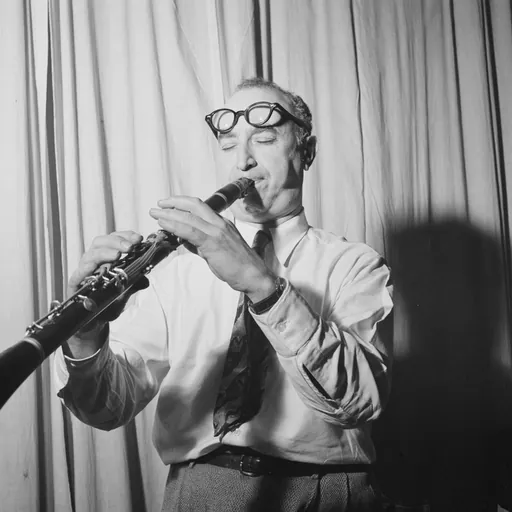
Mezz Mezzrow
American jazz clarinetist and saxophonist
About Mezz Mezzrow
Lived 1899 – 1972 (aged 72). Mezz Mezzrow was an American clarinetist, jazz musician, saxophonist, musician and saxophone.
Music career According to one biographer: "As a juvenile delinquent, [Mezzrow] was in and out of reformatory schools and prisons where he was exposed to jazz and blues music. He began to play the clarinet and decided to adopt the African American culture as his own. He became a ubiquitous figure on the Chicago jazz scene of the 1920s and ran in the circles of musicians that included King Oliver, Louis Armstrong, Sidney Bechet, Jimmy Noone, Al Jolson, Baby Dodds, Bix Beiderbecke, Louis Bellson and many others. [He] was an advocate for the pure New Orleans jazz style."
Along with other white musicians of his era, such as Eddie Condon and Frank Teschemacher, Mezzrow visited the Sunset Café in Chicago to learn from, and listen to, Louis Armstrong and his Hot Five. He admired Armstrong so much that after the release of "Heebie Jeebies", he, along with Teschemacher, drove 53 miles to Indiana in order to play the song for Bix Beiderbecke.
Mezzrow's first recordings were released in 1933, under the band name Mezz Mezzrow And His Orchestra. The group was composed primarily of black musicians such as Benny Carter, Teddy Wilson, Pops Foster, and Willie "The Lion" Smith, but also included the Jewish trumpet player Max Kaminsky. During the 1930s and 1940s, Mezzrow organized and took part in many recording sessions with Sidney Bechet.
Mezzrow's own playing was held in low regard by most critics, and his reputation rested more on his activities as an organizer and promoter than on his abilities as an instrumentalist. Nat Hentoff wrote in 1953 that he was "so consistently out of tune that he may have invented a new scale system", Whitney Balliett later called him an "abysmal" clarinetist, and Gunther Schuller, in The Swing Era (1989), dismissed his "corny arrangements and inept alto playing". Sidney Bechet's biographer John Chilton judged him "a limited musician with a sour tone and a stunted rhythmic, melodic and harmonic imagination", at his best on the slow blues duets where he could lean on Bechet but often "ludicrous" at faster tempos. Bechet, whose King Jazz sessions Mezzrow financed, never engaged him on a recording of his own, holding privately that "race does not matter — it is hitting the notes right that counts". He nonetheless retained defenders: Panassié championed him throughout his life, the bandleader Claude Luter thought him "a good amateur" in a non-pejorative sense, and the record producer Al Rose, though granting that "he wasn't a very good clarinetist", praised "his generosity and his total devotion to the music we call jazz".
Personal life
Milton Mesirow was ethnically and religiously Jewish, and was raised in Chicago. His wife, Johnnie Mae, was a black Baptist. They had one son, Milton Mesirow, Jr. According to the younger Mesirow, the surname "Mezzrow" was a "pen name" of his father's. In an interview with The New York Times in 2015, "Mezz Jr.", as he was known, told a reporter: "My father put me in a shul, and my mother's side tried to make me a Baptist. So when I'm asked what my religion is, I just say 'jazz.'"
Mezzrow praised and admired African-American culture and style. In his autobiography, Really the Blues, he wrote that from the moment he heard jazz he "was going to be a Negro musician, hipping [telling] the world about the blues the way only Negroes can." Eddie Condon said of him (in We Called It Music, London; Peter Davis 1948): "When he fell through the Mason–Dixon line he just kept going".
The family lived in Harlem, New York City, where Mezzrow declared himself a "voluntary Negro" and was listed as Negro on his draft card in World War II.
Mezzrow became known as much for his cannabis advocacy as his music. He was also known as the Muggles King, the word muggles being slang for marijuana at that time; the title of the 1928 Louis Armstrong recording "Muggles" refers to this. Armstrong was one of his biggest customers. A letter from 1932, written by Armstrong, demonstrates this relationship; while in England, Armstrong detailed in this letter about where and how Mezzrow should send marijuana.
In 1940, he was arrested in possession of sixty joints while trying to enter a jazz club at the 1939 New York World's Fair, with intent to distribute. When he was sent to jail, he insisted to the guards that he was black and was transferred to the segregated prison's black section. In Really the Blues, he wrote:
Mezzrow was lifelong friends with Panassié and spent the last 20 years of his life in France. He was preceded in death by his wife, Johnnie Mae Mezzrow, and was buried in the Père Lachaise Cemetery in Paris. The couple were survived by their son Mezz Jr.
In 2015, a Greenwich Village jazz club called Mezzrow was named in his honor.
Selected discography 1947: Really the Blues, Jazz Archives (France) 1951: Mezz Mezzrow & His Band Featuring Collins & Singleton, Blue Note 1954: Mezz Mezzrow 1954: Mezz Mezzrow with Frankie Newton, Victor Records 1954: Mezz Mezzrow's Swing Session, X Records 1954: Mezzin' Around, RCA 1955: Mezz Mezzrow, Disques Swing 1955: Paris 1955, Vol. 1, Disques Swing 1955: Mezz Mezzrow in Paris, 1955, Jazz Time Records 1956: Mezz Mezzrow a La Schola Cantorum, Ducretet-Thomson Records 1995: Makin' Friends, EPM 2007: Tells the King Jazz Story, Crisler 2012: Mezzrow and Bechet Remastered, Gralin Music
Don’t just read it —
keep it.
Full-length biographies made to live with: read them, listen on the way to work, watch them tonight.
- E-book
- Audio
- Video
Instant download · yours to keep · every purchase keeps this site free
Important facts
People in Mezz Mezzrow's life
Named in this biography and alive at the same time




Related people
Same field, nearest in time


Contemporaries
People whose lives overlapped Mezz Mezzrow's


Frequently asked questions
Who was Mezz Mezzrow?
American jazz clarinetist and saxophonist
When was Mezz Mezzrow born?
Mezz Mezzrow was born on 9 November 1899 in Chicago.
When did Mezz Mezzrow die?
Mezz Mezzrow died on 5 August 1972 in Neuilly-sur-Seine.
What was Mezz Mezzrow's occupation?
Mezz Mezzrow was a clarinetist, jazz musician, saxophonist, musician and saxophone.
What nationality was Mezz Mezzrow?
Mezz Mezzrow was American.
Sources & further reading
Cite this page
APA: Biography.guide. (2026). Mezz Mezzrow. https://biography.guide/mezz-mezzrow/
MLA: "Mezz Mezzrow." Biography.guide, https://biography.guide/mezz-mezzrow/.
Chicago: "Mezz Mezzrow." Biography.guide. https://biography.guide/mezz-mezzrow/.
Data last updated: 2026-09-22 · Spot an error? Report a correction.
Portrait: Wikimedia Commons · author & licence
Page generated 2026-09-27 05:04 UTC