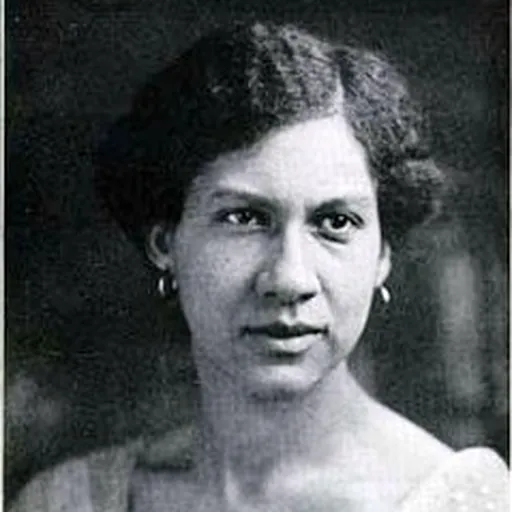
About Meta Vaux Warrick Fuller
Lived 1877 – 1968 (aged 90). Meta Vaux Warrick Fuller was an American sculptor, poet, artist, designer and civil rights advocate.
Meta Vaux Warrick Fuller ( ; born Meta Vaux Warrick; June 9, 1877 – March 13, 1968) was an African-American artist who celebrated Afrocentric themes. At the fore of the Harlem Renaissance, Warrick was known for being a poet, painter, theater designer, and sculptor of the Black American experience. At the turn of the 20th century, she achieved a reputation as the first Black woman sculptor and was a well-known sculptor in Paris before returning to the United States.
Warrick was a protégée of Auguste Rodin, and has been described as "one of the most imaginative Black artists of her generation." Through adopting a horror-based figural style and choosing to depict events of racial injustice, like the lynching of Mary Turner, Warrick used her platform to address the societal traumas of African Americans.
Early life Meta Vaux Warrick Fuller was born in Philadelphia, Pennsylvania, on June 9, 1877. Her parents were Emma (née Jones) Warrick, an accomplished wig maker and beautician for upperclass white women, and William H. Warrick, a successful barber and caterer. Her father owned several barber shops and her mother owned her own beauty salon. Warrick was named after Meta Vaux, the daughter of Senator Richard Vaux, one of her mother's customers. Her maternal grandfather, Henry Jones, was a successful caterer in the city. Despite this, Warrick's parents were able to find creative success Warrick's art education and art influences began at home, nurtured from childhood by her older sister Blanche, who studied art, and visits to Pennsylvania Academy of the Fine Arts with her father, who was interested in sculpture and painting.
Education Warrick's career as an artist began after one of her high-school projects was chosen to be included in the 1893 World's Columbian Exposition in Chicago . Based upon this work, she won a four-year scholarship to the Pennsylvania Museum and School of Industrial Art (now The University of the Arts College of Art and Design) in 1894, In 1898, she received her Pennsylvania Museum and School of Industrial Art diploma and teacher's certificate working on sculpture and anatomy at the Académie Colarossi and drawing at the École des Beaux-Arts.
Warrick's work grew stronger in Paris, where she studied until 1902. Influenced by the conceptual realism of Auguste Rodin, she became so adept at depicting the spirituality of human suffering that the French press named her "the delicate sculptor of horrors." In 1902, she became the protege of Rodin. Of her plaster sketch entitled Man Eating His Heart, Rodin remarked, "My child, you are a sculptor; you have the sense of form in your fingers."
Career
Warrick created works of the African-American experience that were revolutionary. They touched on the complexities of nature, religion, identity, and nation. She is considered part of the Harlem Renaissance, a flourishing in New York of African Americans making art of various genres, literature, plays and poetry. The Danforth Museum, which received a $40,000 grant from the Henry Luce Foundation to safeguard Warrick Fuller's work, states that Fuller is "generally considered one of the first African-American female sculptors of importance."
Paris In Paris, she met American sociologist W. E. B. DuBois, who became a lifelong friend and confidant. He encouraged Warrick to draw from African and African-American themes in her work. She met French sculptor Auguste Rodin, who encouraged her sculpting. It was the "masculinity and primitive power" of her sculptures that drew the French crowds to her work and generated her acclaim.
Samuel Bing, patron of Aubrey Beardsley, Mary Cassatt, and Henri de Toulouse-Lautrec, recognized her abilities by sponsoring a one-woman exhibition including Siegfried Bing's Salon de l'Art Nouveau (Maison de l'Art Nouveau). In 1903, just before Warrick returned to the United States, two of her works, The Wretched and The Impenitent Thief, were exhibited at the Paris Salon. The display included fourteen dioramas and 130 painted plaster figures depicting scenes such as slaves arriving in Virginia in 1619 and the home lives of Black peoples.
Mary Turner was her response to the 1918 lynching of a young, pregnant Black woman in Lowndes County, Georgia. Fuller's contemporary, Angelina Weld Grimké, wrote the short story "Goldie" based on this murder. Warrick's activism also spanned into feminist work. She participated in the Women's Peace Party and the Equal Suffrage Movement, but abruptly stopped once she realized that Black women were not included in the fight for equal voting rights. She often sold pieces to fund voter registration campaigns in the South. She exhibited there again in 1908. In 1910, a fire at a warehouse in Philadelphia, where she kept tools and stored numerous paintings and sculptures, destroyed her belongings; she lost 16 years' worth of work. Among her oeuvre, only a few early works stored elsewhere were preserved. The losses were emotionally devastating for her. Warrick's tableaux were given prominent display in the Negro Building at the Jamestown Tercentennial, where they occupied 15,000 square feet. Ethiopia, drawn from Egyptian sculptural concepts, is an academic sculpture of an African woman emerging from a mummy's wrappings, like a chrysalis from a cocoon, represented her statement on Black consciousness globally. Fuller made multiple versions of Ethiopia, including a small maquette with the figure's left hand projecting from its body (now lost) and two full-size bronze casts, one with the left hand projecting and a second made incorrectly, with the left hand flush to the figure's side.
In 1922, Fuller showed her sculpture work at the Boston Public Library. Her work was included in an exhibition for the Tanner League, held in the studios of Dunbar High School in Washington, D.C. The federal commissions kept her employed, but she did not receive as much encouragement in the US as she had in Paris. Fuller continued to exhibit her work until her last show at Howard University (Washington, D.C.) in 1961.
The time is near (reluctance laid aside) I see the barque afloat upon the ebbing tide While on the shores my friends and loved ones stand. I wave to them a cheerful parting hand, Then take my place with Charon at the helm, And turn and wave again to them. Oh, may the voyage not be arduous nor long, But echoing with chant and joyful song, May I behold with reverence and grace, The wondrous vision of the Master's face.
Theater Warrick Fuller made significant contributions to theater. She was a multi-faceted designer, director, and actress. One of her focuses was stage lighting, which was not considered a true art form until the late 1920s; moreover, lighting design was dominated by men. Fuller was able to design for both African-American and white theater companies, which was unheard of at the time. In 1918, she joined theater organizations in Boston, Massachusetts. She was known for her paintings of "living pictures" as well as the creation of props, scenery, and masks. The Answer was an African-American stage production where Fuller designed costumes while also performing a small role. She became active in the Civic League Players (CLS) in the late 1920s and was the only African American in the organization. With the CLS, Fuller worked on over thirty shows in all different areas of production and taught workshops. In 1928, she was taking theater classes at Wellesley College and Columbia University that focused on pageantry, lighting, and playwriting. After becoming less active in the CLS, Fuller joined a Black theater company called the Allied Arts Theatre Group (AATG) where she worked as a head designer, director, and board member. She was involved with the AATG until the founder's death in 1936. Even with her commitments of being an artist and working in theater, Fuller wrote at least six plays under the pseudonym, Danny Deaver. The following is an excerpt of stage directions in her production titled, A Call After Midnight:"On the long hall table is a lamp, which the characters snap on and off, as they stop to look for mail, which is left in a receptacle for that purpose. The wall lights of the room are controlled by a switch at right of entrance, but these are of dull amber, the candle variety, the light is never bright." The couple settled on Warren Road in Framingham, Massachusetts, one of the first Black families to join the community.
After the fire in 1910, Warrick Fuller built a studio in the back of her house, something which her husband strongly opposed. She found herself inspired by her religion and began to sculpt traditional biblical scenes.
Death Warrick Fuller died at Cardinal Cushing Hospital in Framingham, Massachusetts, on March 13, 1968, (The Boston Globe reported her death on March 13, with a funeral service scheduled for Friday, March 15.) Her work was also featured in a traveling exhibition called Three Generations of African American Women Sculptors: A Study in Paradox, in Georgia in 1998.
The Danforth Museum has a large collection of Fuller's sculptures, including many unfinished works from her home studio. Many were exhibited in a solo retrospective show of her work there from November 2008 to May 2009.
Works Meta Vaux Warrick Fuller, Ethiopia Awakening, c. 1921, small maquette (location unknown), reproduced in Robert T. Kerlin, Negro Poets and their Poems (Washington, DC: Associated Publishers, Inc., 1923), 45. Bacchante, painted plaster sculpture, 1930 Featured on the Boston Women's Heritage Trail. Ethiopia, small maquette cast in plaster and painted to resemble bronze, c. 1921, 13 × 3 1/2 × 3 7/8 in., National Museum of African American History and Culture. Ethiopia Awakening, bronze sculpture, greenish-black patina, with hand incorrectly placed flush with the figure's side, , 67 x 16 x 20 in., Schomburg Center for Research in Black Culture, New York Public Library. Henry Gilbert, painted plaster sculpture, 1928 Les Miserables, bronze sculpture, Maryhill Museum of Art, Goldendale, Washington Phyllis Wheatley (c. 1753-1784), painted plaster sculpture. It was made based upon an engraving published in 1773
Don’t just read it —
keep it.
Full-length biographies made to live with: read them, listen on the way to work, watch them tonight.
- E-book
- Audio
- Video
Instant download · yours to keep · every purchase keeps this site free
Important facts
Family & relationships
People in Meta Vaux Warrick Fuller's life
Named in this biography and alive at the same time





Related people
Same field, nearest in time


Contemporaries
People whose lives overlapped Meta Vaux Warrick Fuller's




Frequently asked questions
Who was Meta Vaux Warrick Fuller?
American artist (1877–1968)
When was Meta Vaux Warrick Fuller born?
Meta Vaux Warrick Fuller was born on 9 June 1877 in Philadelphia.
When did Meta Vaux Warrick Fuller die?
Meta Vaux Warrick Fuller died on 18 March 1968 in Framingham.
What was Meta Vaux Warrick Fuller's occupation?
Meta Vaux Warrick Fuller was a sculptor, poet, artist, designer and civil rights advocate.
What nationality was Meta Vaux Warrick Fuller?
Meta Vaux Warrick Fuller was American.
Sources & further reading
· Wikipedia: Meta Vaux Warrick Fuller
· DBpedia: Meta Vaux Warrick Fuller
Cite this page
APA: Biography.guide. (2026). Meta Vaux Warrick Fuller. https://biography.guide/meta-vaux-warrick-fuller/
MLA: "Meta Vaux Warrick Fuller." Biography.guide, https://biography.guide/meta-vaux-warrick-fuller/.
Chicago: "Meta Vaux Warrick Fuller." Biography.guide. https://biography.guide/meta-vaux-warrick-fuller/.
Data last updated: 2026-09-22 · Spot an error? Report a correction.
Page generated 2026-09-27 05:09 UTC