
Menas of Egypt
Egyptian saint, martyr and wonder-worker, said to have lived 285-ca. 309
About Menas of Egypt
Lived 285 – 309 (aged 23–24). Menas of Egypt was a Roman hermit and soldier.
Relics The soldiers who executed Menas set his body on fire for three days but the body remained unharmed. Menas' sister then bribed the soldiers and managed to carry the body away. She embarked on a ship heading to Alexandria, where she placed his body in a church.
When the time of persecution ended, during the papacy of Athanasius of Alexandria the pope had a vision of an angel appearing to him and ordering him to load Menas' body on a camel and head towards the Libyan Desert. At a certain spot near a water well at the end of Lake Mariout, not far from Alexandria, the camel stopped and wouldn't move. The Christians took this a sign from God and buried Menas' body there.
The Berbers of Pentapolis rose against the cities around Alexandria. As the people were getting ready to face them, the Roman governor decided to secretly take the body of Menas with him to be his deliverer and his strong protector. Through Menas' blessings, the governor overcame the Berbers and returned victorious. However, he decided not to return the body to its original place and wanted to take it to Alexandria. On the way back, as they passed by Lake Mariout at the same spot where the body was originally buried, the camel carrying the body knelt down and would not move. People moved the body to another camel, but the second camel would not move either. The governor finally realized that this was God's command. He made a coffin from decay-resistant wood and placed the silver coffin in it.
Veneration Terracotta pilgrim's Menas flask impressed with Saint Mina between two camels, Byzantine, probably made at Abu Mina, Egypt, c. 6th–7th century. (Louvre Museum)
Most versions of the story state that the location of the tomb was then forgotten until its miraculous rediscovery by a local shepherd. A shepherd was feeding his sheep in that location, and a sick lamb fell on the ground. As it struggled to get on its feet again, its scab was cured. The story spread quickly and the sick who came to this spot recovered from whatever illnesses they had just by lying on the ground. The Ethiopian Synaxarium describes Constantine I sending his sick daughter to the shepherd to be cured, and credits her with finding Menas' body, after which Constantine ordered the construction of a church at the site. Some versions of the story replace Constantine with the late-5th century emperor Zeno, but archaeologists have dated the original foundation to the late 4th century. According to the Zeno version, his daughter was leprous and his advisors suggested that she should try that place, and she did. At night Menas appeared to the girl and informed her that his body was buried in that place. The following morning, Zeno's daughter was cured and she related her vision about the saint to her servants. Zeno immediately ordered Mina's body to be dug out and a cathedral to be built there.
After his martyrdom in the early fourth century, Menas acquired a reputation for miraculous healing powers. The cult of Saint Menas was centered on Abu Mena near Alexandria. Sick people from all over the Christian world used to visit that city and were healed through the intercessions of Menas, who became known as the Wonders' Maker. Today, numerous little clay Menas flasks, or bottles for holy water or oil on which the saint's name and picture are stamped, are found by archeologists in diverse countries around the Mediterranean world, such as Heidelberg in Germany, Milan in Italy, Dalmatia in Croatia, Marseille in France, Dongola in Sudan, Meols (Cheshire) in England, and the holy city of Jerusalem, as well as modern Turkey and Eritrea. Pilgrims would buy these bottles and take them back to their relatives.
Patronage Menas is the patron saint of many German and Swiss towns. He was venerated as the protector of pilgrims and merchants. St. Menas is also noted for healing various illnesses.
Iconography Pottery pilgrim bottle, for storing water from the spring of Saint Menas. Byzantine period. From Alexandria, Egypt. The Petrie Museum of Egyptian Archaeology, London Menas is generally shown between two camels, the animals that, according to the legend, returned his body to Egypt for burial.
Don’t just read it —
keep it.
Full-length biographies made to live with: read them, listen on the way to work, watch them tonight.
- E-book
- Audio
- Video
Instant download · yours to keep · every purchase keeps this site free
Important facts
People in Menas of Egypt's life
Named in this biography and alive at the same time

Related people
Same field, nearest in time


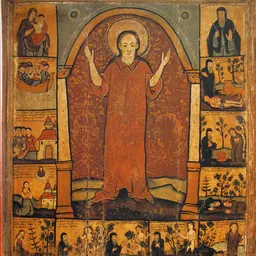

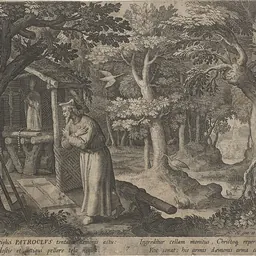
Contemporaries
People whose lives overlapped Menas of Egypt's


Frequently asked questions
Who was Menas of Egypt?
Egyptian saint, martyr and wonder-worker, said to have lived 285-ca. 309
When was Menas of Egypt born?
Menas of Egypt was born in 285 in Memphis.
When did Menas of Egypt die?
Menas of Egypt died in 309 in Phrygia.
What was Menas of Egypt's occupation?
Menas of Egypt was a hermit and soldier.
What nationality was Menas of Egypt?
Menas of Egypt was Roman.
Sources & further reading
Cite this page
APA: Biography.guide. (2026). Menas of Egypt. https://biography.guide/menas-of-egypt/
MLA: "Menas of Egypt." Biography.guide, https://biography.guide/menas-of-egypt/.
Chicago: "Menas of Egypt." Biography.guide. https://biography.guide/menas-of-egypt/.
Data last updated: 2026-09-20 · Spot an error? Report a correction.
Page generated 2026-09-27 05:23 UTC