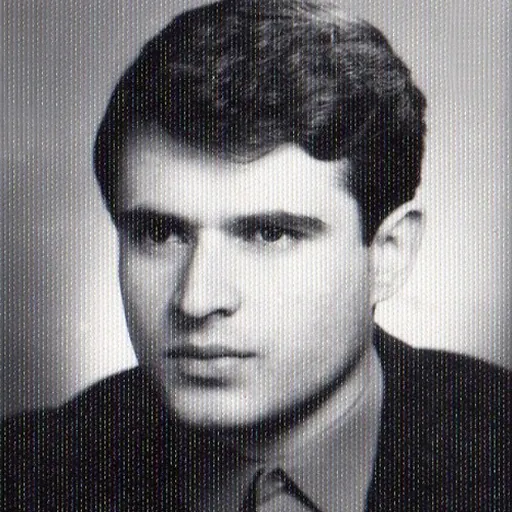
About Mehmed Karahyuseinov
Lived 1945 – 1990 (aged 44). Mehmed Karahyuseinov was a Bulgarian poet.
Mehmed Karahyuseinov (, , 5 October 1945 – 3 May 1990) was a Bulgarian poet, translator, artist, and dissenter of Turkish and Muslim background. On 2 February 1985, he committed an act of self-immolation in protest against the state policy of the forced assimilation of Turks and Muslims in communist Bulgaria.
Biography
Mehmed Karahyuseinov was born on 5 October 1945 in the then-mixed (Turkish and Bulgarian) village of Sevar, near the town of Kubrat in the Razgrad Province. The village was inhabited both by Sunnis and Alevis. The family professed the latter strain of Islam, namely, Alevism. His father was writer and politician Hasan Hyuseinov Karahyuseinov (Хасан Хюсеинов Карахюсеинов), also known under the literary pseudonym Sevarski. In 1985, a new Bulgarianized name was imposed on the father, namely, Asen Sevarski (Асен Севарски). The poet's mother, Zühre Karahuseinova (in Turkish; Зюхре Карахюсеинова Zyuhre Karahyuseinova in Bulgarian), was a homemaker. Mehmed had two siblings, younger sister Nesrin (Несрин) and elder brother Ahmed (Ахмед).
The family spoke Turkish at home and both parents were fully literate in this language. In the mid-1950s, the family moved to the country's capital of Sofia, where the father had been sent, in 1951, by the Bulgarian Communist Party to work in the minority Turkish-language periodical Yeni Işık (New Light, 1945-1985; bilingual, Turkish-Bulgarian after 1969) and mainstream Bulgarian newspapers (for instance, Rabotnichesko delo, Narodna mladezh, Trud). This rapid social advancement was triggered by Sevarski's meeting with the world-famous Turkish communist poet Nâzım Hikmet, who visited Bulgaria in September 1951. The communist authorities took note of Sevarski as an aspiring young Bulgarian Turkish intellectualist and loyal communist.
Mehmed learned Bulgarian at school. In Sofia he completed elementary school. Later, he attended the capital's so-called Russian Gymnasium, or Bulgaria's prestigious (elite) secondary school with the extended Russian language curriculum. At that time, it was the main language of international education and politics across the Soviet bloc. An excellent drawer, Mehmed applied to the National Academy of Art (Национална художествена академия), but without success. Subsequently, he graduated with an MA in Russian philology from Veliko Tarnovo University.
Mehmed continued to practice his Turkish language skills during summer vacations when his family would go back to their village house in Sevar. What is more, he honed his command of the standard form of this language by reading voraciously Turkish-language books from his father's home library. Meanwhile, during his youth in Sofia, Mehmed became fluent in Bulgarian. Then it was already the family's main language.
In the mid-1960s, Mehmed began to work as a printer and copy editor in the Turkish-language literary monthly Yeni Hayat (New Life, 1954-1985; bilingual, Turkish-Bulgarian, after 1970). For satisfying his artistic aspiration, Mehmed found employment as a stage designer and lighting engineer at the Boyana Cinema Center. was born, while the couple's son, Aspar, was born in 1990, a couple of months after the poet's death. amounting to a tenth of the population. Yet, he entered adult life at the turn of the 1970s, when the authorities rapidly dismantled the preominantly monolingual Turkish-medium monolingual system, pushing for full bilingualism in Bulgarian and Turkish. Bulgaria's Turks and Muslims were expected to be fully Bulgarianized in their language, identity (names) and culture. In the 1980s, monolingualism became the enforced norm, and beginning in 1985, officially no ethnolinguistic minorities remained in Bulgaria. The use of Turkish and of the term 'Turk' was banned. Hence, in the regime's mass media, the country's Turks had to be referred to as 'Bulgarian Mohammedans.' In the winter of 1984-1985, the names of 0.8 million Turks (Muslims) were Bulgarianized by force.
In addition to becoming a translator, editor, and artist, Mehmed began writing poetry in the mid-1960s. He wanted to publish his own poems, like his father did. He kept submitting material for as many as three collections of poetry, but the publishing house Narodna Mladezh Nation's Youth sat on these submissions for over three years and did not reply. Through backchannels, Mehmed was informed that, first, he would have to glorify Bulgaria and communism with some poems. Afterward, another requirement was added, namely, to write five poems praising the 'Revival Process,' or the forced assimilation (Bulgarianization) of the country's Turks and Muslims. Mehmed refused because serving propaganda was not a poet's tasks, whereas denying one's own identity and language was a moral and logical impossibility to him.
On Saturday, before leaving for the countryhouse, Sheri with Sevara visited her parents-in-law to ask if Mahmud had phoned as his custom was. Because he had not, they became frightened and rang up Pirogov Hospital. They learned the poet was hospitalized there.
Forced name change
Mehmed lost consciousness at the hospital entrance. He suffered burns to half of his body's surface. No one believed he would survive. He remained in coma for 20 days. The Bulgarian secret service DS guarded the patient, not allowing his family to visit him. Sheri was then pregnant with their son Aspar. The main objective was to prevent any leak to the international press about Mehmed's solitary and principled protest. For his unwavering loyalty to the communist authorities and the program of forced assimilation of the country's Turks and Muslims, Asen Sevarski was rewarded with his election to the Bulgarian Parliament for the 1986-1990 term.
Poet Mehmed Karahyuseinov survived but required numerous plastic surgeries. His looks remained off-putting. He put on a brave face but was plagued by ill health. In 1987, Mehmed underwent a lung surgery. He witnessed the 1989 ethnic cleansing of Bulgaria's Turks and Muslims and the end of communism in Bulgaria and across the Soviet bloc. Mehmed died in 1990 of lung cancer. Karahyuseinov's case falls into the latter category.
Like, the Bulgarian-Turkish poet, in 1978, Ukrainian Oleksa Hirnyk self-immolated alone to protest against Russification of Soviet Ukraine. Non-public acts of self-immolation were also committed by Crimean Tatar Musa Mamut (1978) and Kurd Mazlum Doğan (1982) against the policies of Russfication and Turkicization, respectively.
Non-public politically-motivated acts of self-immolation by women are rare. On the other hand, such instances may be under-recorded, due to the gender bias, which leads to classifying such cases as related to 'domestic' problems.
Survival after a non-public immolation is rare, but it happens, as for instance, in the cases of Mehdi Darini (2021) and Kazem Alinejad (2024), both recorded in Iran's notorious Evin Prison, Tehran. Unlike in Karahyuseinov's case, penitentiary survaillance under such controlled circumstances played a significant role in the two inmates' survival.
Don’t just read it —
keep it.
Full-length biographies made to live with: read them, listen on the way to work, watch them tonight.
- E-book
- Audio
- Video
Instant download · yours to keep · every purchase keeps this site free
Important facts
People in Mehmed Karahyuseinov's life
Named in this biography and alive at the same time
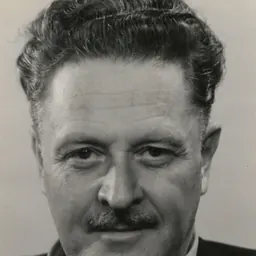
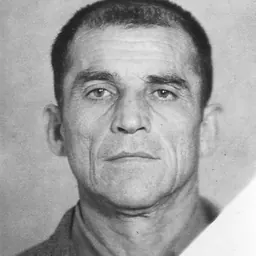


Related people
Same field, nearest in time
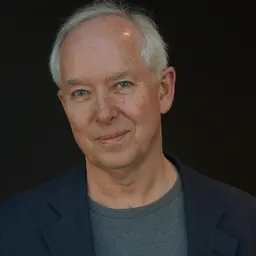

Contemporaries
People whose lives overlapped Mehmed Karahyuseinov's


Frequently asked questions
Who was Mehmed Karahyuseinov?
Bulgarian poet (1945-1990)
When was Mehmed Karahyuseinov born?
Mehmed Karahyuseinov was born on 5 October 1945 in Sevar.
When did Mehmed Karahyuseinov die?
Mehmed Karahyuseinov died on 3 May 1990 in Sofia.
What was Mehmed Karahyuseinov's occupation?
Mehmed Karahyuseinov was a poet.
What nationality was Mehmed Karahyuseinov?
Mehmed Karahyuseinov was Bulgarian.
Sources & further reading
· Wikipedia: Mehmed Karahyuseinov
· DBpedia: Mehmed Karahyuseinov
Cite this page
APA: Biography.guide. (2026). Mehmed Karahyuseinov. https://biography.guide/mehmed-karahyuseinov/
MLA: "Mehmed Karahyuseinov." Biography.guide, https://biography.guide/mehmed-karahyuseinov/.
Chicago: "Mehmed Karahyuseinov." Biography.guide. https://biography.guide/mehmed-karahyuseinov/.
Data last updated: 2026-09-23 · Spot an error? Report a correction.
Portrait: Wikimedia Commons · author & licence
Page generated 2026-09-27 05:08 UTC