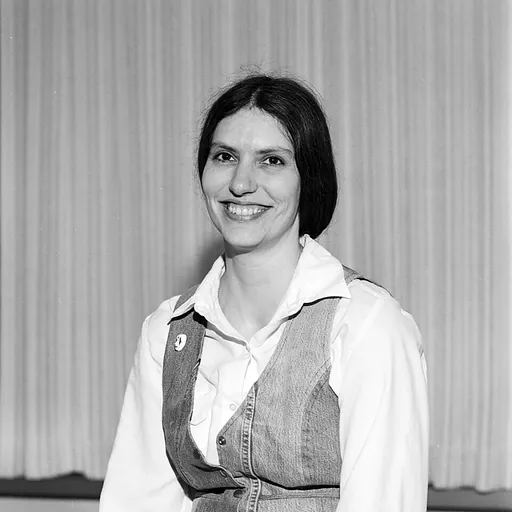
Megan Cornish
American labor activist, feminist, member of Radical Women and the Freedom Socialist Party, and one of the first female electricians for Seattle City Light (born 1947)
About Megan Cornish
Born 1947. Megan Cornish is an American trade unionist, activist and electrician.
Megan Cornish (born May 27, 1947) is an American socialist feminist and labor activist with the Freedom Socialist Party (FSP) and Radical Women, as well as a retired electrician with Seattle City Light. Cornish became an electrician after participating in an affirmative action program in 1974. Much of her activism work has focused on fighting workplace discrimination at Seattle City Light.
Early life Cornish was born on May 27, 1947, into a military family in Oswego, New York, and spent her childhood in various locations around the United States. Cornish says she was drawn to feminism after reading The Feminine Mystique, describing the book's effect on her as "like a bomb had been dropped." After graduating from Cornell University in 1969 with a BA in literature, Cornish moved to the Puget Sound region and worked at The Shelter Half, a GI coffeehouse, as part of the anti-war movement in Tacoma, Washington. It was at this time that Cornish became involved with the labor, anti-war, and desegregation movements. She was arrested while participating in a demonstration on behalf of the United Construction Workers Association. Her activism focused on creating employment opportunities in the trades for black men, and she later stated that "it never dawned on me that I may ever [seek trades employment]."
Involvement in Radical Women In her early years in the Pacific Northwest, Cornish was not a member of a formal group or organization, but she joined Radical Women in 1972 after being drawn to the group's intersectional approach, saying they "put it all [ Black civil rights, desegregation, anti-war, labor, women's liberation, etc.] together." Gordon Vickery, the former fire chief and superintendent of City Light, was exploring the possibility of running for mayor and hoped to cite the successful completion of a female ETT program as a cornerstone of his experience in future elections. To increase the chances of the program's success, Fraser was hired to redesign the ETT program in a way that did not duplicate failed affirmative action programs for black men at the company. Unlike in the previous programs, the female ETT members were given extra training and allowed to join the IBEW Local 77 with their own bargaining unit within the union.
Shortly before her training began, an eleven-day employee walkout in response to a new disciplinary code proposed by Vickery shut down City Light. Fraser participated in the walkout and organized other, mostly female, non-unionized clerical workers to join, whose support proved essential to the walkout's success. While this strengthened Fraser's relations with the IBEW and mostly male electrical workers, her relations with Vickery and management were left in shambles. Fraser was terminated the following year in an act seen by her supporters as retaliation.
Cornish was selected to be one of ten female ETTs out of an application pool of over 300. The sense of solidarity between workers as a result of the walkout caused Cornish and the other female ETTs to be received "mostly warmly." The shared resentment towards Vickery and management created a sense of unity amongst the mostly male electrical workers and reduced their hostility towards their new female coworkers. The severed relationship between Fraser and management, however, left the ETTs in a highly vulnerable position as management sought to retaliate against Fraser by damaging the ETT program.
Only a week after starting, Vickery cancelled the ETT training program and removed Fraser from her position as the training coordinator. Trainees were told on a Friday afternoon to report to field work the next week, where they made $1 less per hour than the other electrical helpers. In response, the ETTs filed a complaint with the City of Seattle Office of Women's Rights (OWR), stating that they were being denied the typical amount of training and pay reserved for male employees. Following an organizing meeting led by the walkout leaders that many of the trainees attended, Vickery called the women into his office and forced them to sign a loyalty oath pledging to fulfill their employment obligations without complaint. After a year of training, Cornish and seven of the other ETTs were laid off, along with Fraser. Like Fraser, the ETTs saw their terminations as politically motivated and retaliatory, and they added the layoffs to their OWR complaint. After the July 1976 victory in court, Cornish applied for a City Light apprenticeship as a lineworker alongside two other Radical Women members named Teri Bach and Heidi Durham. Vickery and other management, angered by the ruling, placed Cornish and her female colleagues into positions that were designed to be the most difficult to succeed in. Each of the women were placed into divisions that were known to be dangerous, which ultimately led to Durham falling from a pole and breaking her back in a near-fatal accident.
In addition to being antagonized by management, Cornish and the other women apprentices were also met with animosity from the male electrical workers that they worked alongside. In 1975, Local 77 of the IBEW staged a strike for 98 days, the longest public worker strike in Washington history. Despite the strike's longevity, the electricians were unable to gain the support of their larger union and they were forced to settle for an unfavorable contract. While the electricians did win a wage increase, the new contract also created harsher working conditions. Many male electricians, frustrated and demoralized by their strike's defeat, held resentment towards the former ETTs for winning their discrimination case, and these feelings were exploited by management to increase the sexist hostility of the work environments.
Despite having an affirmative action plan in place to diversify its workforce, Cornish, Bach, and Durham remained some of the only female electrical workers at City Light for nearly ten years. The three regularly gave public comment at Seattle City Council meetings to demand the hiring of more women and people of color at City Light. In the early 1980s, City Light hired its first new female electrical worker in nearly a decade. CERCL membership grew rapidly in the mid-1980s and pressured the HRD to investigate discrimination cases. In 1991, Cornish and Durham were jointly named Advocate of the Year by the Washington Women in the Trades. She remains an active member of Radical Women and the Freedom Socialist Party and continues to write for the Freedom Socialist newspaper. Cornish's organizing activities at City Light are the subject of the book High Voltage Women published in 2019.
Don’t just read it —
keep it.
Full-length biographies made to live with: read them, listen on the way to work, watch them tonight.
- E-book
- Audio
- Video
Instant download · yours to keep · every purchase keeps this site free
Important facts
People in Megan Cornish's life
Named in this biography and alive at the same time


Related people
Same field, nearest in time




Contemporaries
People whose lives overlapped Megan Cornish's


Frequently asked questions
Who is Megan Cornish?
American labor activist, feminist, member of Radical Women and the Freedom Socialist Party, and one of the first female electricians for Seattle City Light (born 1947)
When was Megan Cornish born?
Megan Cornish was born on 27 May 1947.
What is Megan Cornish's occupation?
Megan Cornish is a trade unionist, activist and electrician.
What nationality is Megan Cornish?
Megan Cornish is American.
Sources & further reading
Cite this page
APA: Biography.guide. (2026). Megan Cornish. https://biography.guide/megan-cornish/
MLA: "Megan Cornish." Biography.guide, https://biography.guide/megan-cornish/.
Chicago: "Megan Cornish." Biography.guide. https://biography.guide/megan-cornish/.
Data last updated: 2026-09-22 · Spot an error? Report a correction.
Portrait: Wikimedia Commons · author & licence
Page generated 2026-09-27 05:03 UTC