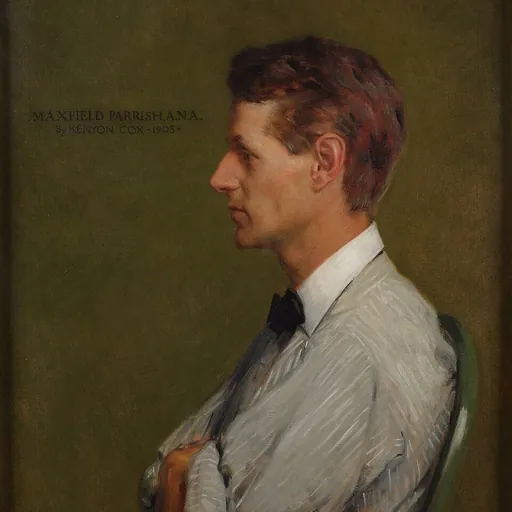
About Maxfield Parrish
Lived 1870 – 1966 (aged 95). Maxfield Parrish was an American painter, illustrator and designer.
Maxfield Parrish (July 25, 1870 – March 30, 1966) was an American painter and illustrator active in the first half of the 20th century. His works featured distinctive saturated hues and idealized neo-classical imagery. The National Museum of American Illustration deemed his painting Daybreak to be the most successful art print of the 20th century.
Early life and education Maxfield Parrish was born in Philadelphia to painter and etcher Stephen Parrish and Elizabeth Bancroft. He was raised in a Quaker society. As a child he began drawing for his own amusement, showed talent, and his parents encouraged him. Between 1884 and 1886, his parents took Parrish to Europe, where he toured England, Italy, and France, was exposed to architecture and the paintings by the old masters, and studied at the Paris school of Dr. Kornemann.
He attended the Haverford School and later studied architecture at Haverford College for two years beginning in 1888.
Career "The Lantern Bearers" (1908), created for Collier's magazine, shows Parrish's use of glazes and saturated color in an evocative night scene. Crystal Bridges Museum of American Art
Parrish entered into an artistic career that lasted for more than half a century, and which helped shape the Golden Age of illustration and American visual arts. During his career, he produced almost 900 pieces of art including calendars, greeting cards, and magazine covers. Parrish's early works were mostly in black and white.
In 1895, his work was on the Easter edition of Harper's Bazaar. He also did work for other magazines like Scribner's Magazine. One of his posters for The Century Magazine was published in Les Maîtres de l'Affiche. He also illustrated a children's book in 1897, Mother Goose in Prose and such traditional works as Arabian Nights in 1909. Books illustrated by Parrish are featured in A Wonder Book and Tanglewood Tales in 1910, The Golden Treasury of Songs and Lyrics in 1911, and The Knave of Hearts in 1925.
Parrish was earning over $100,000 per year by 1910, when homes could be bought for $2,000.
The Dinky Bird, an illustration from Poems of Childhood by Eugene Field (1904), exemplifies Parrish's characteristic use of androgynous figures.
In 1910 Parrish received a commission to create 18 panels to go into the Girls Dining Room of the Curtis Publishing Company building, then under construction at 6th and Walnut in Philadelphia. It would take him six years to finish the monumental project. In 1914, before the murals were completed, Curtis commissioned Parrish to design a mural for the building lobby. Tiffany Studios constructed a favrile glass mosaic mural titled The Dream Garden, which is now a part of Pennsylvania Academy of the Fine Arts collection.
Parrish worked with popular magazines throughout the 1910s and 1920s, including Hearst's and Life. He also created advertising for companies like Wanamaker's, Edison-Mazda Lamps, Colgate, and Oneida Cutlery. Parrish worked with Collier's from 1904 to 1913. From 1918 to 1934, Parrish worked on calendar illustrations for General Electric.
In 1931, Parrish declared to the Associated Press, "I'm done with girls on rocks", and opted instead to focus on landscapes. By 1935, Parrish exclusively painted landscapes.
Technique
Parrish's art is characterized by vibrant colors; the color Parrish blue was named after him. He achieved such luminous color through glazing. This process involves applying layers of translucent paint and oil medium (glazes) over a base rendering. Parrish usually used a blue and white monochromatic underpainting.
His paintings/illustrations were unique in that they depicted a highly idealized fantasy world that was accessible to the general public. Although one would rarely see a glimpse of that color in reality, Parrish was and still is linked with a particularly bright shade of blue that coated the skies of his landscapes. He invented a time-consuming process that involved a cobalt blue base and white undercoating, which he then coated with a series of thin alternating coatings of oil and varnish. When exposed to ultraviolet light, the dammar gum resins that Parrish employed fluoresce a shade of yellow-green, giving the painted sky its distinctive turquoise tint.
Parrish used many other innovative techniques in his paintings. He would take pictures of models in black and white geometric prints and project the image onto his works. This technique allowed for his figures to be clothed in geometric patterns, while accurately representing distortion and draping. Parrish would also create his paintings by taking pictures, enlarging, or projecting objects. He would cut these images out and put them onto his canvas. He would later cover them with clear glaze. Parrish's technique gave his paintings a more three-dimensional feel.
The outer proportions and internal divisions of Parrish's compositions were carefully calculated in accordance with geometric principles such as root rectangles and the golden ratio. In this Parrish was influenced by Jay Hambidge's theory of Dynamic Symmetry.
Cultural influences
Parrish's works continue to influence pop culture. Daybreak is seen in a treehouse in Terrence Malick's 1973 film Badlands. The cover of the 1985 Bloom County cartoon collection Penguin Dreams and Stranger Things comprises elements of Daybreak, The Garden of Allah, and The Lute Players. The poster for The Princess Bride was inspired by Daybreak.
The 1986 television commercial announcing Nestle's Alpine White chocolate bar, entitled "Sweet Dreams," staged live-action representations of Parrish's Ecstasy, Dinky Bird, and Daybreak.
The Elton John album Caribou has a Parrish-inspired background. The Moody Blues album The Present uses a variation of the Parrish painting Daybreak for its cover. In 1984, Dali's Car, the British New Wave project of Peter Murphy and Mick Karn, used Daybreak as the cover art of their only album, The Waking Hour. The Irish musician Enya has been inspired by the works of Parrish. The cover art of her 1995 album The Memory of Trees is based on his painting The Young King of the Black Isles. A number of her music videos include Parrish imagery, including "Caribbean Blue".
In the 1995 music video "You Are Not Alone", Michael Jackson and his then wife Lisa Marie Presley appear semi-nude in emulation of Daybreak. The Italian singer-songwriter Angelo Branduardi's fourth album La pulce d'acqua of 1977 featured nine inlay full colour print reproductions of painter Mario Convertino's works; one of them is clearly inspired by Parrish's Stars.
The original painting of Daybreak sold in 2006 for US$7.6 million. The National Museum of American Illustration claims the largest body of his work in any collection, with sixty-nine works by Parrish including the 1910 Curtis Publishing Company's 18-panel mural commission. Some of his works are located at the Hood Museum of Art in Hanover, New Hampshire, and a few at the Metropolitan Museum of Art in New York. The San Diego Museum of Art organized and toured a collection of his work in 2005.
The American painter Norman Rockwell referred to Parrish as "my idol".
In Alan Moore's 32-issue comic series Promethea, the cover of issue #13 was noted by the artist on the cover as "after Parrish", imitating his style.
Personal life
Parrish developed arthritis. He accepted his last commission in the late 1950s. By 1960 his arthritis prevented him from painting. He died on March 30, 1966, in Plainfield, New Hampshire, at the age of 95.
Works Book illustrator Baum, L. F. – Mother Goose in Prose, Way & Williams, 1897 Read, O. – Bolanyo (cover), Way & Williams, 1897 Butler, W. M. – Whist Reference Book (frontispiece), Yorston, 1898 Grahame, K. – The Golden Age, Lane, 1900 Irving, W. – Knickerbocker's History of New York, Russell, 1900 Grahame, K. – Dream Days, Lane, 1902 Carryl, G. W. – The Garden of Years (frontispiece), Putnam, 1904 Field, E. – Poems of Childhood, Scribner & Sons, 1904 Wharton, E. – Italian Villas and their Gardens, Century, 1904 Smith, A. C. – The Turquoise Cap, and The Desert, Scribner & Sons, 1905 Wiggin, K. D. – The Arabian Nights, Scribner & Sons, 1909 Hawthorne, N. – A Wonder Book and Tanglewood Tales, Duffield, 1910 Scudder, H. – The Children's Book (cover), Houghton Mifflin, 1910 Hawthorne, H. – Lure of the Garden, Century, 1911 Palgrave, F. T. – The Golden Treasury, Duffield, 1911 Saunders, L. – The Knave of Hearts, Scribner & Sons, 1925
Muralist
Old King Cole – St. Regis Hotel, New York, 1906 Pied Piper – Palace Hotel, San Francisco, 1909 The Dream Garden - Glass mosaic executed by Louis Comfort Tiffany. Height 16' width 50′. Curtis Center, Philadelphia, 1916.
Don’t just read it —
keep it.
Full-length biographies made to live with: read them, listen on the way to work, watch them tonight.
- E-book
- Audio
- Video
Instant download · yours to keep · every purchase keeps this site free
Important facts
People in Maxfield Parrish's life
Named in this biography and alive at the same time







Related people
Same field, nearest in time


Contemporaries
People whose lives overlapped Maxfield Parrish's



Frequently asked questions
Who was Maxfield Parrish?
American painter and illustrator (1870-1966)
When was Maxfield Parrish born?
Maxfield Parrish was born on 25 July 1870 in Philadelphia.
When did Maxfield Parrish die?
Maxfield Parrish died on 30 March 1966 in New Hampshire, Plainfield.
What was Maxfield Parrish's occupation?
Maxfield Parrish was a painter, illustrator and designer.
What nationality was Maxfield Parrish?
Maxfield Parrish was American.
Sources & further reading
Cite this page
APA: Biography.guide. (2026). Maxfield Parrish. https://biography.guide/maxfield-parrish/
MLA: "Maxfield Parrish." Biography.guide, https://biography.guide/maxfield-parrish/.
Chicago: "Maxfield Parrish." Biography.guide. https://biography.guide/maxfield-parrish/.
Data last updated: 2026-09-23 · Spot an error? Report a correction.
Portrait: Wikimedia Commons · author & licence
Page generated 2026-09-27 05:05 UTC