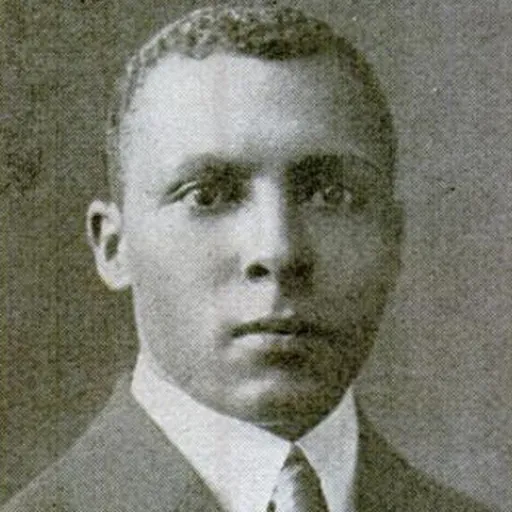
About Max Yergan
Lived 1892 – 1975 (aged 82). Max Yergan was an American civil rights advocate and missionary.
Max Yergan (July 19, 1892 – April 11, 1975) was an American activist notable for being a Baptist missionary for the YMCA, then a Communist working with Paul Robeson, and finally a staunch anti-Communist who complimented the government of apartheid-era South Africa and colonial dominion over Africa, particularly in the case of Portuguese Angola. He was a mentor of Govan Mbeki, who later achieved distinction in the African National Congress. He served as the second president of the National Negro Congress, a coalition of hundreds of African-American organizations created in 1935 by religious, labor, civic and fraternal leaders to fight racial discrimination, establish relations with black organizations throughout the world, and oppose the deportation of black immigrants. Along with Paul Robeson, he co-founded the International Committee on African Affairs in 1937, later the Council on African Affairs.
Youth Max Yergan was born on July 19, 1892, in Raleigh, North Carolina in his grandfather's house to mother Lizzie Yeargan, daughter of Frederick Yeargan. Fred was the source of inspiration for much of Max Yergan's life, as a board member at Shaw Institute and a member of the Baptist church in Raleigh, as well as a man deeply interested in his African heritage. Yergan attended St. Ambrose Episcopal Parish School as a child, and then moved on to attend Shaw University in both the preparatory and college branches. It was there at Shaw that Yergan discovered the YMCA, and in 1916, he joined a missionary trip to India, a trip that would greatly affect the rest of his adult life.
Members of an anti-color line delegation to Major League Baseball, December 3, 1943Left to right: Max Yergan, Robert Murphy, Peter V. Cacchione, Benjamin J. Davis Jr., C. B. Powell, Ira F. Lewis, Paul Robeson, and Adam Clayton Powell Jr.
On his return to the United States, Yergan became the first African-American faculty member ever hired at one of New York City's public colleges, City College of New York, teaching the course "Negro History and Culture" in the fall of 1937. It was the first time this course was offered within the City Colleges of New York. During the Rapp-Coudert hearings, informers reported that his class was "liberal and progressive." Yergan was denied re-appointment and dismissed for his politics. In 1941, he ran for New York City Council on the American Labor Party ticket, but withdrew at the last minute and endorsed Adam Clayton Powell Jr., who won.
The Cold War led him to become disillusioned with Communism and ultimately to become strongly hostile to Communism. In 1948, Yergan was ousted as the director of Council on African Affairs following disputes with other members, causing his turn to the right. In 1952, he spoke against Communism on a visit to South Africa at the Bantu Men's Social Center in Johannesburg, noting the links between the main anti-apartheid group, the African National Congress, and the South African Communist Party. In 1955, Yergan again visited South Africa where he praised apartheid and denied that South African blacks were suffering from apartheid. The same year, he also visited the Portuguese colony of Angola, where he praised Portuguese rule as "just and efficient". Yergan was recruited by a conservative activist Marvin Liebman who founded the ACAKFF and wanted a black man as its president to offset charges of racism given accusations by liberals and communists that Katanga was a "sham". The mercenaries were known to the Congolese as "les affreux" ("the frightful ones") on account of their brutality to blacks. In 1964, Yergan praised aspects of the South African governments "separate development" plan. In 1966, he became co-chairman together with William Rusher of the conservative American-African Affairs Association, which lobbied the United States to recognize the white minority government of Rhodesia. The driving force and dominant personality behind the American Committee for Aid to Katanga Freedom Fighters and the American-African Affairs Association was Liebman, and notably both groups had virtually identical letter-heads, the same mailing lists, the same boards, and the same address in New York, 79 Madison Avenue, which was also the headquarters of Marvin Liebman Associates.
His papers are held at Howard University.
Don’t just read it —
keep it.
Full-length biographies made to live with: read them, listen on the way to work, watch them tonight.
- E-book
- Audio
- Video
Instant download · yours to keep · every purchase keeps this site free
Important facts
People in Max Yergan's life
Named in this biography and alive at the same time



Related people
Same field, nearest in time


Contemporaries
People whose lives overlapped Max Yergan's

Frequently asked questions
Who was Max Yergan?
American activist
When was Max Yergan born?
Max Yergan was born on 19 July 1892 in Raleigh.
When did Max Yergan die?
Max Yergan died on 11 April 1975.
What was Max Yergan's occupation?
Max Yergan was a civil rights advocate and missionary.
What nationality was Max Yergan?
Max Yergan was American.
Sources & further reading
Cite this page
APA: Biography.guide. (2026). Max Yergan. https://biography.guide/max-yergan/
MLA: "Max Yergan." Biography.guide, https://biography.guide/max-yergan/.
Chicago: "Max Yergan." Biography.guide. https://biography.guide/max-yergan/.
Data last updated: 2026-09-23 · Spot an error? Report a correction.
Portrait: Wikimedia Commons · author & licence
Page generated 2026-09-27 05:05 UTC