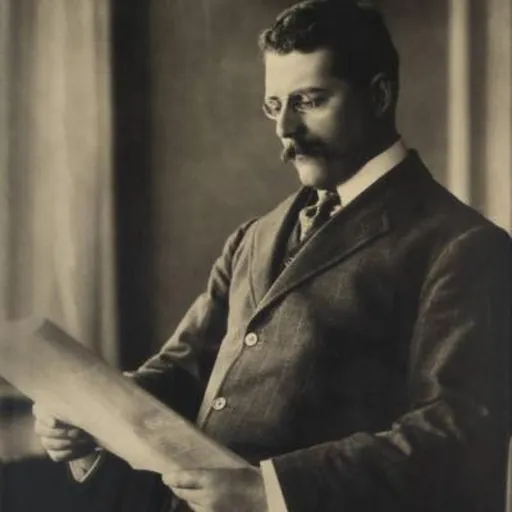
About Max Muspratt
Lived 1872 – 1934 (aged 62). Max Muspratt was a British chemist and politician.
Sir Max Muspratt, 1st Baronet (3 February 1872 – 20 April 1934) was a British chemist and a politician in the city of Liverpool, England.
Early life and education He was born at Seaforth Hall, Seaforth, Lancashire, the son of Edmund Knowles Muspratt and his wife Frances Jane Baines. He was one of eight children and a brother of Suffragists Nessie Stewart-Brown and Julia Solly. He was an uncle of Nelia Penman, who served as President of the Women's Liberal Federation. The Muspratt family were originally from Dublin but moved to Liverpool in 1822 when James Muspratt, the father of Edmund, established a chemical factory in Vauxhall Road.
Muspratt was educated at a private school in Hemel Hempstead and at Clifton College before studying industrial chemistry at Zürich Polytechnic.
United Alkali Muspratt joined the United Alkali Company in 1892 (the firm had been founded by his father), becoming a director in 1901 and its chairman from 1914. In 1926 the United Alkali Company merged with three other companies to form Imperial Chemical Industries (ICI) and Muspratt was a director from its founding until his death in 1934. He was also a director of the International Automatic Telephone Company. He was a member of the Society of Chemical Industry from 1894, becoming its Vice–President from 1904 to 1906 and again from 1921 to 1924. From 1924 he was chairman of the Association of British Chemical Manufacturers and from 1926 to 1927 president of the Federation of British Industries.
Political career
Muspratt was a Liberal and served on the Liverpool City Council from 1904. At the January 1910 general election he was returned to the House of Commons as Member of Parliament (MP) for Liverpool Exchange, but was not re-elected at the December 1910 general election, and was defeated in the 1911 Bootle by-election. He left the Liberals for the Conservative Party in 1926.
During the First World War, Muspratt served as Lord Mayor of Liverpool from 1916 to 1917. He advised the Ministry of Munitions about industrial chemical matters, particularly in the supply of sulphuric acid.
He died on 20 April 1934, the day after undergoing an operation for "internal trouble." The baronetcy became extinct on his death.
Don’t just read it —
keep it.
Full-length biographies made to live with: read them, listen on the way to work, watch them tonight.
- E-book
- Audio
- Video
Instant download · yours to keep · every purchase keeps this site free
Important facts
People in Max Muspratt's life
Named in this biography and alive at the same time



Related people
Same field, nearest in time




Contemporaries
People whose lives overlapped Max Muspratt's



Frequently asked questions
Who was Max Muspratt?
British politician (1872-1934)
When was Max Muspratt born?
Max Muspratt was born on 3 February 1872 in Seaforth.
When did Max Muspratt die?
Max Muspratt died on 20 April 1934 in Liverpool.
What was Max Muspratt's occupation?
Max Muspratt was a chemist and politician.
What nationality was Max Muspratt?
Max Muspratt was British.
Sources & further reading
Cite this page
APA: Biography.guide. (2026). Max Muspratt. https://biography.guide/max-muspratt/
MLA: "Max Muspratt." Biography.guide, https://biography.guide/max-muspratt/.
Chicago: "Max Muspratt." Biography.guide. https://biography.guide/max-muspratt/.
Data last updated: 2026-09-24 · Spot an error? Report a correction.
Portrait: Wikimedia Commons · author & licence
Page generated 2026-09-27 05:09 UTC