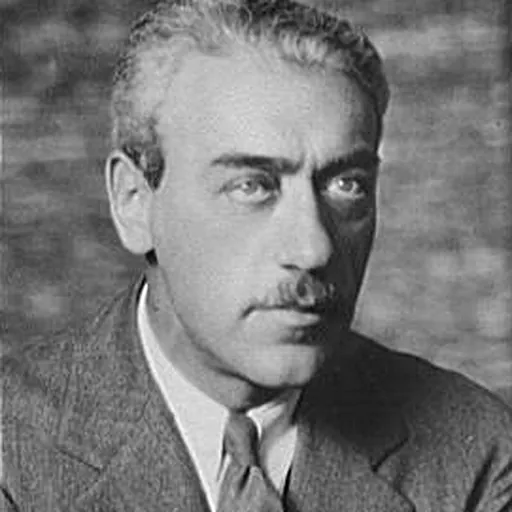
About Mauritz Stiller
Lived 1883 – 1928 (aged 45). Mauritz Stiller was a Swedish and Russian film director, screenwriter and actor.
Mauritz Stiller (born Moshe Stiller, 17 July 1883 – 8 November 1928) was a Swedish-Finnish film director of Jewish origin, best known for discovering Greta Garbo and bringing her to America. Stiller was a pioneer of the Swedish film industry, writing and directing many short films from 1912. When Metro-Goldwyn-Mayer invited him to Hollywood as a director, he arrived with his new discovery Greta Gustafsson, whose screen name Greta Garbo is believed to have been his suggestion. After frequent disagreements with studio executives at MGM and Paramount Pictures, Stiller returned to Sweden, where he died soon afterward.
Early life Moshe Stiller was born on 17 July 1883 in Helsinki. His family was of Ashkenazi Jewish heritage, having lived in Russia and Poland before settling in Finland, these countries being ruled by the Russian Empire at that time. After his father's death when he was four, his mother committed suicide. He was raised by family friends. From an early age, Stiller was interested in acting. His talents did not go unnoticed, and soon Stiller was offered the opportunity to practise and display his acting skills in the theatres of Helsinki and Turku in Finland.
Drafted into the army of Czar Nicholas II — Finland was at the time the Grand Duchy of Finland, an autonomous state ruled by the Russian Czars — rather than report for duty he fled the country and settled in Sweden. He became a Swedish citizen in 1921.
Career By 1912, Stiller had become involved with Sweden's rapidly developing silent film industry. He began by writing scripts, acting and directing in short films but within a few years gave up acting to devote his time to writing and directing. He was soon directing feature-length productions, and his 1918 work Thomas Graals bästa barn (Thomas Graal's First Child), starring Karin Molander, and with Victor Sjöström in the leading role, received much acclaim.
By 1920, having directed more than 35 films, including Sir Arne's Treasure and Erotikon, Stiller was a leading figure in Swedish filmmaking. He also directed The Blizzard, starring a young Einar Hanson and based on the Selma Lagerlöf novel En herrgårdssägen (English: The Tale of a Manor).
Stiller and Garbo
At the Royal Dramatic Theatre in Stockholm, he met a young actress named Greta Gustafsson whom he cast in an important but secondary role in his film, Gösta Berlings saga (The Atonement of Gosta Berling), and who some have said gave her the stage name Greta Garbo. For Stiller, the screen presence of the 20-year-old actress led to him bringing her and Hanson to the United States after he accepted an offer from Louis B. Mayer to direct for Metro-Goldwyn-Mayer.
In Hollywood, Stiller was assigned to direct The Temptress (1926), Garbo's second film with MGM, but he could not deal with the studio structure. After repeated arguments with MGM executives, he was replaced on the film by Fred Niblo, and his contract with the studio terminated. Stiller immediately was hired by Paramount Pictures, where he made three successful films, but he was let go a second time while directing his fourth film because of his continuing disagreements with studio bosses.
Personal life Stiller identified as homosexual. He was, as critic Richard Dyer said, flamboyantly so, and his most public friendships were with other gay men in Stockholm and Berlin.
Being homosexual was an asset in European cultural circles at the time, as it was associated with fine art. He was Asther's first lover.
Stiller had no romantic or sexual relationship with Greta Garbo. Yet, the American press persisted in saying that Stiller was Garbo's "first and greatest love", omitting to tell the public about Stiller's homosexuality.
Death and legacy Stiller returned to Sweden in 1927 and died on 8 November 1928 from pleurisy at the age of 45. He was interred in the Norra begravningsplatsen in Stockholm.
Stiller's contribution to the motion picture industry was recognised in 1960 with a star on the Hollywood Walk of Fame at 1713 Vine Street. Originally his star was listed erroneously as "Maurice Diller"
A theatre in Filmhuset, home of the Swedish Film Institute, was named in his honour as "Bio Mauritz".
In Kristianstad, a monument was erected in his honour.
In the Badehotellet episode "Feriebarnet", Kitty tells Frigh that Stiller wrote her a letter and wants to take her to Hollywood. When Frigh admits he doesn't know who he is, Kitty replies that Stiller discovered Garbo and shows him a newspaper clipping of the photo of Garbo and Stiller posing on the deck of the SS Drottningholm.
Filmography YearFilmCredited as DirectorWriterActor Role 1912 The Gardener (Trädgårdsmästaren) Passenger 1912 Mor och dotter Raoul de Saligny 1912 I lifvets vår von Plæin 1912 Den tyranniske fästmannen Elias Pettersson 1912 De svarta maskerna 1913 Vampyren 1913 På livets ödesvägar 1913 När larmklockan ljuder 1913 När kärleken dödar 1913 Mannekängen 1913 The Conflicts of Life (Livets konflikter) 1913 Brother Against Brother (Gränsfolken) 1913 En pojke i livets strid 1913 Den okända 1913 Den moderna suffragetten 1913 Barnet 1914 Stormfågeln 1914 När svärmor regerar Elias 1914 Kammarjunkaren 1914 För sin kärleks skull 1914 Det röda tornet 1914 Bröderna 1915 När konstnärer älska 1915 Minlotsen 1915 Mästertjuven 1915 Madame de Thèbes 1915 Playmates (Lekkamraterna) 1915 Hans hustrus förflutna 1915 Hans bröllopsnatt 1915 Hämnaren 1915 Dolken 1916 The Wings (Vingarne) Film director 1916 Lyckonålen 1916 Kärlek och journalistik 1916 Kampen om hans hjärta 1916 Balettprimadonnan 1917 Thomas Graals bästa film 1917 Alexander den store 1918 Thomas Graals bästa barn 1919 Song of the Scarlet Flower (Sången om den eldröda blomman) 1919 Sir Arne's Treasure (Herr Arnes pengar) 1920 Fiskebyn 1920 Erotikon 1921 Johan 1921 Guarded Lips (De landsflyktige) 1923 The Blizzard (Gunnar Hedes saga) 1924 The Saga of Gösta Berling (Gösta Berlings saga) 1926 The Temptress replaced by Fred Niblo 1927 The Woman on Trial 1927 Hotel Imperial 1927 Barbed Wire 1928 Street of Sin
Don’t just read it —
keep it.
Full-length biographies made to live with: read them, listen on the way to work, watch them tonight.
- E-book
- Audio
- Video
Instant download · yours to keep · every purchase keeps this site free
Important facts
People in Mauritz Stiller's life
Named in this biography and alive at the same time




Related people
Same field, nearest in time

Contemporaries
People whose lives overlapped Mauritz Stiller's


Frequently asked questions
Who was Mauritz Stiller?
Swedish film director (1883–1928)
When was Mauritz Stiller born?
Mauritz Stiller was born on 17 July 1883 in Helsinki.
When did Mauritz Stiller die?
Mauritz Stiller died on 18 November 1928 in Stockholm, Gustav Vasa parish.
What was Mauritz Stiller's occupation?
Mauritz Stiller was a film director, screenwriter and actor.
What nationality was Mauritz Stiller?
Mauritz Stiller was Swedish and Russian.
Sources & further reading
Cite this page
APA: Biography.guide. (2026). Mauritz Stiller. https://biography.guide/mauritz-stiller/
MLA: "Mauritz Stiller." Biography.guide, https://biography.guide/mauritz-stiller/.
Chicago: "Mauritz Stiller." Biography.guide. https://biography.guide/mauritz-stiller/.
Data last updated: 2026-09-22 · Spot an error? Report a correction.
Page generated 2026-09-27 05:09 UTC