
About Maurice Kouandété
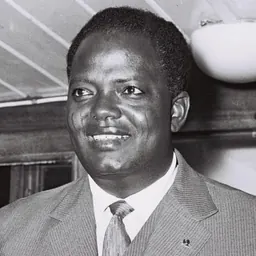
Lived 1932 – 2003 (aged 70). Maurice Kouandété was a Beninese and French politician, soldier, military personnel, minister and officer (armed forces).
Iropa Maurice Kouandété (22 September 1932 – 7 April 2003) was a Beninese military officer and politician. Kouandété enrolled in the army in his late teens. Over the years, he became popular among junior soldiers in the north and gained the contempt of those in the south. Jim Hoagland of The Washington Post described Kouandété as a "moody, brilliant and highly ambitious soldier". He was a cousin of Mathieu Kérékou, who also become president of Benin. In his late teens, Kouandété enrolled in the army, and went to Ecole Militaire and Saint Cyr in France . Jim Hoagland of The Washington Post described Kouandété as a "moody, brilliant and highly ambitious soldier".
Kouandété's rose to power during a period of intense regionalism in Dahomey. They were spurred by the historical resentment shared by members of the former kingdoms of Abomey, Porto Novo, and disorganised tribes from the north. Its result led to the creation of three de facto tribal zones: the north, southeast, and southwest. This regionalism permeated into the armed forces, compounded by divisions of officers into cliques based on education.
Despite Kouandété's disdain for him, Soglo appointed the former to his palace guard in 1965. He was removed the next year after the president asserted Kouandété falsified reports in opposition to Soglo. Kouandété was appointed Alley's chef de cabinet in 1967 Two days later, in an attempt to fix the crisis in Dahomey, Kouandété appointed the well-liked Alley provisional president, whom Kouandété previously put under house arrest. Kouandété served as prime minister thereafter. By that time, Alley became little more than Kouandété's mouthpiece. This transition of power was enacted mostly to improve relations with the French, as Zinsou was popular among them. Zinsou was not expected to be chosen president, as he believed that Kouandété's coup was an illegal matter. He also condemned Gnassingbé Eyadéma of Togo, whom Kouandété regarded highly. In September, Alley was forced to resign his position as chief of staff and was released from the military. Kouandété was chosen as the next chief of staff.
1969 coup d'état In 1969, Kouandété discovered that Zinsou planned to replace him and cut the size of the armed forces. On 10 December 1969 Zinsou was overthrown by Kouandété. Zinsou was met with soldiers firing automatic guns when he arrived at his presidential palace. The former president escaped with an injury, though two of his bodyguards were murdered. Kouandété justified the coup by saying that Zinsou failed to reconcile the country.
The military, however, did not recognize Kouandété. Because the two men could stop quarreling, a Military Directorate was established with Paul Emile de Souza as its chairman, Kouandete a member, and Col. Benoit Sinzogan of the Gendarmie the occupant of the third seat. An election was held on 28 March 1970 to determine the true president. This time, veteran politicians Hubert Maga, Sourou-Migan Apithy, and Justin Ahomadégbé-Tomêtin were allowed to campaign in this election, and they took advantage of the opportunity. Violent outbursts accompanied these campaigns; unvalidated reports state that six people were killed were wounded at incidents in Parakou on the eve of the elections. The elections were later annulled, and a presidential council, which consisted of Maga, Ahomadégbé-Tomêtin, and Apithy, was set up on 7 May with a presidency that changed every two years. Maga inaugurated this system for the first two years. Kouandété had his chief of staff status revoked and was forced to be an aide of Alley, who was recently let out of jail. The former was also appointed Deputy Secretary of National Defense.
1972 coup attempt
Kouandété attempted to usurp to power again at dawn on 23 February. When he first heard of the mutiny, Ahomadégbé-Tomêtin believed it to be an attempt by Maga to retain power. Leading the Ouidah garrison, Kouandété also attempted to take over government buildings and murder de Souza. During the operation, assailant Major Moumouni was mortally wounded by de Souza's bullets. The plot was foiled, although Maga cancelled a visit to France to attend to the matter at hand. A 12-member military commission soon discovered another plot that would have been undertaken simultaneous to Kouandété's.
The organization of a military trial was slow, and it did not begin until 12 May. The court tried 21 men in addition to Kouandété, The punishments were announced on 16 May. Kouandété received the death penalty, as did Captains Josué and Glélé, Quartermaster Sergeant Agboton, and a corporal and a sergeant in absentia. Lesser sentences were handed to five men who were given life imprisonment, two who would serve 20 years in prison, another with 15 years, two with ten, and two with five. An additional four were acquitted. The sentences were never carried out; the jurors believed that Kouandété would seize power in another coup. He was immediately pardoned when Major Mathieu Kérékou seized power on 26 October 1972.
Later life and death After his pardon Kouandété retired from military life.
Don’t just read it —
keep it.
Full-length biographies made to live with: read them, listen on the way to work, watch them tonight.
- E-book
- Audio
- Video
Instant download · yours to keep · every purchase keeps this site free
Important facts
People in Maurice Kouandété's life
Named in this biography and alive at the same time



Related people
Same field, nearest in time





Contemporaries
People whose lives overlapped Maurice Kouandété's

Frequently asked questions
Who was Maurice Kouandété?
Military Officer (1932-2003)
When was Maurice Kouandété born?
Maurice Kouandété was born on 22 September 1932 in Natitingou.
When did Maurice Kouandété die?
Maurice Kouandété died on 7 April 2003 in Natitingou.
What was Maurice Kouandété's occupation?
Maurice Kouandété was a politician, soldier, military personnel, minister and officer (armed forces).
What nationality was Maurice Kouandété?
Maurice Kouandété was Beninese and French.
Sources & further reading
· Wikipedia: Maurice Kouandété
Cite this page
APA: Biography.guide. (2026). Maurice Kouandété. https://biography.guide/maurice-kouandete/
MLA: "Maurice Kouandété." Biography.guide, https://biography.guide/maurice-kouandete/.
Chicago: "Maurice Kouandété." Biography.guide. https://biography.guide/maurice-kouandete/.
Data last updated: 2026-09-20 · Spot an error? Report a correction.
Page generated 2026-09-27 05:33 UTC