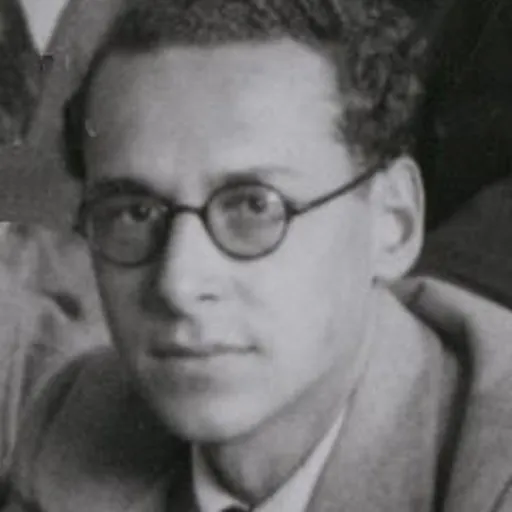
About Maurice Goldhaber
Lived 1911 – 2011 (aged 100). Maurice Goldhaber was an American physicist, nuclear physicist and university teacher, known for Helicity (particle physics) and Neutrino.
Maurice Goldhaber (April 18, 1911 – May 11, 2011) was an American physicist and director of Brookhaven National Laboratory. He is known for the discovery that deuteron is made of a neutron and a proton, for first measuring the mass of the neutron and for the Goldhaber experiment that first determined that neutrinos have negative helicity.
Early life and childhood He was born on April 18, 1911, in Lemberg, Austria, now called Lviv, Ukraine to a Jewish family. His great-grandfather Gershon Goldhaber was a rabbi.
After beginning his physics studies at the University of Berlin, he earned his doctorate at Magdalene College, Cambridge in 1936.
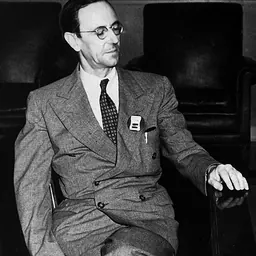
Career In 1934, working at the Cavendish Laboratory in Cambridge, England he and James Chadwick, through what they called the nuclear photo-electric effect, established that the neutron has a great enough mass over the proton to decay. They showed that the neutron was a new nucleon and measured for the first time the mass of the neutron.
He moved to the University of Illinois in 1938. In 1948, with his wife Gertrude Scharff-Goldhaber, he devised an experiment to confirm that beta particles are identical to electrons based on Pauli exclusion principle.
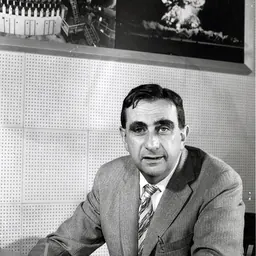
He joined Brookhaven National Laboratory in 1950. With Edward Teller he proposed that the so-called "giant-dipole nuclear resonance" was due to the neutrons in a nucleus vibrating as a group against the protons as a group (Goldhaber–Teller model).
Goldhaber made a well-known bet with Hartland Snyder in about 1955 that anti-protons could not exist; which he lost. After that, in 1956 he speculated that the reason anti-matter does not appear to be abundant in the universe is that before the Big Bang, a single particle, the "universon" existed that then decayed into cosmon and anti-cosmon, and that the cosmon subsequently decayed to produce the known cosmos.
In 1956, Golhaber also speculated that strange particles were composites of just 3 basic particles, this model became known as the Goldhaber–Christy model (named after Golhaber and Robert F. Christy who published independently). He also proposed that all fermions such as electrons, protons and neutrons have doublets, that is that each is associated with a similar heavier particle.
Maurice Goldhaber (left) and Ernest Courant in 2000 in front of the C-shaped Cosmotron magnet that sits outside Building 911, home to Brookhaven Lab's Collider-Accelerator Department.
The 1957 Goldhaber experiment (with Lee Grodzins and ) established that neutrinos have negative helicity. His brother Gerson Goldhaber was a professor of physics at the University of California Berkeley; his son Alfred Scharff Goldhaber is a professor of physics at SUNY Stony Brook; his grandson (son of Alfred) David Goldhaber-Gordon is a professor of physics at Stanford.
Goldhaber died May 11, 2011, at his home in East Setauket, New York at 100.
Honors and awards Among his many other awards, he won the National Medal of Science in 1983, the Golden Plate Award of the American Academy of Achievement in 1985, the J. Robert Oppenheimer Memorial Prize in 1982 (shared with Robert Marshak), the Wolf Prize in 1991, shared with Valentine Telegdi "for their separate seminal contributions to nuclear and particle physics, particularly those concerning the weak interactions involving leptons", and the Fermi Award in 1998. He was an elected member of the United States National Academy of Sciences, the American Academy of Arts and Sciences, and the American Philosophical Society. Although never a Nobel laureate, he was nominated in 1962 by Otto Struve for the Nobel Prize in Physics.
In 2001, Brookhaven National Laboratory created the Gertrude and Maurice Goldhaber Distinguished Fellowships in his honor. These Fellowships are awarded to early-career scientists with exceptional talent and credentials who have a strong desire for independent research at the frontiers of their fields.
Don’t just read it —
keep it.
Full-length biographies made to live with: read them, listen on the way to work, watch them tonight.
- E-book
- Audio
- Video
Instant download · yours to keep · every purchase keeps this site free
Important facts
People in Maurice Goldhaber's life
Named in this biography and alive at the same time

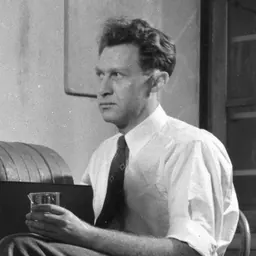
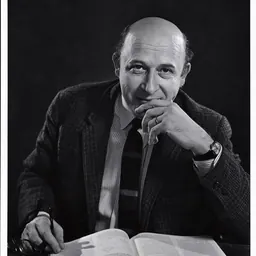


Related people
Same field, nearest in time

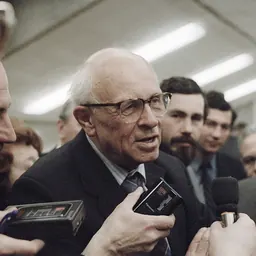

Contemporaries
People whose lives overlapped Maurice Goldhaber's






Frequently asked questions
Who was Maurice Goldhaber?
American physicist (1911-2011)
When was Maurice Goldhaber born?
Maurice Goldhaber was born on 18 April 1911 in Lviv.
When did Maurice Goldhaber die?
Maurice Goldhaber died on 11 May 2011 in Suffolk County.
What was Maurice Goldhaber's occupation?
Maurice Goldhaber was a physicist, nuclear physicist and university teacher.
What was Maurice Goldhaber known for?
Maurice Goldhaber was known for Helicity (particle physics) and Neutrino.
What nationality was Maurice Goldhaber?
Maurice Goldhaber was American.
Sources & further reading
· Wikipedia: Maurice Goldhaber
Cite this page
APA: Biography.guide. (2026). Maurice Goldhaber. https://biography.guide/maurice-goldhaber/
MLA: "Maurice Goldhaber." Biography.guide, https://biography.guide/maurice-goldhaber/.
Chicago: "Maurice Goldhaber." Biography.guide. https://biography.guide/maurice-goldhaber/.
Data last updated: 2026-09-20 · Spot an error? Report a correction.
Page generated 2026-09-27 05:09 UTC