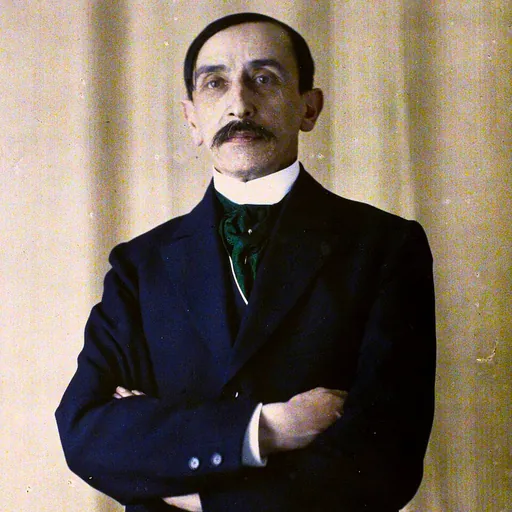
About Maurice Barrès
Lived 1862 – 1923 (aged 61). Maurice Barrès was a French writer, politician, novelist and journalist.
Auguste-Maurice Barrès (; 19 August 1862 – 4 December 1923) was an anti-Semitic French novelist, journalist, philosopher, and politician. Spending some time in Italy, he became a figure in French literature with the release of his work The Cult of the Self in 1888. He was elected a member of the Académie Française in 1906.
In politics, Barrès was first elected to the Chamber of Deputies in 1889 as a Boulangist and would play a prominent political role for the rest of his life. He presided over the Ligue des Patriotes from 1914 until his death in 1923.
Biography Barrès was associated in his literary works with Symbolism, a movement which had equivalence with British Aestheticism and Italian Decadentism; indeed he was a close associate of Gabriele d'Annunzio representing the latter. As the name of his trilogy suggests, his works glorified a humanistic love of the self and he also flirted with occult mysticisms in his youth. The Dreyfus affair saw an ideological shift from a liberal individualism rooted in the French Revolution to a more organic and traditional concept of the nation. He also became a leading anti-Dreyfusard popularising the term nationalisme to describe his views. He stood on a platform of "Nationalism and Protectionism.". In this second major trilogy, he superated his early individualism with a patriotic fidelity to the fatherland and an organicist conception of the nation. He directed a Boulangist paper at Nancy, and was elected deputy in 1889, at the age of 27, under a platform of "Nationalism, Protectionism, and Socialism", retaining his seat in the legislature until 1893, when he was defeated under the etiquette of "National Republican and Socialist" (Républicain nationaliste et socialiste). Barrès's anti-Jewishness found its roots both in the scientific racial contemporary theories and on Biblical exegesis. They also demanded 'reparation by arms', or a duel, so that Barrès would 'pay' for insulting them on his own campaign posters. Barrès preferred to send out his servants and did not leave his mansion. ) to defend his ideas, attempting to bridge the gap between the far-left and the far-right. His many wartime columns in L'Écho de Paris were collected in L'Âme française et la guerre (12 volumes, 1915–1920) and Chronique de la Grande Guerre (14 volumes, 1920–1924). His personal notes showed however that he himself did not always believe in his purported war optimism, being at times close to defeatism. During the war Barrès also revised his views of Jews, by paying tribute to French Jews in Les familles spirituelles de la France, where he placed them as one of the four elements of the "national genius", alongside Traditionalists, Protestants and Socialists – thus opposing himself to Maurras who placed them in the "four confederate states" of "Anti-France".
After World War I, Barrès demanded the annexation of Luxembourg into the French Republic, and also sought to increase French influence in the Rhineland. On 24 June 1920, the National Assembly adopted his draft aiming to establish a national day in remembrance of Joan of Arc.
Nationalism
Barrès is considered, alongside Charles Maurras, as one of the main thinkers of ethnic nationalism at the turn of the century in France, associated with Revanchism—the desire to reconquer the Alsace-Lorraine, annexed by the newly created German Empire at the end of the 1871 Franco-Prussian War (Barrès was aged 8 at that time). In fact, he himself popularised the word "nationalism" in French. Michel Winock (who titled the first part of his book, Le Siècle des intellectuels, "Les Années Barrès" ("The Barrès Years"), followed by Les Années André Gide and Les Années Jean-Paul Sartre), Pierre-André Taguieff, etc. He shared as common points with Paul Bourget his disdain for utilitarianism and liberalism. Much closer to Herder and Fichte than to Renan in his definition of the Nation, Barrès opposed French centralism (as did Maurras), as he considered the Nation to be a multiplicity of local allegiances, first to the family, the village, the region, and ultimately to the nation-state. Influenced by Edmund Burke, Frédéric Le Play, G.W.F. Hegel, and Hippolyte Taine, he developed an organicist conception of the Nation which contrasted with the universalism of the 1789 Declaration of the Rights of Man and of the Citizen.
Barrès feared miscegenation of modern times, represented by Paris, claiming against Michelet that it jeopardised the unity of the Nation. The Nation was to be balanced between various local nationalities (he spoke of the "Lorraine nationality" as much as of the "French nationality"
Hispanophilia Barrès was a noted hispanophile. Always passionate about the "South" and "Orient", he emphasized in his work the period of Moorish domination. He interpreted the Spain of the time as a nation refractory to the attempts of economic and bureaucratic rationalization threatening his own country. He visited Spain in 1892, 1893 and 1902, capturing his vision of the country in his writings, taking a particular interest in Toledo.
Dada and Barrès The Dadaists organised in spring 1921 the trial of Barrès, charged with an "attack on the safety of the mind" ("attentat à la sûreté de l'esprit") and sentenced him to 20 years of forced labour. This fictitious trial also marked the dissolution of Dada - its founders, among whom was Tristan Tzara, refusing any form of justice even if organised by Dada.
Final years and death
An Orientalist romance, Un jardin sur l'Oronte (A Garden on the Orontes)—which would be the basis of an opera of the same name—was published in 1922, triggering what would be called (the Orontes Quarrel).
Barrès died in Neuilly-sur-Seine on 4 December 1923.
Works in English translation The Undying Spirit of France, Yale University Press, 1917. "Young Soldiers of France". In The War and the Spirit of Youth, Atlantic Monthly Company, 1917. Colette Baudoche: The Story of a Young Girl of Metz, George H. Doran Company, 1918. "Officers and Gentlemen", The Atlantic Monthly, Vol. CXXI, 1918. The Faith of France, Houghton Mifflin & Company, 1918. The Sacred Hill, The Macaulay Company, 1929. "Uprooted". In The World's Greatest Books, W. H. Wise & Co., 1941.
Other Massia Bibikoff, Our Indians at Marseilles, with an Introduction by Maurice Barrès, Smith, Elder and Company, 1915. Georges Lafond, Covered with Mud and Glory, with a Preface by Maurice Barrès, Small, Maynard & Company, 1918.
Don’t just read it —
keep it.
Full-length biographies made to live with: read them, listen on the way to work, watch them tonight.
- E-book
- Audio
- Video
Instant download · yours to keep · every purchase keeps this site free
Important facts
People in Maurice Barrès's life
Named in this biography and alive at the same time




Related people
Same field, nearest in time


Contemporaries
People whose lives overlapped Maurice Barrès's



Frequently asked questions
Who was Maurice Barrès?
French novelist (1862-1923)
When was Maurice Barrès born?
Maurice Barrès was born on 19 August 1862 in Charmes.
When did Maurice Barrès die?
Maurice Barrès died on 4 December 1923 in Neuilly-sur-Seine.
What was Maurice Barrès's occupation?
Maurice Barrès was a writer, politician, novelist and journalist.
What nationality was Maurice Barrès?
Maurice Barrès was French.
Sources & further reading
Cite this page
APA: Biography.guide. (2026). Maurice Barrès. https://biography.guide/maurice-barres/
MLA: "Maurice Barrès." Biography.guide, https://biography.guide/maurice-barres/.
Chicago: "Maurice Barrès." Biography.guide. https://biography.guide/maurice-barres/.
Data last updated: 2026-09-22 · Spot an error? Report a correction.
Portrait: Wikimedia Commons · author & licence
Page generated 2026-09-27 05:02 UTC