
Matthew Murray
British steam engine and machine tool engineer and manufacturer
About Matthew Murray
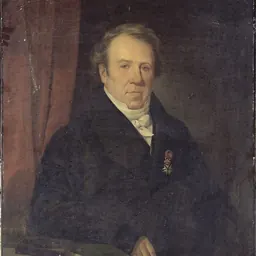
Lived 1765 – 1826 (aged 60–61). Matthew Murray was a British engineer, railway engineer and millwright.
Matthew Murray (1765 – 20 February 1826) was an English steam engine and machine tool manufacturer, who designed and built the first commercially viable steam locomotive, the twin-cylinder Salamanca in 1812. He was an innovative designer in many fields, including steam engines, machine tools and machinery for the textile industry.
Early years Little is known about Matthew Murray's early years. He was born in Newcastle upon Tyne in 1765. He left school at fourteen and was apprenticed to be either a blacksmith or a whitesmith. In 1785, when he concluded his apprenticeship, he married Mary Thompson (1764–1836) of Whickham, County Durham. The following year he moved to Stockton and began work as a journeyman mechanic at the flax mill of John Kendrew in Darlington, where the mechanical spinning of flax had been invented.
Murray and his wife, Mary, had three daughters and a son, also called Matthew.
Leeds In 1789, due to a lack of trade in the Darlington flax mills, Murray and his family moved to Leeds to work for John Marshall, who was to become a prominent flax manufacturer. John Marshall had rented a small mill at Adel, for the purpose of manufacture but also to develop a pre-existing flax-spinning machine, with the aid of Matthew Murray. After some trial and error, to overcome the problem of breakages in the flax twine during the spinning of the flax, sufficient improvements were made to enable John Marshall to undertake the construction of a new mill at Holbeck in 1791, Murray was in charge of the installation. The installation included new flax-spinning machines of his own design, which Murray patented in 1790. In 1793 Murray took out a second patent on a design for "Instruments and Machines for Spinning Fibrous Materials". His patent included a carding engine and a spinning machine that introduced the new technique of "wet spinning" flax, which revolutionised the flax trade. In 1799 William Murdoch, who worked for the firm of Boulton and Watt, invented a new type of steam valve, called the D slide valve. This, in effect, slid backwards and forwards admitting steam to one end of the cylinder then the other. Matthew Murray improved the working of these valves by driving them with an eccentric gear attached to the rotating shaft of the engine.
Murray also patented an automatic damper that controlled the furnace draft depending on the boiler pressure, and he designed a mechanical hopper that automatically fed fuel to the firebox. Murray was the first to adopt the placing of the piston in a horizontal position in the steam engine. He expected very high standards of workmanship from his employees, and the result was that Fenton, Murray and Wood produced machinery of a very high precision. He designed a special planing machine for planing the faces of the slide valves. Apparently this machine was kept in a locked room, to which only certain employees were allowed access.
The Round Foundry As a result of the high quality of his steam engines, sales increased a great deal and it became apparent that a new engine assembly shop was required. Murray designed this himself, and produced a huge three-storeyed circular building known as the Round Foundry. This contained a centrally mounted steam engine to power all of the machines in the building. Murray also built a house for himself adjoining the works. The design of this was pioneering, as each room was heated by steam pipes, so that it became known locally as Steam Hall. The image features the earliest known representation of a steam train.
In 1812 the firm supplied John Blenkinsop, manager of Brandling's Middleton Colliery, near Leeds, with the first twin-cylinder steam locomotive (Salamanca). This was the first commercially successful steam locomotive.
The double cylinder was Murray's invention; he paid Richard Trevithick a royalty for the use of his patented high pressure steam system, but improved upon it, using two cylinders rather than one to give a smoother drive.
Because only a lightweight locomotive could work on cast iron rails without breaking them, the total load they were capable of hauling was very much limited. In 1811, John Blenkinsop patented a toothed wheel and rack rail system. The toothed wheel was driven by connecting rods, and meshed with a toothed rail at one side of the track. This was the first rack railway, and had a gauge of 4 ft 1½ ins.
Once a system had been devised for making malleable iron rails, around 1819, the rack and pinion motion became unnecessary, apart from later use on mountain railways. However, until that time it enabled a small and lightweight locomotive to haul loads totalling at least 20 times its own weight. Salamanca was so successful that Murray made three more models. One of these was known as Lord Wellington, and the others are said to have been named Prince Regent and Marquis Wellington, though there is no known contemporary mention of those two names. The third locomotive intended for Middleton was sent, at Blenkinsop's request, to the Kenton and Coxlodge Colliery waggonway near Newcastle upon Tyne, where it appears to have been known as Willington. There it was seen by George Stephenson, who modelled his own locomotive Blücher on it, minus the rack drive, and therefore much less effective. served an apprenticeship at the Round Foundry and went to Russia; he founded an engineering business in Moscow,
Don’t just read it —
keep it.
Full-length biographies made to live with: read them, listen on the way to work, watch them tonight.
- E-book
- Audio
- Video
Instant download · yours to keep · every purchase keeps this site free
Important facts
People in Matthew Murray's life
Named in this biography and alive at the same time

Related people
Same field, nearest in time

Contemporaries
People whose lives overlapped Matthew Murray's





Frequently asked questions
Who was Matthew Murray?
British steam engine and machine tool engineer and manufacturer (1765-1826)
When was Matthew Murray born?
Matthew Murray was born in 1765 in Newcastle upon Tyne.
When did Matthew Murray die?
Matthew Murray died on 20 February 1826.
What was Matthew Murray's occupation?
Matthew Murray was an engineer, railway engineer and millwright.
What nationality was Matthew Murray?
Matthew Murray was British.
Sources & further reading
Cite this page
APA: Biography.guide. (2026). Matthew Murray. https://biography.guide/matthew-murray-engineer/
MLA: "Matthew Murray." Biography.guide, https://biography.guide/matthew-murray-engineer/.
Chicago: "Matthew Murray." Biography.guide. https://biography.guide/matthew-murray-engineer/.
Data last updated: 2026-09-22 · Spot an error? Report a correction.
Page generated 2026-09-27 05:30 UTC