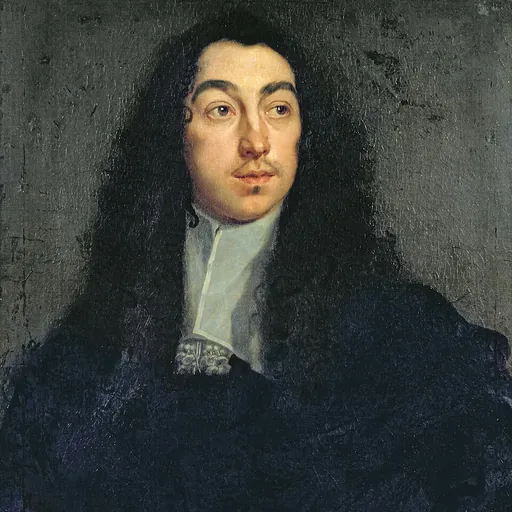
About Matthew Locke
Lived 1621 – 1677 (aged 55–56). Matthew Locke was an English composer, musicologist, music theorist, singer, musician and organist.
"Up and Down This World Goes Round", three voice round by Matthew Locke.
Matthew Locke (c. 1621 – August 1677) was an English Baroque composer and music theorist.
Biography
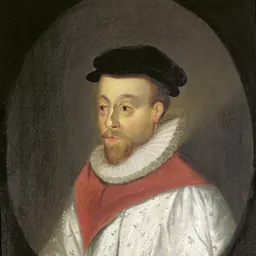
Locke was born in Exeter and was a chorister in the choir of Exeter Cathedral, under Edward Gibbons, the brother of Orlando Gibbons. At the age of eighteen Locke travelled to the Netherlands, possibly converting to Roman Catholicism at the time.
Locke, with Christopher Gibbons (the son of Orlando), composed the score for Cupid and Death, the 1653 masque by Caroline-era playwright James Shirley. Their score for that work is the sole surviving score for a dramatic work from that era. Locke was one of the quintet of composers who provided music for The Siege of Rhodes (1656), the breakthrough early opera by Sir William Davenant. Locke wrote music for subsequent Davenant operas, The Cruelty of the Spaniards in Peru (1658) and The History of Sir Francis Drake (1659). He wrote the music for the processional march for the coronation of Charles II.
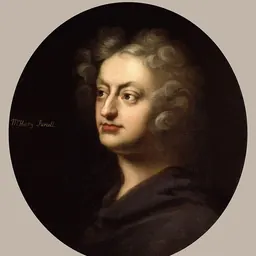
Locke's treatise on music theory, Melothesia, was published in 1673. The title page describes him as "Composer in Ordinary to His Majesty, and organist of her Majesty's chapel"—those monarchs being Charles II and Catherine of Braganza. Locke also served King Charles as Composer of the Wind Music ("music for the King's sackbutts and cornets"), and Composer for the Violins. (His successor in the latter office was Henry Purcell, who composed an ode on the death of Locke entitled What hope for us remains now he is gone?, Z. 472; Locke was a family friend and may have had a musical influence on the young Purcell ). In 1675 Locke composed the music for the score of Thomas Shadwell's Psyche.
Don’t just read it —
keep it.
Full-length biographies made to live with: read them, listen on the way to work, watch them tonight.
- E-book
- Audio
- Video
Instant download · yours to keep · every purchase keeps this site free
Important facts
People in Matthew Locke's life
Named in this biography and alive at the same time



Related people
Same field, nearest in time


Contemporaries
People whose lives overlapped Matthew Locke's





Frequently asked questions
Who was Matthew Locke?
English Baroque composer
When was Matthew Locke born?
Matthew Locke was born in 1621 in Exeter.
When did Matthew Locke die?
Matthew Locke died on 1 August 1677 in London.
What was Matthew Locke's occupation?
Matthew Locke was a composer, musicologist, music theorist, singer, musician and organist.
What nationality was Matthew Locke?
Matthew Locke was English.
Sources & further reading
· DBpedia: Matthew Locke (composer)
Cite this page
APA: Biography.guide. (2026). Matthew Locke. https://biography.guide/matthew-locke-composer/
MLA: "Matthew Locke." Biography.guide, https://biography.guide/matthew-locke-composer/.
Chicago: "Matthew Locke." Biography.guide. https://biography.guide/matthew-locke-composer/.
Data last updated: 2026-09-22 · Spot an error? Report a correction.
Portrait: Wikimedia Commons · author & licence
Page generated 2026-09-27 05:04 UTC