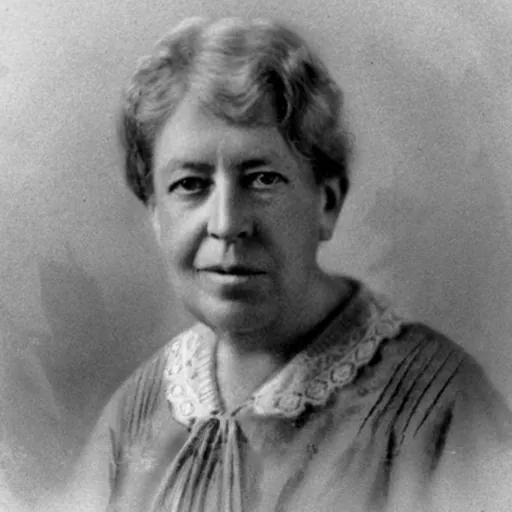
Mary Whiton Calkins
American philosopher and psychologist
About Mary Whiton Calkins
Lived 1863 – 1930 (aged 66). Mary Whiton Calkins was an American psychologist, university teacher and philosopher.
Mary Whiton Calkins (; 30 March 1863 – 26 February 1930 ) was an American philosopher and psychologist, whose work informed theory and research of memory, dreams and the self. She developed the paired-associate learning technique and the theory of self-psychology. In 1903, Calkins was the twelfth in a listing of fifty psychologists with the most merit, chosen by her peers. In 1895 Calkins was refused a Ph.D. by Harvard University because of her gender even though she completed all the requirements. Calkins' experience at Harvard reflected the limited status of women in graduate education at the time, as they were often permitted to attend lectures informally but were excluded from official enrollment and degree recognition. She was given honorary membership of the British Psychology Association in 1928.
She taught psychology and philosophy at Wellesley College for four decades, and conducted research there and at Harvard University. At Wellesley College, Calkins established the first psychological laboratory for women. She later became president of the American Psychological Association and the American Philosophical Association, and was the first woman to be president of both.
Background Mary Whiton Calkins was born on March 30, 1863, in Hartford, Connecticut. She was the eldest of Wolcott and Charlotte Whiton Calkins's five children in what was a close family. In 1880, when she was 17 her family moved to Newton, Massachusetts so her father, a Presbyterian minister, could take up a new job .
In 1882, Calkins entered Smith College as a sophomore. She returned to Smith College in 1884 and graduated that same year with a degree in classics and philosophy.
After graduation, Calkins and her family took an eighteen-month trip to Europe, and she was able to explore Leipzig, Italy, and Greece. During her travels she also tutored her two brothers and in Greece she spent several months travelling and studying modern Greek. She worked at Wellesley as a tutor and eventually as a teacher
Finding a psychology course that accepted women proved difficult. She considered psychology programs at the University of Michigan with John Dewey, Yale University with George Trumbull Ladd, Clark University with Granville Stanley Hall, and Harvard University with William James.
Career Calkins published four books and over one hundred papers in her career, in both the fields of psychology and philosophy. Calkins was interested in memory and later in the concept of the self. She is best known for her accomplishments within the field of psychology and her struggles to achieve. She was the first woman to serve as president of the American Psychological Association, marking a significant milestone for women in psychology. After being rejected for a degree from Harvard, Calkins continued to work and strive for equality.
Initial psychological training Royce influenced Calkins to take classes taught by William James in Harvard, with men as her peers. However, Harvard president Charles William Eliot opposed this idea of a woman learning in the same room as a man. They slept with a notepad right beside their bed to allow note-taking of dreams as quickly as possible. Each morning, they studied all the records regardless of whether they seemed slight and trivial, or significant. They also took account of the different types of dreams and they discovered elements of various emotions. Their findings suggested that dreams were closely related to recent waking experiences and reflected elements of everyday life. These findings are consistent with Calkins’ broader research on dreams, which formed part of her work on psychology and mental processes. Yet, the prime factor influencing memory was not color but the frequency of exposure.
Calkins described the technical memorizing method that she used, known as paired-associations, as even more significant than the results of the experiment. Although Georg Elias Müller criticized her method, he refined and adopted it, calling it and it has been widely used ever since. Edward B. Titchener included her research in his Student's Manual, and in her autobiography, Calkins refers to a Professor Kline who selected the paired-associates method for his textbook, Psychology By Experiment. Although the paired-associates technique is regarded as one of Calkins' biggest contributions to psychology, Calkins herself did not attach very much importance to this work.
Her study on paired associates learning under Münsterberg constituted her doctoral dissertation which was published in 1896. The paired-associates method continues to be used in psychological research today, demonstrating that lasting impact of Calkins’ work on the study of memory. Harvard refused to approve the unanimous recommendation of the Department of Philosophy and Psychology to grant Calkins her doctoral degree. Eliot believed strongly that the two sexes should be educated separately and, although he allowed Calkins to be a "guest," he and the rest of the board refused to grant her the degree. Calkins had completed all of the requirements for the Ph.D., including passing exams and completing a dissertation, and all of her Harvard professors had recommended her for the degree. Yet, solely due to her gender, she was denied the honour of a conferred degree.
Calkins' most notable instance of social justice for women was her rejection of a PhD from Radcliffe, a women's college in association with Harvard. Although the qualification has never been officially conferred, Calkins was one of the first women complete all the coursework, examinations, and research for a doctoral degree. (Margaret Floy Washburn was the first woman to complete Ph.D. in psychology in 1894.) In 1902, Radcliffe offered doctoral degrees to Calkins and three other women who had completed their studies at Harvard but were not granted PhDs due to their gender. In the rejection letter to the Radcliffe board it stated:
Despite ongoing petitioning, as of 2015 Harvard University continues to refuse to posthumously award her with a doctoral degree.
Later work With her supplemental education completed, she returned to Wellesley in 1895 as an associate professor of psychology. At this time, it was particularly impressive for women in academia to successfully balance teaching, research, and leadership roles, making her career especially significant. Calkins paired-associates method became a foundational experimental technique in memory research and later influenced how psychologists studied learning and recall processes in humans. This became quite unpopular and controversial as many psychologists did not feel the self or soul was relevant. At the time, the main schools of psychology were structuralism and functionalism, which were quite competitive with one another; statements made by one school could expect a strong rebuttal from the other.
She spent a great deal of time working with the system of self-psychology, critically examining the self from both philosophical and psychological viewpoints. Over her many years of study, Calkins wrote many books and articles on the topic of self-psychology. Over the years she spent working on the system, it was widely unpopular, which is why she is less often remembered for her work relating to it. Despite its lack of appreciation, Calkin's refused to lose interest in the subject, which is described as "the science of conscious selves." By way of studying self-psychology, she was able to form descriptions of the self, such as the self that remains the same, the self that is changed, the unique self, and a few other descriptions. She would go on to discuss self-psychology during the entirety of her career, mentioning it in some of her books, one of which is A First Book in Psychology.
Calkins considered her self-psychology to be a form of introspectionist psychology, involving examining one's own mental experience. She believed that causing someone to think introspectively could help in multiple aspects of their life including religion, their morals, and various other aspects in the mind that otherwise may not be thought of. Introspectionistic psychology was composed of two schools: impersonalistic, which denied the "self" in its definition of psychology, and personalistic, which defined psychology as the study of consciousness, functioning, experiencing selves. Calkins' conviction was that a laboratory was essential for adequate instruction in psychology. Calkins claimed that self-psychology could be experimentally investigated, but did not personally involve herself in laboratory experiments relating to self-psychology. Calkins desired that her school of self-psychology would be a theory on which functionals and structuralists could find common ground.
Calkins' self-psychology did not live without criticism from fellow psychologists of the era. James Angell, a founding father of functionalism, opposed Calkins' neglect of the body as part of the self. Following Calkins' Presidential Address (of the American Psychological Association), where Calkins publicly outlined self-psychology, he claims: "Such as functional psychology as I have been presenting would be entirely reconcilable with Miss Calkins' 'psychology of selves' ... were it not for her extreme scientific conservatism in refusing to allow the self to have a body ... The real psychological self, as I understand her, is pure disembodied spirit - an admirable thing of good religious and philosophic ancestry, but surely not the thing before which psychology is under any obligation to know". This was written despite its inaccuracy; Calkins did in fact leave considerable room for the body in her address, taking sensorimotor processes and physiological phenomena into account, however, she did not consider the body as an essential "basal fact" of psychology.
Personal life Outside of her contributions to the field of psychology, Calkins was an avid supporter of women's rights. Calkins was a suffragist, disputing "in a democratic country, governed as this is by the suffrage of its citizens, and given over as this is to the principle and practice of educating women, a distinction based on the difference of sex is artificial and illogical". Calkins was a pacifist and a member of the American Civil Liberties Union. While working at Wellesley around the time of World War I, a colleague of Calkins was fired for holding pacifistic views. Calkins offered her resignation, stating she held the same views as her colleague who was terminated, but her resignation from Wellesley was not accepted by the President or board.
As it can be seen in her writings, although she was very grateful for the individuals who accepted her, she did not hold resentment against those who did not. For instance, instead of expressing disdain towards the Harvard board for not accepting her application for a degree, she conveyed her appreciation toward Harvard for allowing her to partake in the courses, conduct research under her professors, and work with individuals such as James, Sanford and Münsterberg. She also mentions the assistance of figures such as Robert MacDougall and several others who spent years with her as her mechanicians, subjects, counselors, and even friends. In addition, when the episode with the waiter refusing her admission took place, she stated in her autobiography that "he correctly insisted against her admission." Overall, Calkins’ life highlights both her major contributions to psychology and the barriers women faced in gaining recognition in the field.
Legacy and Historical Recognition
Mary Whiton Calkins is still considered an important figure in early psychology today, especially because of her work on memory, dreams, and self-psychology. Her paired-associates method is often mentioned as one of her bigger contributions since it helped shape how researchers study learning and memory.
Her career is also usually talked about in terms of the barriers she faced as a woman in psychology. Even though she finished all the requirements for a Ph.D. at Harvard, she was still denied the degree because of her gender, which shows how limited opportunities were for women at the time. Later on, though, she still made a lot of history by becoming the first woman president of both the American Psychological Association and the American Philosophical Association, which was a major accomplishment given the time period.
Calkins served as a faculty member at Wellesley College for forty years until she retired in 1929. Calkins died in 1930 after writing four books and over a hundred papers that are evenly divided between the fields of psychology and philosophy.
Publications
Books
1888: Sharing the Profits, Ginn & Company. 1896: Association: An Essay Analytic and Experimental, Macmillan 1901: An Introduction to Psychology, The Macmillan Company. 1907: The Persistent Problems of Philosophy: An Introduction to Metaphysics Through the Study of Modern Systems, The Macmillan Company. 1909: A First Book in Psychology, The Macmillan Company 1918: The Good Man and the Good, The Macmillan Company
Don’t just read it —
keep it.
Full-length biographies made to live with: read them, listen on the way to work, watch them tonight.
- E-book
- Audio
- Video
Instant download · yours to keep · every purchase keeps this site free
Important facts
People in Mary Whiton Calkins's life
Named in this biography and alive at the same time







Related people
Same field, nearest in time
Contemporaries
People whose lives overlapped Mary Whiton Calkins's




Frequently asked questions
Who was Mary Whiton Calkins?
American philosopher and psychologist (1863–1930)
When was Mary Whiton Calkins born?
Mary Whiton Calkins was born on 30 March 1863 in Hartford.
When did Mary Whiton Calkins die?
Mary Whiton Calkins died on 26 February 1930 in Newton.
What was Mary Whiton Calkins's occupation?
Mary Whiton Calkins was a psychologist, university teacher and philosopher.
What nationality was Mary Whiton Calkins?
Mary Whiton Calkins was American.
Sources & further reading
· Wikipedia: Mary Whiton Calkins
· DBpedia: Mary Whiton Calkins
Cite this page
APA: Biography.guide. (2026). Mary Whiton Calkins. https://biography.guide/mary-whiton-calkins/
MLA: "Mary Whiton Calkins." Biography.guide, https://biography.guide/mary-whiton-calkins/.
Chicago: "Mary Whiton Calkins." Biography.guide. https://biography.guide/mary-whiton-calkins/.
Data last updated: 2026-09-24 · Spot an error? Report a correction.
Portrait: Wikimedia Commons · author & licence
Page generated 2026-09-27 05:08 UTC