
About Mary-Lou Pardue
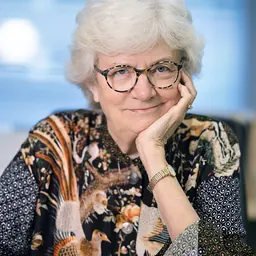
Lived 1933 – 2024 (aged 90). Mary-Lou Pardue was an American geneticist and cell biologist, known for Drosophila.
Mary-Lou Pardue (September 15, 1933 – June 1, 2024) was an American geneticist and professor emerita in the Department of Biology at the Massachusetts Institute of Technology, where she originally joined in 1972. Her research focused on the role of telomeres in chromosome replication, particularly in Drosophila (fruit flies). Pardue died on June 1, 2024, at the age of 90.
Early life and education Pardue was born in Lexington, Kentucky on September 15, 1933. She received a bachelor's degree in biology in 1955 from the College of William and Mary. Pardue received a master's degree in radiation biology in 1959 from the University of Tennessee, where she had been eligible for a Ph.D. but convinced the department to give her the master's degree instead, later explaining in an interview that "in the society I was in it was quite all right for a wife to be going to school, but getting a Ph.D. was a little too serious". Pardue then became a postdoctoral fellow with Max Birnstiel at the University of Edinburgh. Pardue was among the women faculty who organized with fellow MIT biologist Nancy Hopkins in the mid-1990s to bring complaints of institutional discrimination against women faculty to then-President Charles Vest. In 1994, Pardue was one of 16 women faculty in the School of Science at MIT who drafted and co-signed a letter to the then-Dean of Science (now Chancellor of Berkeley) Robert Birgeneau, which started a campaign to highlight and challenge gender discrimination at MIT.
Pardue became a fellow of the American Association for the Advancement of Science in 1978, a member of the United States National Academy of Sciences in 1983 and a fellow of the American Academy of Arts and Sciences in 1985. Work in her research group at MIT focused on telomeres in the chromosomes of the model organism Drosophila (fruit flies), with particular interest in the retrotransposon elements that maintain Drosophila telomeres, unlike many other organisms in which the enzyme telomerase performs much the same function. Pardue's 1969 publication entitled Molecular hybridization of radioactive DNA to the DNA of cytological preparations, focused on the radioactive DNA localization in the nuclei of ovarian cells in Xenopus. Through her work, she was able to conclude that the localization of binding in the oocytes of Xenopus is specific. Pardue also found that hybridization reactions with radioactive DNA were able to discriminate between different types of DNA.
Pardue died on June 1, 2024, at the age of 90.
Don’t just read it —
keep it.
Full-length biographies made to live with: read them, listen on the way to work, watch them tonight.
- E-book
- Audio
- Video
Instant download · yours to keep · every purchase keeps this site free
Important facts
People in Mary-Lou Pardue's life
Named in this biography and alive at the same time

Related people
Same field, nearest in time





Contemporaries
People whose lives overlapped Mary-Lou Pardue's




Frequently asked questions
Who was Mary-Lou Pardue?
American geneticist (1933 - 2024)
When was Mary-Lou Pardue born?
Mary-Lou Pardue was born on 15 September 1933 in Lexington.
When did Mary-Lou Pardue die?
Mary-Lou Pardue died on 1 June 2024.
What was Mary-Lou Pardue's occupation?
Mary-Lou Pardue was a geneticist and cell biologist.
What was Mary-Lou Pardue known for?
Mary-Lou Pardue was known for Drosophila.
What nationality was Mary-Lou Pardue?
Mary-Lou Pardue was American.
Sources & further reading
Cite this page
APA: Biography.guide. (2026). Mary-Lou Pardue. https://biography.guide/mary-lou-pardue/
MLA: "Mary-Lou Pardue." Biography.guide, https://biography.guide/mary-lou-pardue/.
Chicago: "Mary-Lou Pardue." Biography.guide. https://biography.guide/mary-lou-pardue/.
Data last updated: 2026-09-20 · Spot an error? Report a correction.
Page generated 2026-09-27 05:19 UTC