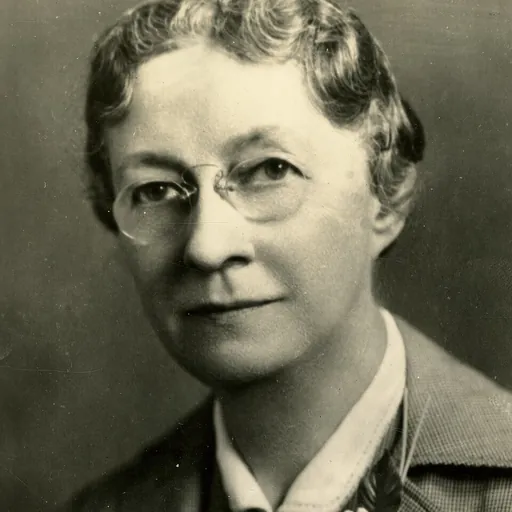
About Mary Engle Pennington
Lived 1872 – 1952 (aged 80). Mary Engle Pennington was an American chemist, inventor, bacteriologist and engineer.
Mary Engle Pennington (October 8, 1872 – December 27, 1952) was an American bacteriological chemist, food scientist and refrigeration engineer. She was an innovator in the preservation, handling, storage, and transportation of perishable foods and the first female lab chief at the U.S. Food and Drug Administration. She was awarded 5 patents (3 of which were shared), received the Notable Service Medal from President Herbert Hoover, and received the Garvin-Olin Medal from the American Chemical Society. She is an inductee of the National Inventor's Hall of Fame, the National Women's Hall of Fame and the ASHRAE Hall of Fame.
Early life and education
Pennington was born on October 8, 1872, in Nashville, Tennessee, to Henry and Sarah Malony Pennington. Shortly after her birth, her parents moved to Philadelphia to be closer to her mother's Quaker relatives.
She entered the University of Pennsylvania in 1890 and completed the requirements for a B.S. degree in chemistry with minors in botany and zoology in 1892. However, since the University of Pennsylvania did not grant degrees to women at this time, she was given a certificate of proficiency instead of a degree.
Pennington received her Ph.D. from the University of Pennsylvania in 1895. Her thesis was entitled "Derivatives of Columbium and Tantalum." and conducted bacteriological analyses. She educated farmers on the handling of raw milk in order to improve the safety of ice cream sold at local schools. Her director at the Bureau of Chemistry, Harvey W. Wiley, encouraged her to apply for a position as chief of the newly created Food Research Laboratory, which had been established to enforce the Pure Food and Drug Act of 1906. She was submitted to the position under the name M.E. Pennington in order to hide her gender. She accepted the position in 1907 and became the first female lab chief. One of her major accomplishments was the development of standards for the safe processing of chickens raised for human consumption. She also served as head of an investigation of refrigerated boxcar design and served on Herbert Hoover's War Food Administration during World War I.
In 1919, Pennington accepted a position with a private firm, American Balsa, which manufactured insulation for refrigeration units. She left the firm in 1922 to start her own consulting business, which she ran until her retirement in 1952. She founded the Household Refrigeration Bureau in 1923 to educate consumers in safe practices in domestic refrigeration. Much of her work in the 1920s was supported by the National Association of Ice Industries (NAII), an association of independent icemakers and distributors who delivered ice to the home for use in iceboxes, before the widespread availability of electric refrigerators. With NAII support, she published pamphlets on home food safety, including The Care of the Child's Food in the Home (1925) and Cold is the Absence of Heat (1927).
In 1932 she was issued a U.S. patent for a scale for determining the color of egg meat.
In 1935 she and Arthur W. Thomas were issued a U.S. patent for a method of treating eggs.
Later in 1935, she was issued a U.S. patent for a method for freezing eggs.
She was also a member of the Philadelphia Pathological Society, Sigma Xi, and the Kappa Kappa Gamma sorority.
Awards received while alive In 1919, she was awarded the Notable Service Medal by President Herbert Hoover for her work in refrigeration. In 1940, she became the second recipient of the Garvan–Olin Medal, then called the Francis P. Garvan Medal, from the American Chemical Society.
Death Pennington died on December 27, 1952,
Posthumous recognition In 1959 she became the first woman elected to the Poultry Historical Society Hall of Fame. and the National Inventors Hall of Fame in 2018.
Publications Derivatives of Columbium and Tantalum, J. Am. Chem. Soc. 1896, 18, 1, 38–67, January 1, 1896 Studies of Poultry from the Farm to the Consumer, Washington, D.C.: U.S. Department of Agriculture, 1910 The Refrigeration of Dressed Poultry in Transit, U.S. Department of Agriculture, 1913 How to Kill and Bleed Market Poultry, Washington D.C.: U.S. Government Printing Office, 1915 A Study of the Preparation of Frozen and Dried Eggs in the Producing Section, Washington, D.C.: U.S. Department of Agriculture, 1916 How to Candle Eggs, Washington D.C.: U.S. Department of Agriculture, 1918 The Prevention of Breakage of Eggs in Transit When Shipped in Carlots, Washington, D.C.: U.S. Department of Agriculture, 1918
Don’t just read it —
keep it.
Full-length biographies made to live with: read them, listen on the way to work, watch them tonight.
- E-book
- Audio
- Video
Instant download · yours to keep · every purchase keeps this site free
Important facts
People in Mary Engle Pennington's life
Named in this biography and alive at the same time
Related people
Same field, nearest in time




Contemporaries
People whose lives overlapped Mary Engle Pennington's



Frequently asked questions
Who was Mary Engle Pennington?
American bacteriological chemist and refrigeration engineer (1872-1952)
When was Mary Engle Pennington born?
Mary Engle Pennington was born on 8 October 1872 in Nashville.
When did Mary Engle Pennington die?
Mary Engle Pennington died on 27 December 1952 in New York City.
What was Mary Engle Pennington's occupation?
Mary Engle Pennington was a chemist, inventor, bacteriologist and engineer.
What nationality was Mary Engle Pennington?
Mary Engle Pennington was American.
Sources & further reading
· Wikipedia: Mary Engle Pennington
· DBpedia: Mary Engle Pennington
Cite this page
APA: Biography.guide. (2026). Mary Engle Pennington. https://biography.guide/mary-engle-pennington/
MLA: "Mary Engle Pennington." Biography.guide, https://biography.guide/mary-engle-pennington/.
Chicago: "Mary Engle Pennington." Biography.guide. https://biography.guide/mary-engle-pennington/.
Data last updated: 2026-09-22 · Spot an error? Report a correction.
Portrait: Wikimedia Commons · author & licence
Page generated 2026-09-27 05:02 UTC