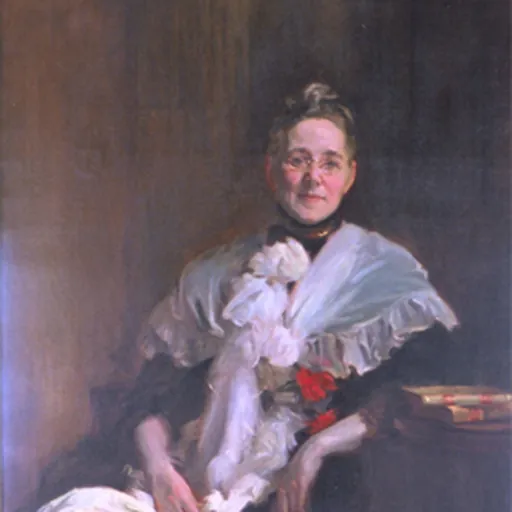
About Mary Elizabeth Garrett
Lived 1854 – 1915 (aged 61). Mary Elizabeth Garrett was an American philanthropist and suffragist, known for Baltimore.
Mary Elizabeth Garrett (March 5, 1854 – April 3, 1915) was an American suffragist and philanthropist. She was the youngest child and only daughter of John W. Garrett, a philanthropist and president of the Baltimore and Ohio Railroad (B. & O.).
Well known for her "coercive philanthropy", Mary Garrett donated money to start the Johns Hopkins University Medical School in 1893 on the condition that the school would accept female students "on the same terms as men". thumb
Mary Garrett was raised in a wealthy household. After her father was elected president of B&O Railroad, the Garrets moved into a mansion in Mount Vernon Place. Although living in a luxurious house in the most prosperous part of Baltimore, Garrett had a lonely and unhappy childhood. Her youngest brother was 5 years older than her, and the age difference made it difficult for her to connect with her brothers.
School life and self-education Garrett went to Miss Kummer's School when she was twelve. At school, she met two lifelong friends, Julia Rebecca Rogers, nicknamed "Dolly" and Elizabeth King, nicknamed "Bessie". Both Dolly and Bessie were from well-known families associated with the Garrett family in Baltimore. Dolly was the daughter of a steel magnate and became the legal ward of John W. Garrett after her father's death. Bessie, from a famous Quaker family, was the daughter of an associate of Mary's father. Mary was initially excited about school life and enjoyed it, but she gradually got bored because of her school's conservative stances toward girls' education. The school principal, who once had a very good relationship with Mary, believed "in cultivation, not in college." Through collective effort, the members of "The Friday Evening" started the Bryn Mawr School for Girls in Baltimore, 1885. It was an elite preparatory institution for girls, named after the famous women's college, Bryn Mawr College of Pennsylvania.
Later on, Garrett shifted her focus to medical education. At the age of 22, she requested special permission from Daniel Coit Gilman, the first president of the Johns Hopkins University, to enroll in Johns Hopkins University, but was denied entrance due in part to her status as a woman. Garrett endowed the Johns Hopkins Medical School with a great sum of money. At first, the president of Johns Hopkins University, Daniel Coit Gilman requested $100,000 to open the medical school, but he increased this amount to $500,000 even before the Women's Medical School Fund committee (WMSF) started to raise the money. The trustees of the WMSF, many of whom were daughters of members of the Johns Hopkins University board of trustees, had a strong incentive to fund a Hopkins initiative. The medical schools sold medical degrees to whoever paid the tuition fee. No preliminary education was required for admission. She also added that the university could modify the admission requirement, but the standard should remain the same. On February 20, 1893, she approved the statement and terms and signed the Requirements of Admission. Women in the United States were lawfully given the right to vote five years after Garrett's death. She was buried in Baltimore's Green Mount Cemetery, next to her father. She left most of her funds and properties including the Mount Vernon mansion to M. Carey Thomas in her will. Famous women graduates include Florence Rena Sabin, Dorothy Reed Mendenhall, and Helen B. Taussig. Notable alumnae of Bryn Mawr School include Julia Randall, Mildred Natwick, and Léonie Gilmour.
Don’t just read it —
keep it.
Full-length biographies made to live with: read them, listen on the way to work, watch them tonight.
- E-book
- Audio
- Video
Instant download · yours to keep · every purchase keeps this site free
Important facts
People in Mary Elizabeth Garrett's life
Named in this biography and alive at the same time






Related people
Same field, nearest in time


Contemporaries
People whose lives overlapped Mary Elizabeth Garrett's
Frequently asked questions
Who was Mary Elizabeth Garrett?
American suffragist & philanthropist
When was Mary Elizabeth Garrett born?
Mary Elizabeth Garrett was born on 5 March 1854 in Baltimore.
When did Mary Elizabeth Garrett die?
Mary Elizabeth Garrett died on 3 April 1915 in Bryn Mawr, Pennsylvania.
What was Mary Elizabeth Garrett's occupation?
Mary Elizabeth Garrett was a philanthropist and suffragist.
What was Mary Elizabeth Garrett known for?
Mary Elizabeth Garrett was known for Baltimore.
What nationality was Mary Elizabeth Garrett?
Mary Elizabeth Garrett was American.
Sources & further reading
· Wikipedia: Mary Elizabeth Garrett
Cite this page
APA: Biography.guide. (2026). Mary Elizabeth Garrett. https://biography.guide/mary-elizabeth-garrett/
MLA: "Mary Elizabeth Garrett." Biography.guide, https://biography.guide/mary-elizabeth-garrett/.
Chicago: "Mary Elizabeth Garrett." Biography.guide. https://biography.guide/mary-elizabeth-garrett/.
Data last updated: 2026-09-22 · Spot an error? Report a correction.
Portrait: Wikimedia Commons · author & licence
Page generated 2026-09-27 05:02 UTC