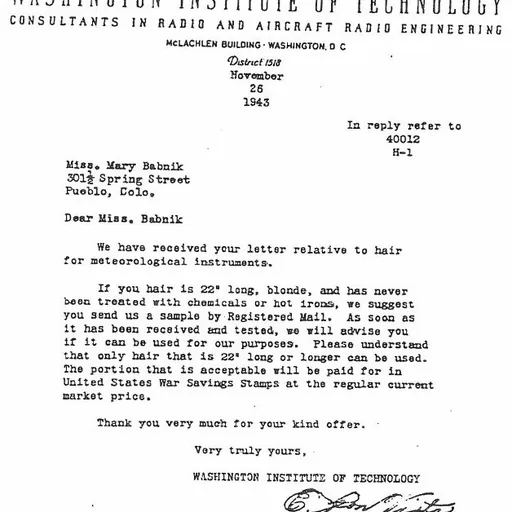
About Mary Babnik Brown
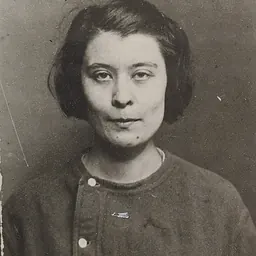
Lived 1907 – 1991 (aged 83). Mary Babnik Brown was an American laborer and dancer.
Mary Babnik Brown (November 22, 1907 – April 14, 1991) was an American woman who became known for donating her hair to the United States military during World War II. long, her blonde hair had never been chemically treated or heated with curling irons.
Early life Brown (née Babnik, often misspelled Babnick) was born in Pueblo, Colorado, to Frank and Mary Babnik, immigrants from Slovenia. Her father worked at the railroad and her mother was a domestic helper. Her parents named her Mitzi, a Slovenian name, but she Americanized it to Mary. The oldest of the children, she had three younger siblings; her sister, Josephine, arrived in 1908, followed by two brothers, Frank in 1910 and Joseph in 1912. Brown spent her early childhood in the Bessemer and Grove neighborhoods of Pueblo. Her father abandoned the family around 1920, leaving her mother to raise the children.
Brown left elementary school when she was 12 years old to help support the family. She first obtained part-time domestic work for $5 a week.
Brown's hair was long and had never been cut, chemically treated or heated with irons. It was her most prized possession. She washed it with "pure soap" twice weekly and combed it twice a day; it stretched down to her knees when she combed it out. She normally wore it wrapped around her head in a braid, and as a result was known as the "lady with the crown".
The government purchasing agent at the Washington Institute of Technology told her that her hair would be used for meteorological instruments. She sent off samples, and they concluded that it would be appropriate. Brown agreed in 1944 to have it cut. The government offered to pay her for it in war savings stamps, but she refused, seeing it as her duty to help in the war effort.
Brown's hair was used in scientific equipment to make precise measurements of humidity, paramount in the production of military aircraft and other war equipment.
Later life Brown married Carl Brown sometime after 1944, and became Mary "Mitzi" Babnik Brown. In 1947 she became vice president of the State Federation of Labor, the first woman to hold that position. Paul Harvey told Brown's story on his nationally broadcast program The Rest of the Story, on November 19, 1990.
Footnotes
Don’t just read it —
keep it.
Full-length biographies made to live with: read them, listen on the way to work, watch them tonight.
- E-book
- Audio
- Video
Instant download · yours to keep · every purchase keeps this site free
Important facts
People in Mary Babnik Brown's life
Named in this biography and alive at the same time

Related people
Same field, nearest in time



Contemporaries
People whose lives overlapped Mary Babnik Brown's



Frequently asked questions
Who was Mary Babnik Brown?
labourer and dancer (1907-1991)
When was Mary Babnik Brown born?
Mary Babnik Brown was born on 22 November 1907 in Pueblo.
When did Mary Babnik Brown die?
Mary Babnik Brown died on 14 April 1991.
What was Mary Babnik Brown's occupation?
Mary Babnik Brown was a laborer and dancer.
What nationality was Mary Babnik Brown?
Mary Babnik Brown was American.
Sources & further reading
· Wikipedia: Mary Babnik Brown
Cite this page
APA: Biography.guide. (2026). Mary Babnik Brown. https://biography.guide/mary-babnik-brown/
MLA: "Mary Babnik Brown." Biography.guide, https://biography.guide/mary-babnik-brown/.
Chicago: "Mary Babnik Brown." Biography.guide. https://biography.guide/mary-babnik-brown/.
Data last updated: 2026-09-22 · Spot an error? Report a correction.
Portrait: Wikimedia Commons · author & licence
Page generated 2026-09-27 05:01 UTC