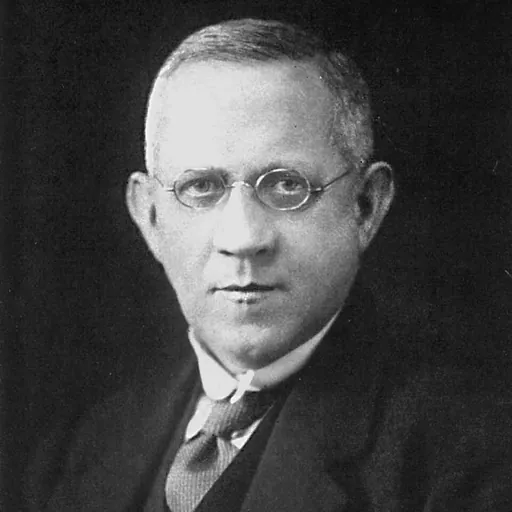
About Martin Lowry
Lived 1874 – 1936 (aged 62). Martin Lowry was a British chemist and physicist, known for Brønsted–Lowry acid–base theory.
Thomas Martin Lowry (; 26 October 1874 – 2 November 1936) was an English physical chemist who developed the Brønsted–Lowry acid–base theory simultaneously with and independently of Johannes Nicolaus Brønsted and was a founder-member and president (1928–1930) of the Faraday Society.
Biography Lowry was born in Low Moor, Bradford, West Riding of Yorkshire, England, in a Cornish family. He was the second son of the Reverend E. P. Lowry who was the minister of the Wesleyan Church in Aldershot from 1892 to 1919. He was educated at Kingswood School, Bath, Somerset, and then at the Central Technical College in South Kensington. During those years he realized that he wanted to be a chemist. He studied chemistry under Henry Edward Armstrong, an English chemist whose interests were primarily in organic chemistry but also included the nature of ions in aqueous solutions. From 1896 to 1913 Lowry was assistant to Armstrong, and between 1904 and 1913 worked as lecturer in chemistry at the Westminster Training College. In 1913, he was appointed head of the chemical department in Guy’s Hospital Medical and became the first teacher of chemistry in a Medical School to be made a university professor, at the University of London. From 1920 till his death, Lowry served as the Chair of Physical Chemistry at the University of Cambridge. He married a daughter of the Rev. C. Wood in 1904 and was survived by his widow, two sons and a daughter. During and after the World War I, Lowry acted as director of shell-filling (1917–1919) and worked for the Trench Warfare Committee, Chemical Warfare Committee and Ordnance Committee. For this service, he was awarded the Order of the British Empire and the Order of Saints Maurice and Lazarus. Lowry published a few hundred papers and several books. His 1935 monograph on "Optical Rotatory Power" (1935) has long been regarded as a standard work on the subject.
Don’t just read it —
keep it.
Full-length biographies made to live with: read them, listen on the way to work, watch them tonight.
- E-book
- Audio
- Video
Instant download · yours to keep · every purchase keeps this site free
Important facts
People in Martin Lowry's life
Named in this biography and alive at the same time



Related people
Same field, nearest in time




Contemporaries
People whose lives overlapped Martin Lowry's

Frequently asked questions
Who was Martin Lowry?
English chemist (1874–1936)
When was Martin Lowry born?
Martin Lowry was born on 26 October 1874 in Low Moor.
When did Martin Lowry die?
Martin Lowry died on 2 November 1936 in Cambridge.
What was Martin Lowry's occupation?
Martin Lowry was a chemist and physicist.
What was Martin Lowry known for?
Martin Lowry was known for Brønsted–Lowry acid–base theory.
What nationality was Martin Lowry?
Martin Lowry was British.
Sources & further reading
Cite this page
APA: Biography.guide. (2026). Martin Lowry. https://biography.guide/martin-lowry/
MLA: "Martin Lowry." Biography.guide, https://biography.guide/martin-lowry/.
Chicago: "Martin Lowry." Biography.guide. https://biography.guide/martin-lowry/.
Data last updated: 2026-09-21 · Spot an error? Report a correction.
Portrait: Wikimedia Commons · author & licence
Page generated 2026-09-27 04:59 UTC