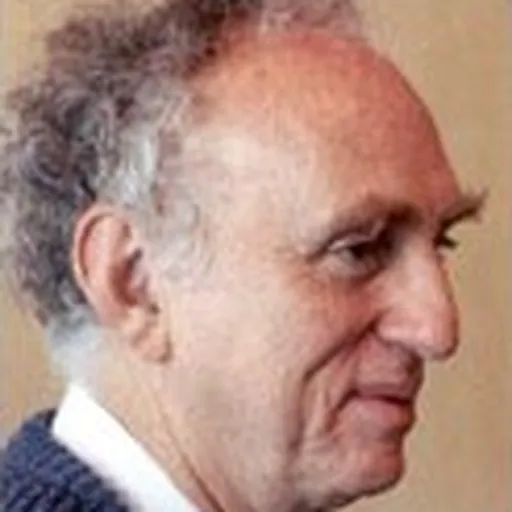
About Martin Lewis Perl
Lived 1927 – 2014 (aged 87). Martin Lewis Perl was an American physicist, engineer and university teacher, known for Tau lepton.
Martin Lewis Perl (June 24, 1927 – September 30, 2014) was an American chemical engineer and physicist who won the Nobel Prize in Physics in 1995 for his discovery of the tau lepton.
Life and career Perl was born in New York City, New York. His parents, Fay (née Resenthal), a secretary and bookkeeper, and Oscar Perl, a stationery salesman who founded a printing and advertising company, were Jewish immigrants to the US from the Polish area of Russia.
Perl was a 1948 chemical engineering graduate of Brooklyn Polytechnic Institute (now known as NYU-Tandon) in Brooklyn. After graduation, Perl worked for the General Electric Company, as a chemical engineer in a factory producing electron vacuum tubes. To learn about how the electron tubes worked, Perl signed up for courses in atomic physics and advanced calculus at Union College in Schenectady, New York, which led to his growing interest in physics, and eventually to becoming a graduate student in physics in 1950. He had the opportunity to start planning experimental work in this area when he moved in 1963 to the Stanford Linear Accelerator Center (SLAC), then being built in California. He was particularly interested in understanding the muon: why it should interact almost exactly like the electron but be 206.8 times heavier, and why it should decay through the route that it does. Perl chose to look for answers to these questions in experiments on high-energy charged leptons. In addition, he considered the possibility of finding a third generation of lepton through electron-positron collisions.
He died after a heart attack at Stanford University Hospital on September 30, 2014, at the age of 87. His son, Jed Perl, is an author and art critic for The New Republic.
The tau was first detected in a series of experiments between 1974 and 1977 by Perl with his colleagues at the SLAC-LBL group. Their equipment consisted of SLAC's then-new – colliding ring, called SPEAR, and the LBL magnetic detector. They could detect and distinguish between leptons, hadrons and photons. SPEAR was able to collide electrons and positrons at higher energies than had previously been possible, initially at up to 4.8 GeV and eventually at 8 GeV, energies high enough to lead to the production of a tau/antitau pair. Hence Perl and his coworkers did not detect the tau directly, but rather discovered anomalous events where they detected either an electron and a muon, or a positron and an antimuon:
The need for at least two undetected particles was shown by the inability to conserve energy and momentum with only one. However, no other muons, electrons, photons, or hadrons were detected. It was proposed that this event was the production and subsequent decay of a new particle pair:
+ → + → + + 4
This was difficult to verify, because the energy to produce the pair is similar to the threshold for D meson production. Work done at DESY-Hamburg, and with the Direct Electron Counter (DELCO) at SPEAR, subsequently confirmed the discovery
Nobel Prize and later career Perl won the Nobel Prize in 1995 jointly with Frederick Reines. The prize was awarded "for pioneering experimental contributions to lepton physics". Perl received half "for the discovery of the tau lepton" while Reines received his share "for the detection of the neutrino". In 1996 he published Reflections on Experimental Science, which consists of "comments, scientific reprints, reflections, and a memoir ...".
He joined University of Liverpool as a visiting professor. He served on the board of advisors of Scientists and Engineers for America, an organization focused on promoting sound science in American government. In 1996, he received the Golden Plate Award of the American Academy of Achievement. In 2009, Perl received an honorary doctorate from the University of Belgrade.
Don’t just read it —
keep it.
Full-length biographies made to live with: read them, listen on the way to work, watch them tonight.
- E-book
- Audio
- Video
Instant download · yours to keep · every purchase keeps this site free
Important facts
Family & relationships
People in Martin Lewis Perl's life
Named in this biography and alive at the same time



Related people
Same field, nearest in time


Contemporaries
People whose lives overlapped Martin Lewis Perl's


Frequently asked questions
Who was Martin Lewis Perl?
American scientist (1927–2014)
When was Martin Lewis Perl born?
Martin Lewis Perl was born on 24 June 1927 in Manhattan.
When did Martin Lewis Perl die?
Martin Lewis Perl died on 30 September 2014 in Palo Alto.
What was Martin Lewis Perl's occupation?
Martin Lewis Perl was a physicist, engineer and university teacher.
What was Martin Lewis Perl known for?
Martin Lewis Perl was known for Tau lepton.
What nationality was Martin Lewis Perl?
Martin Lewis Perl was American.
Sources & further reading
· Wikipedia: Martin Lewis Perl
Cite this page
APA: Biography.guide. (2026). Martin Lewis Perl. https://biography.guide/martin-lewis-perl/
MLA: "Martin Lewis Perl." Biography.guide, https://biography.guide/martin-lewis-perl/.
Chicago: "Martin Lewis Perl." Biography.guide. https://biography.guide/martin-lewis-perl/.
Data last updated: 2026-09-20 · Spot an error? Report a correction.
Page generated 2026-09-27 05:10 UTC