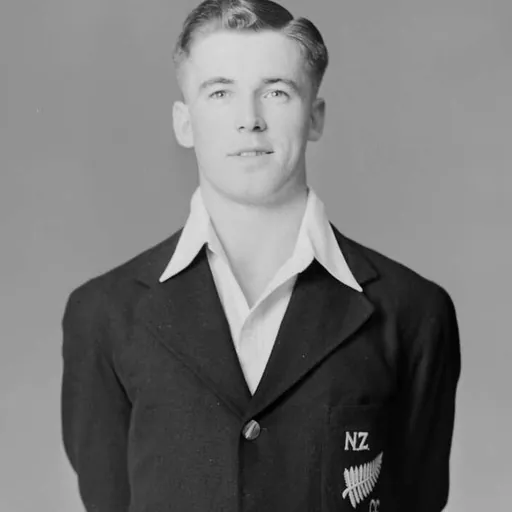
About Martin Donnelly
Lived 1917 – 1999 (aged 82). Martin Donnelly was a New Zealand and British cricketer and rugby union player.
Martin Paterson Donnelly (17 October 1917 – 22 October 1999) was a New Zealand-born sportsman who played Test cricket for New Zealand and rugby union for England. He worked for Courtaulds in England and Sydney.
Personal life Born in Ngāruawāhia, New Zealand, Donnelly's twin brother Maurice died in the Spanish flu epidemic in 1918. Donnelly's maternal great-grandfather, William Butler was a British Army veteran in the 20th Regiment of Foot later renamed the Lancashire Fusiliers and settled in Howick, New Zealand in 1847 as part of the Royal New Zealand Fencible Corps.
Cricket career 1930s Donnelly's sporting talent emerged quickly and Donnelly became known for his batting and fielding skills, as well as his prowess at Rugby Union. He attended New Plymouth Boys' High School, and quickly made an impact- recording 187 for NPBHS in a club match in 1934 which stood as a school record for 76 years. Donnelly made 49 for Taranaki against the touring MCC side in January 1936. This led to his first-class debut in January 1936 for Wellington in a Plunket Shield match against Auckland, in which he made 22 and 38.
Aged only 19, Donnelly was a surprise selection for the 1937 New Zealand tour of England, having played only one first-class match. After showing more promise than results in the warm up matches, the selectors showed patience and Donnelly made his Test debut in the 1st Test at Lord's. He made a duck and 21, but remained in the team to make 4 and 37*, and 58 and 0 in the following two Tests. He achieved greater success against the county sides, finishing second in the batting averages, and earned praise from Wisden, which called him "a star in the making".
Returning to New Zealand, Donnelly moved to Christchurch in 1938 to attend the University of Canterbury and play for Canterbury. While there, he won the Redpath Cup as the best batsman in the Plunket Shield in 1939. He also played rugby for Canterbury University, the Canterbury Provincial XV, and for New Zealand Universities.
1940s At the completion of his degree, Donnelly returned to Wellington but played only one more first-class match before enlisting in the New Zealand Army in 1940. Commissioned in 1941, he served as a tank commander in northern Africa and Italy, rising to the rank of Major. While in Cairo, he purchased what would become his lucky cap, an old multi-striped number, that he would wear whenever he took the field in his post-war cricketing career.
At war's end, Donnelly was a member of the Dominions side that played an England XI at Lord's in 1945, making 133, including a six hit onto the roof of the pavilion, before going up to Worcester College, Oxford, to read history. He played cricket for Oxford University in 1946, scoring six centuries, and then as captain in 1947. He headed the Oxford batting averages each year, gained a reputation as the best left-hander in the world, and won selection as Wisden Cricketer of the Year in 1948.
Following his graduation from Oxford, Donnelly commenced working as a manager for textile manufacturing company Courtaulds while playing cricket for Warwickshire. In 1948, playing for Warwickshire against Middlesex, he was bowled by left-arm spinner Jack Young from the wrong side of the stumps, the ball having bounced off his foot and over his head before landing behind the stumps and spinning back to dislodge the bails.
He continued to impress observers with his attacking style of play, including former champion C B Fry, who believed Donnelly to be the best left-handed batsman he had seen. On this form, Donnelly was chosen for the 1949 New Zealand tour of England, where he continued to enhance his reputation, making 462 runs in the Test series at 77.00, including scores of 64, 206, 75 and 80. Donnelly's 206 at Lord's was the first Test double century by a New Zealander and remained the highest New Zealand Test score until Bert Sutcliffe's 230 not out against India at Delhi in 1955–56.
The 1949 series would prove to be the end of Donnelly's Test career. In all, Donnelly played just seven Tests, all in England, making 582 runs at 52.90.
A short man (his nickname was "Squib"), He died in Sydney on 22 October 1999, survived by his wife, three sons and one daughter.
Donnelly House, one of four houses at New Plymouth Boys' High School, is named in his honour.
Wesley Harte wrote Martin Donnelly: His Record-By-Innings in 1990. A biography titled Martin Donnelly: New Zealand Cricket's Master Craftsman was written by Rod Nye and published in 1999.
Don’t just read it —
keep it.
Full-length biographies made to live with: read them, listen on the way to work, watch them tonight.
- E-book
- Audio
- Video
Instant download · yours to keep · every purchase keeps this site free
Important facts
People in Martin Donnelly's life
Named in this biography and alive at the same time



Related people
Same field, nearest in time


Contemporaries
People whose lives overlapped Martin Donnelly's

Frequently asked questions
Who was Martin Donnelly?
New Zealand sportsman (1917-1999)
When was Martin Donnelly born?
Martin Donnelly was born on 17 October 1917 in Ngāruawāhia.
When did Martin Donnelly die?
Martin Donnelly died on 22 October 1999 in Sydney.
What was Martin Donnelly's occupation?
Martin Donnelly was a cricketer and rugby union player.
What nationality was Martin Donnelly?
Martin Donnelly was New Zealand and British.
Sources & further reading
· DBpedia: Martin Donnelly (sportsman)
Cite this page
APA: Biography.guide. (2026). Martin Donnelly. https://biography.guide/martin-donnelly-cricketer/
MLA: "Martin Donnelly." Biography.guide, https://biography.guide/martin-donnelly-cricketer/.
Chicago: "Martin Donnelly." Biography.guide. https://biography.guide/martin-donnelly-cricketer/.
Data last updated: 2026-09-20 · Spot an error? Report a correction.
Portrait: Wikimedia Commons · author & licence
Page generated 2026-09-27 04:57 UTC