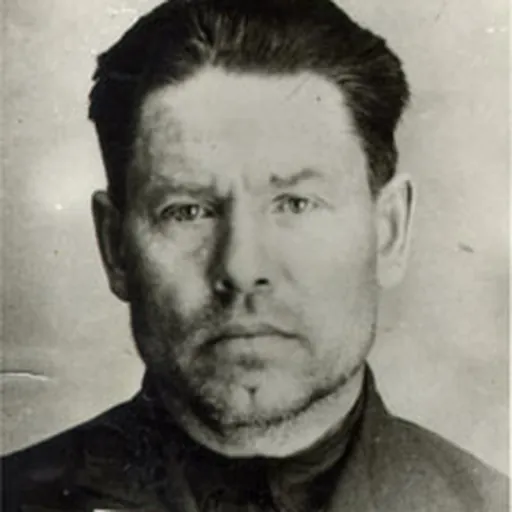
About Martemyan Ryutin
Lived 1890 – 1937 (aged 46). Martemyan Ryutin was a Russian politician.
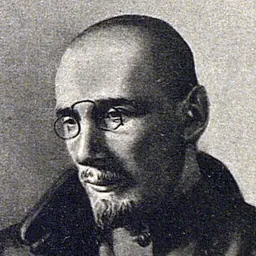
Martemyan Nikitich Ryutin (; 13 February 1890 – 10 January 1937) was a Russian Marxist activist, Bolshevik revolutionary, and a political functionary of the Russian Communist Party. Ryutin is best remembered as the leader of a pro-peasant political faction organized against Soviet leader Joseph Stalin in the early 1930s and as the primary author of a 200-page oppositional platform.
Ryutin was arrested by the Soviet secret police, along with his co-thinkers, in what has come to be known as the Ryutin Affair, in September 1932. He was later executed in January 1937 as part of the “Yezhovshchina" conducted against political oppositionists and suspected economic "wreckers" and spies.
During the final years of the Soviet Union, Ryutin was politically rehabilitated, and his lengthy critique of Stalin and his policies was published for the first time. The document saw its first edition in English translation in 2010.
Biography
Early years
Martemyan Nikitich Ryutin was born on to a peasant family in Verkhne-Ryutino, a village in Irkutsk oblast in Siberia, then part of the Russian Empire. He was descended from an Estonian rebel who was exiled to Siberia in 1830. He worked in a factory from the age of 13, but later graduated from the Irkutsk Teachers' Seminary, and worked as a teacher and journalist. In October 1914, he joined the Menshevik faction of the Russian Social Democratic Labour Party Drafted into the Russian Army in June 1915, he reached the rank of ensign in a Siberian reserve regiment, and was transferred to Harbin, in China, where he was elected chairman of the Harbin garrison Soviet during the February Revolution, and joined the Bolsheviks in summer 1917, around the time that he was elected chairman of Harbin Soviet, but in December was forced to return to Irkutsk after the Chinese had threatened military action against radicalised Russian units in Harbin. He was promoted to head of the more important Krasnaya Presnya Raion Committee in 1927. |
During 1927, Ryutin was the main organiser of the strong arm squads known as 'Uglanov's hooligans', who used intimidation to break up opposition meetings in the Krasnaya Presnya district. In November 1927, he and others forced their way into a locked building where Ivar Smilga and Yevgeni Preobrazhensky were holding an opposition meeting, and began assaulting them. He also disrupted the last public demonstration by the left, when Trotsky and others spoke at the funeral of Adolph Joffe, who had committed suicide in protest at the state of the Communist party. Ryutin spoke on behalf of the leadership in such a confrontational style that Trotsky had to intervene to dissuade the crowd from attacking him. By the end of the month, Ryutin had been removed from his position as Secretary of the city party committee. Upon his return to Moscow, Ryutin sharply criticized the collectivization program in a report to the Politburo. On 1 March of that same year, Ryutin was made a member of the Presidium of the Supreme Council of National Economy (VSNKh), one of the leading state economic planning organizations of the period.
Unlike Bukharin and other leading members of the so-called "Right" in the Communist Party, Ryutin refused to recant his views and endorse the policies of Stalin and his associates. The Stalin faction launched an effort to eliminate Ryutin from the Communist Party in the fall of 1930. Ryutin was accused of "propagandizing right-opportunist views" and the move was made not just from the Central Committee of the VKP(b), but to expel him from the VKP(b) completely. Ryutin was held in jail for investigation but was ultimately released on January 17, 1931, for lack of sufficient evidence.
The so-called Ryutin Platform attacked the "adventurist" tempos of industrialization that were part of the first five-year plan, charging that they had brought about a massive fall in the real income of the working class, high taxation, and an inflationary fall in the value of the currency. In the countryside, Ryutin declared, expropriation through the exertion of brute force had created "appalling impoverishment of the masses and famine" and the flight of "all the young and healthy people" from the countryside.
It is unclear how many individuals read the so-called Ryutin Platform or even how many knew of its existence. According to Russian historian Roy Medvedev, the opposition was organized by Ryutin with his friend P.A. Galkin and included a membership of "fifteen at most." Outside of this small group, it seems that only a handful of party leaders were familiar with the content of the document, including most notably Nikolai Uglanov,
What is clear is that when the secret police discovered the existence of the document, they took its appeal to "destroy Stalin's dictatorship,” and usher “new leaders and heroes” into government as a call for armed revolution. On September 22, 1932, Ryutin was arrested and held for investigation. The expulsions meted were for a period of one year.
A three-person Collegium of the OGPU — consisting of GPU chairman Vyacheslav Menzhinsky, his successor Genrikh Yagoda, and future People's Commissar of Internal Affairs V. A. Balitsky — formally decided the charges against Ryutin. |
Late in 1932, a number of prominent leaders of opposition movements within the Communist Party, including Grigory Zinoviev, Lev Kamenev, and Karl Radek, were called before the Central Control Committee and interrogated about whether they were aware of or had read the so-called Ryutin Platform. Even knowing of the document and failing to report that knowledge was considered a crime.
On January 10, 1937, the Military Collegium of the Supreme Court of the USSR sentenced him to death. He was executed that same day.
The rest of Ryutin's family also suffered brutal repression at the hands of the state, with his younger son Vissarion (born 1913) similarly retried and executed in a camp in Central Asia in 1937 and his older son Vassily (born 1910) shot to death in Lefortovo prison in that same year. His widow was sent to a camp of the Gulag located in Karaganda, where she also perished. The source of this publication was an official typescript of the original handwritten document; the original, if it still exists in the archives, remains to be located.
Footnotes
Don’t just read it —
keep it.
Full-length biographies made to live with: read them, listen on the way to work, watch them tonight.
- E-book
- Audio
- Video
Instant download · yours to keep · every purchase keeps this site free
Important facts
People in Martemyan Ryutin's life
Named in this biography and alive at the same time




Related people
Same field, nearest in time





Contemporaries
People whose lives overlapped Martemyan Ryutin's


Frequently asked questions
Who was Martemyan Ryutin?
soviet politician (1890-1937)
When was Martemyan Ryutin born?
Martemyan Ryutin was born on 1 February 1890 in Irkutsk Governorate.
When did Martemyan Ryutin die?
Martemyan Ryutin died on 10 January 1937 in Moscow.
What was Martemyan Ryutin's occupation?
Martemyan Ryutin was a politician.
What nationality was Martemyan Ryutin?
Martemyan Ryutin was Russian.
Sources & further reading
Cite this page
APA: Biography.guide. (2026). Martemyan Ryutin. https://biography.guide/martemyan-ryutin/
MLA: "Martemyan Ryutin." Biography.guide, https://biography.guide/martemyan-ryutin/.
Chicago: "Martemyan Ryutin." Biography.guide. https://biography.guide/martemyan-ryutin/.
Data last updated: 2026-09-24 · Spot an error? Report a correction.
Portrait: Wikimedia Commons · author & licence
Page generated 2026-09-27 05:08 UTC