
About Marshe Dickinson
Lived 1703 – 1765 (aged 61). Marshe Dickinson was a British politician.
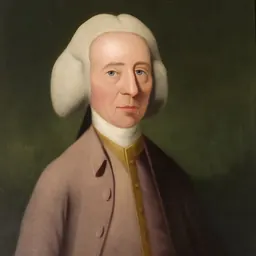
Marshe Dickinson (24 June 1703 – 6 February 1765) was a British politician who sat in the House of Commons between 1754 and 1765 and held the office of Lord Mayor of London between 1756 and 1757. Dickinson served as a Tory Member of Parliament and was affiliated with the interest of the Duke of Bedford during his time in Parliament.
Early life and career Dickinson was the third son of John Dickinson, a London merchant and his wife Elizabeth, daughter of fellow merchant Thomas Powell and goddaughter of Francis Marshe. Dickinson was baptised at the parish church of St Peter le Poer on Broad Street in the City of London on 8 July 1703. Dickinson was educated at Westminster School until the age of fifteen in 1718 and later entered the Inner Temple before being called in 1728 after which he became a city attorney, later being listed as a practicing lawyer.
Marriage and family
In 1726, aged 23, he married Mary Cleve, daughter of Alexander Cleeve and his wife Mary, both of London. Dickinson remained married to his wife until her death in 1732 at the age of 29, after which he does not appear to have remarried. From his marriage Dickinson had two children, Mary Marsh Dickinson born in 1728, and John Marsh Dickinson born in 1730.
Dickinson's son later served as Surveyor of the Gardens and sat on the Board of Green Cloth but was convinced to give up the position to Richard Vernon in favour of a pension despite his father's unease at the proposal. Through his daughter, who married Robert Ball in 1751, Dickinson was the grandfather of officer Ingram Ball and Sir Alexander Ball, later Civil Commissioner of Malta.
Municipal politics
Dickinson was elected a common councillor in the City of London in 1738 and served until 1743. From 1749 until his death he served as an alderman, later becoming a Sheriff of London between 1751 and 1752, and serving a term as Lord Mayor of London between 1756 and 1757. In London politics Dickinson was considered a moderate Tory and aligned with fellow alderman and Member of Parliament for the City of London Robert Ladbroke. The contest occurred while the young Duke of Bridgewater was on his Grand Tour which enabled a strong local opposition to form and organise behind a hitherto unknown outsider, Thomas Humberston.
Bedford, fearing the loss of his nephew's interest in the seat authorised his election agents to spend anywhere up to two-thousand pounds to secure the election of the two pledged candidates. This proved difficult as the local opposition interest was alert and spent equally heavily, thus ensuring its success. Dickinson was easily returned, while Humberston narrowly outpolled Vernon. Humberston desired to consolidate his support in the borough, yet he died a year later, allowing the seat to revert to the Bedford interest.
In the House of Commons Dickinson sat as both a Tory and a Bedfordite at the same time, thus demonstrating the increasing strain that partisan labels were coming under by the midpoint of the 18th-century. Dickinson, like other Tories who owed their seats to Bedford, such as Robert Henley-Ongley were obliged to vote as the Duke pleased, unless issues of party principle intervened. He was proposed as a candidate in London at the 1761 general election, but withdrew after failing to receive sufficient support and was returned unopposed as a Member for Brackley with Robert Wood, an Anglo-Irish antiquarian and fellow Bedfordite. At the reconvening of Parliament in October 1761 Dickinson was discussed as a potential candidate of Speaker of the House of Commons along with fellow Tory Thomas Prowse, Member for Prowse. Ultimately Sir John Cust was elected unanimously to serve as the new Speaker of the House after the resignation of long-serving Speaker Arthur Onslow. Dickinson was, however, elected as the Chairman of Ways and Means in November 1761, a position he was deemed suited to on account of his links to merchants and finance. From this post he was paid a £500 per annum stipend courtesy of the government's secret service funds. This also coincided with the dissipating of the old Tory and Whig parties in favour of a series of personal parties constructed around leading political figures. Dickinson was among the Tories who aligned under the Bedfordite faction, among the smaller factions in Parliament during this period.
Dickinson generally followed the Bedfordite line and supported the Bute and Grenville ministries, which both included the Duke of Bedford within their ranks. Dickinson was a supporter of the peace preliminaries negotiated and agreed to by Bedford in Paris which brought the Seven Years' War to an end. Dickinson did, however, break with Bedford on occasion when his Tory principles or personal pride came into conflict with the Bedfordite line. A notable occasion of this was when Bedford attempted to convince Dickinson's son John to vacate his position on the Board of the Green Cloth in favour of Richard Vernon, with an assurance of a pension. The elder Dickinson viewed this as a slur upon his family, requesting Bedford desist and even appealed to King George III for assistance.
Don’t just read it —
keep it.
Full-length biographies made to live with: read them, listen on the way to work, watch them tonight.
- E-book
- Audio
- Video
Instant download · yours to keep · every purchase keeps this site free
Important facts
People in Marshe Dickinson's life
Named in this biography and alive at the same time




Related people
Same field, nearest in time



Contemporaries
People whose lives overlapped Marshe Dickinson's



Frequently asked questions
Who was Marshe Dickinson?
British Member of Parliament (died 1765)
When was Marshe Dickinson born?
Marshe Dickinson was born on 24 June 1703 in City of London.
When did Marshe Dickinson die?
Marshe Dickinson died on 6 February 1765 in St Albans.
What was Marshe Dickinson's occupation?
Marshe Dickinson was a politician.
What nationality was Marshe Dickinson?
Marshe Dickinson was British.
Sources & further reading
Cite this page
APA: Biography.guide. (2026). Marshe Dickinson. https://biography.guide/marshe-dickinson/
MLA: "Marshe Dickinson." Biography.guide, https://biography.guide/marshe-dickinson/.
Chicago: "Marshe Dickinson." Biography.guide. https://biography.guide/marshe-dickinson/.
Data last updated: 2026-09-25 · Spot an error? Report a correction.
Page generated 2026-09-27 05:11 UTC