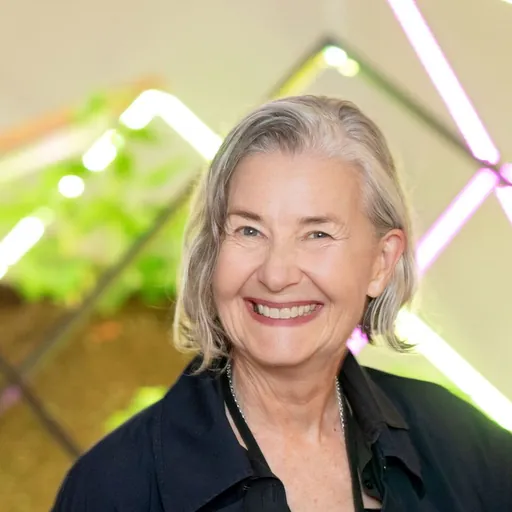
About Marlene McCarty
Born 1957. Marlene McCarty is an American painter, draftsperson, visual artist, graphic designer and installation artist.
Marlene McCarty is a multidisciplinary artist and activist based in New York. She was a member of the AIDS collective Gran Fury and co-founded the trans-disciplinary design studio Bureau. Using everyday materials including graphite, ballpoint pen, and highlighter, McCarty creates mural-sized drawings related to issues ranging from sexual and social formation, gender and power, to parricide and infanticide.
Early life and education
McCarty was born in 1957 and raised in Lexington, Kentucky. After graduating from Sayre School, McCarty attended the University of Cincinnati College of Design Architecture, Art, and Planning (1975- 1977) before studying in Basel, Switzerland, at Schule fur Gestaltung Basel (1978 - 1983),
Career Gran Fury After graduating from Basel in 1983, McCarty moved to New York City's East Village to become an artist. In 1987, while working at M&Co as a designer, McCarty became a member of the AIDS activist art collective Gran Fury. Gran Fury fought to affect AIDS policies, staging public AIDS activist interventions. Their goal was to spread information about AIDS at a time when the government was not speaking on this issue. Their major projects include The Government Has Blood on Its Hands, an action at FDA headquarters in Washington, D.C., that protested Federal policies concerning AIDS drugs, drug trials, and access to drugs. Kissing Doesn't Kill was an appropriation of a Benetton ad showing a diverse group of same sex, interracial, and heterosexual couples kissing, placed on city buses across America countering the public fear that kissing transmitted AIDS.
In January 2012, the first historical survey of Gran Fury’s world-renowned work opened at the NYU Steinhardt 80WSE gallery. The collective’s work is archived at the Whitney Museum of American Art and New York Public Library.
Bureau, 1989-2001
In 1989, McCarty co-founded Bureau with artist Donald Moffett. Bureau was a “trans-disciplinary design studio” In 2014, Bureau received the Visual AIDS Vanguard Award.
Metro Pictures Gallery, 1990s
McCarty landed her first exhibit, Shut Up You Shut Up, at Wessel O-Conner Gallery in 1990. Her early works were large text paintings featuring words such as "Slash" and "Snatch" in a highly stylized typeface, or single phrases such as "I may not go down in history but I may go down on your little sister," and "You're my slut bottom suck." The text was hand drawn and ironed onto T-shirt material that was used as the canvas.
In 1991 McCarty joined Metro Pictures Gallery. Her works were exhibited across the US and Europe accompanied by a catalogue, Die Neoantigen (The Nineties) in 1994 at the Vienna Secession in Austria
Poltergeist, Girls at Home/ The “murder girls” series, 1995–2014
McCarty started research for what was to become her most famous body of work, the “murder girls” series or “Poltergeist, Girls at Home,” a series of 42 mural-sized portraits made with graphite pencil and ball-point pen. Each portrait was based on a true crime case of teenage girls who murdered their mothers, parental figures, or, in some instances, girls who had been murdered by their mothers. McCarty found the final effect of iron-on portraits using the girls' photographs to look like “Warhol wannabes” that were more about production and manufacturing than about the girls themselves.
In McCarty's portraits, the girls wear see-through clothes revealing nipples, breasts, and vulvas. Although McCarty finds the medium physically demanding (because the pressure required to keep the ink flowing when drawing on a wall may cause shoulder injuries), she continues to work with ballpoint pen and graphite, producing monumental works that speak to social and sexual inequality, the role of women, interspecies relationships, and trans biology.
Guggenheim Fellowship
In 2003, McCarty received a Guggenheim Fellowship to research a 3D immersive project, Bad Blood, which was an interactive sculpture based on the portrait of Marlene Olive from the artist's “murder girls” series. As part of her Fellowship, McCarty traveled the world speaking with experts and leading workshops at Hyper Werk Institute for Postindustrial Design in Basel, Switzerland, and the ETH in Zurich. Her project was awarded additional grants from The American Center Foundation and the Site mapping / Bundesamt für Kultur Schweiz grant for technology. Finances required to accomplish her project proved prohibitive. The exhibit at Bronwyn Keenan Gallery, Young Americans, Part 2, featured McCarty's newer multi-figure drawings. One drawing was inspired by an Indiana crime case where four girls murdered a schoolmate because she was having an affair with another girl's female lover.
In 2005, the Brent Sikkema Gallery, which is now known as Sikkema, Jenkins & Co., began representing McCarty's work. In 2008, McCarty presented a major body of work under the exhibition title CANDY.CRY.STINKER.HUG. Mural size drawings that reckoned with queerness, origin, genetics, identity, and love lined the gallery. This work culminated in a monumental 2013 drawing retrospective at the Royal Hibernian Academy of Dublin, Ireland, titled Hard Keepers. These mural-sized drawings included gorillas, orangutans, and chimpanzees signing and using language.
In 2010 New York University’s 80WSE gallery presented the first major survey of Marlene McCarty's paintings, prints, and drawings, “i'm into you now: some work from 1980-2010.” The catalogue included essays by Kathleen Hanna, former lead singer of Le Tigre and Bikini Kill, who wrote, “Marlene's studio was wallpapered with the craziest fucking drawings I’ve ever seen. It looked like a coked up teenage girl decided to take the big pen drawings off her trapper keeper and magnifying them a thousand times. they read like sexed up... paintings advertising a new cult I desperately wanted to join. They were big as billboards obsessive and completely unapologetic.
Into The Weeds
McCarty's most recent works turn to plants to affirm ways not only to survive but also to thrive in toxic conditions.
Into The Weeds was first presented at UB Art Gallery, Center for the Arts, Buffalo, New York, where a large-scale drawing installation was accompanied by an installation of seedlings under grow lights and a large mound of soil that was home to a variety of potent plants. At once poisonous and healing, McCarty used plants that have historically been used by women to maintain their sexual and reproductive health. Mugwort, for instance, promotes menstruation and can be used to induce abortion and regulate hormonal changes during menopause. The majority of the plants are wild and considered to be weeds.
Her drawings ruminate on masculinity, capitalism, whiteness, and their inherent toxicities, layering and merging unruly poisonous flowers with flesh and hair, using graphite and ballpoint pen. Alongside the installation, McCarty includes newsprint pamphlets identifying the plants’ poisonous properties and medicinal uses, as well as including the local history of the plants and geographical area.
To extend the project outside of the gallery walls, McCarty created a 45-foot diameter public garden of poisonous plants, with the support of UB Arts Collaboratory and Silo City. The garden, which is McCarty's first living earthwork, is under Silo City's long-term stewardship and the care of ecologist Josh Smith. the Rubell Museum, the Queens Museum, Contemporary Art Museum, Houston, the Smith College Museum of Art, the Berkeley Art Museum, and the Nasher Museum of Art. The permanent garden Into The Weeds is open to the public in Buffalo, New York.
Don’t just read it —
keep it.
Full-length biographies made to live with: read them, listen on the way to work, watch them tonight.
- E-book
- Audio
- Video
Instant download · yours to keep · every purchase keeps this site free
Important facts
People in Marlene McCarty's life
Named in this biography and alive at the same time





Related people
Same field, nearest in time



Contemporaries
People whose lives overlapped Marlene McCarty's




Frequently asked questions
Who is Marlene McCarty?
American visual artist (born 1957)
When was Marlene McCarty born?
Marlene McCarty was born in 1957 in Kentucky, Lexington.
What is Marlene McCarty's occupation?
Marlene McCarty is a painter, draftsperson, visual artist, graphic designer and installation artist.
What nationality is Marlene McCarty?
Marlene McCarty is American.
Sources & further reading
Cite this page
APA: Biography.guide. (2026). Marlene McCarty. https://biography.guide/marlene-mccarty/
MLA: "Marlene McCarty." Biography.guide, https://biography.guide/marlene-mccarty/.
Chicago: "Marlene McCarty." Biography.guide. https://biography.guide/marlene-mccarty/.
Data last updated: 2026-09-21 · Spot an error? Report a correction.
Portrait: Wikimedia Commons · author & licence
Page generated 2026-09-27 05:00 UTC