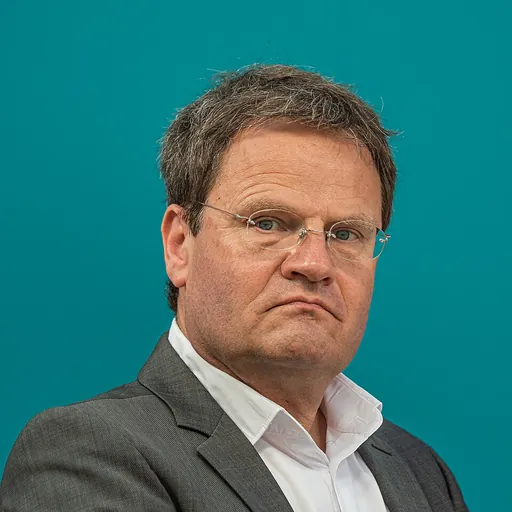
About Markus Rex
Born 1966. Markus Rex is a physicist and university teacher.
Markus Rex (born 28 November 1966 in Braunschweig, Germany) is a German polar researcher, climate scientist, physicist, and author. His research focuses on atmospheric physics, polar climate processes, ozone depletion, and interactions between the atmosphere and sea ice. He is best known for leading the MOSAiC expedition (2019–2020), the largest international Arctic research expedition to date. He is a professor at the University of Potsdam and serves as head of the Atmospheric Physics Section at the Alfred Wegener Institute (AWI).
Career Markus Rex was born in Braunschweig, as was his sister Gundula, to Dietrich Rex, a professor of space engineering, and Ursula Rex (née Schiller). After completing his secondary education at the Raabeschule in Braunschweig in 1986, he studied physics, geophysics, and meteorology at the Technical University of Braunschweig. He later continued his studies in Göttingen and completed his diploma thesis in 1992 using data from an Arctic research project. The thesis, titled Stratospheric Ozone Depletion Rates Derived from Ozone Sounding Data of the EASOE Campaign, marked the beginning of his research on the polar ozone hole.
Rex earned his Ph.D. from the Free University of Berlin in 1997 under the supervision of Karin Labitzke and Steven Pawson. From 2001 to 2004, Rex led the BMBF-funded junior research group DYCHO (Dynamics and Chemistry of the Ozone Layer in a Changing Atmosphere), which investigated the effects of dynamical and chemical processes on the ozone layer. Rex is actively involved in science communication and is the author of the Der Spiegel bestseller Frozen at the North Pole. In 2004, Rex and colleagues provided the first empirical quantification of the relationship between Arctic ozone loss and stratospheric climate change, showing that cooling of the Arctic lower stratosphere substantially increases ozone depletion and suggesting that severe ozone losses observed during the 1990s resulted from both anthropogenic halogens and long-term changes in Arctic stratospheric climate.
Rex and colleagues also developed the SWIFT (Semi-empirical Weighted Iterative Fit Technique) ozone chemistry module, a computationally efficient version of the ATLAS model designed for coupling ozone chemistry to climate models.
From 2019 to 2020, Rex, together with his two deputies, Klaus Dethloff and Matthew Shupe, led the international research project MOSAiC (Multidisciplinary drifting Observatory for the Study of Arctic Climate), a year-long Arctic expedition that investigated the impacts of climate change. The expedition involved hundreds of scientists from numerous countries and represented the largest international Arctic research expedition to date. During the mission, the research icebreaker Polarstern drifted with Arctic sea ice for a full year to collect observations of the Arctic climate system.
Awards and honors
1999 – Ernst‑Reuter‑Preis of Freie Universität Berlin for his doctoral dissertation on atmospheric physics. 2004 – Dobson Award of the International Ozone Commission (IOC) for his research on Arctic ozone depletion, including his publication “On the unexplained stratospheric ozone losses during cold Arctic Januaries”. 2019 – Included in Nature's "Ones to Watch in 2020" list for leadership of the MOSAiC expedition. 2022 – Arctic Circle Prize, awarded to the Alfred Wegener Institute and the MOSAiC Expedition, which was led by Markus Rex, in recognition of their contribution to advancing understanding of Arctic climate change. 2024 – IASC Award for Service from the International Arctic Science Committee (IASC) for his contributions to Arctic research and leadership within the MOSAiC project. 2025 – NOMIS Distinguished Scientist and Scholar Award for his project *Deepcloud*, which develops new AI‑based approaches to model cloud processes and improve understanding of Arctic cloud feedbacks in a warming climate.
Don’t just read it —
keep it.
Full-length biographies made to live with: read them, listen on the way to work, watch them tonight.
- E-book
- Audio
- Video
Instant download · yours to keep · every purchase keeps this site free
Important facts
People in Markus Rex's life
Named in this biography and alive at the same time

Related people
Same field, nearest in time


Contemporaries
People whose lives overlapped Markus Rex's


Frequently asked questions
Who is Markus Rex?
German physicist (1966-)
When was Markus Rex born?
Markus Rex was born on 28 November 1966 in Brunswick.
What is Markus Rex's occupation?
Markus Rex is a physicist and university teacher.
Sources & further reading
Cite this page
APA: Biography.guide. (2026). Markus Rex. https://biography.guide/markus-rex/
MLA: "Markus Rex." Biography.guide, https://biography.guide/markus-rex/.
Chicago: "Markus Rex." Biography.guide. https://biography.guide/markus-rex/.
Data last updated: 2026-09-23 · Spot an error? Report a correction.
Portrait: Wikimedia Commons · author & licence
Page generated 2026-09-27 05:04 UTC