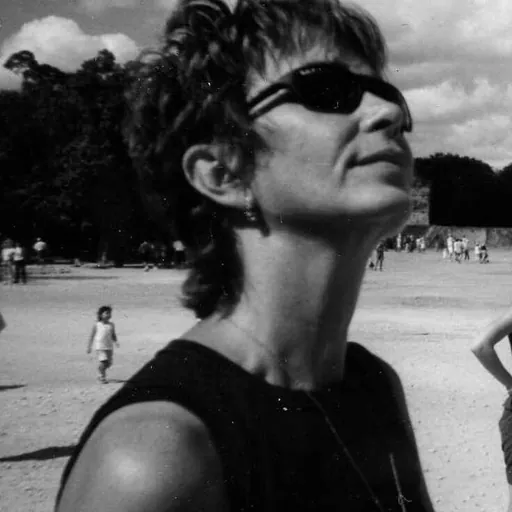
About Marisa Sistach
Born 1952. Marisa Sistach is a Mexican director, film director, screenwriter and writer.
Marisa Sistach (né Marysa Sistach Peret, born September 10, 1952) is a Mexican film director. Her films address themes of femininity and women's issues.
Early life Peret was born on September 10, 1952, in Mexico City, Distrito Federal, Mexico.
Career Her first film was short live-action piece ¿Y si Platicamos de Agosto? in 1980, for which she won an Ariel (Mexican Academy Award). Other films she has directed include Perfume de violetas (2001), El cometa (1999), Anoche soñé contigo (1992), Los pasos de Ana (1990), La niña en la piedra (2006) and Los Crímenes de Mar del Norte (2017).
Legacy Her films are a social commentary on gender inequality, violence against women, socioeconomic class and adolescence. Screening Minors in Latin American Cinema described Sistach's directorial perspective on these issues, saying, "films such as Sistach's highlight the socioeconomic divide between adolescence and sexual exploration in those higher up versus lower down on the economic scale. Moreover, they illustrate the lack of agency and recourse to justice available to adolescents on the lower end of the economic scale - especially female adolescents who are twice marginalized by gender and economic status."
According to Rashkin, Sistach's Los pasos de Ana (1990), along with Busi Cortés' El secreto de Romeila (1988) were the two most popular feature films directed by Mexican women of their time. Her films were described by critics as innovative, as they opened doors and created opportunities for women in cinema and film production.
Rashkin stated that the works created a genre of "women's cinema" that took women characters beyond objectification. She further remarked that Sistach's work allowed for more autonomy for women in film. She aimed to reshape the portrayal of women in Mexican cinema, saying,"I believe that women have to invent, in our field of work, a new language that will be nourished by the common experiences of our individual histories. This woman’s word should be inscribed in our culture. To destroy the false mirror of woman that is, in general, the cinema. . . . It means reappropriating our image and in doing so, seeking our identity." Sistach's perspective is to comment on societal constructs in Mexico as well as to present a feminist demand for change in patriarchal aspects of this society. Critic Diego de Pozo's commentary on Sistach's Perfume de violetas celebrates both of these purposes, stating,"Perfume de violetas shows how the city and its economy interact, which in turn has an effect on individuals as manifested in family and social interaction and expectancies and including the constructions of gender. All of these elements are intensified in the broad lower-class. Sistach's film becomes a representation of how the urban setting, with its limited access and drive to attain capital, provokes sexual violence against females and transforms these citizens into agents of violence to secure survival [...] Perfume de violetas denounces the governmental and societal ignorance which affects females in Mexico. The protagonist interacts with a dominant culture and an urban space that provoke sexual violence against the female subject. The home and school spheres create the construction of gender which result in violence when females enter the public space."
Filmography +YearTitleDescription1980¿Y si Platicamos de Agosto? Two young people in the 1968 student's movement are awakened to love and social conscience. 1983Conozco a los tresA film of single and divorced mothers, responding to the 'nuclear families of classic melodramas'. 1992Anoche soñé contigoTwo teenage boys hoping to spend their summer fulfilling sexual conquests and experiences are in for a surprise when one of the boys' older, more sexually experienced cousin Azucena comes to visit. 1995La línea paternaUsing the home movies of his grandfather Dr. Jose Buil Belenguer, Jose Buil shows a personal history of his life, portraying the intimate life of Mexican domestic life in the small town of Papantia. 1999El CometaAfter her father is arrested for publishing material contradictory to the regime of Mexican dictator Portifirio Diaz, young Valentina escapes to join forces with rebels in Texas. 2001Perfume de violetasThe friendship of Yessica and Miriam, two young girls from different social backgrounds in Mexico city, is put to the test when one of the girls is sexually assaulted.2006La niña en la piedraWhen teenage Gabi's romantic advances are rejected by Mati, he decides to take revenge. 2007El brassier de EmmaEmma, undergoing adolescence, deals with a difficult family situation and her changing figure as she realizes breasts are the centre of the universe. 2014La fórmula del doctor FunesDr. Funes invents a formula that can turn adults into young people and upon testing it on himself, he turns into a 12-year old boy. 2017Los Crímenes de Mar del NorteA young chemistry student Jorge and his girlfriend Paquita's relationship is put to the test when the police find corpses in the garden of the laboratory.
Don’t just read it —
keep it.
Full-length biographies made to live with: read them, listen on the way to work, watch them tonight.
- E-book
- Audio
- Video
Instant download · yours to keep · every purchase keeps this site free
Important facts
People in Marisa Sistach's life
Named in this biography and alive at the same time
Related people
Same field, nearest in time






Contemporaries
People whose lives overlapped Marisa Sistach's



Frequently asked questions
Who is Marisa Sistach?
Mexican film director (b. 1952)
When was Marisa Sistach born?
Marisa Sistach was born on 10 September 1952 in Mexico City.
What is Marisa Sistach's occupation?
Marisa Sistach is a director, film director, screenwriter and writer.
What nationality is Marisa Sistach?
Marisa Sistach is Mexican.
Sources & further reading
· DBpedia: Marisa Sistach Peret
Cite this page
APA: Biography.guide. (2026). Marisa Sistach. https://biography.guide/marisa-sistach/
MLA: "Marisa Sistach." Biography.guide, https://biography.guide/marisa-sistach/.
Chicago: "Marisa Sistach." Biography.guide. https://biography.guide/marisa-sistach/.
Data last updated: 2026-09-22 · Spot an error? Report a correction.
Portrait: Wikimedia Commons · author & licence
Page generated 2026-09-27 05:00 UTC