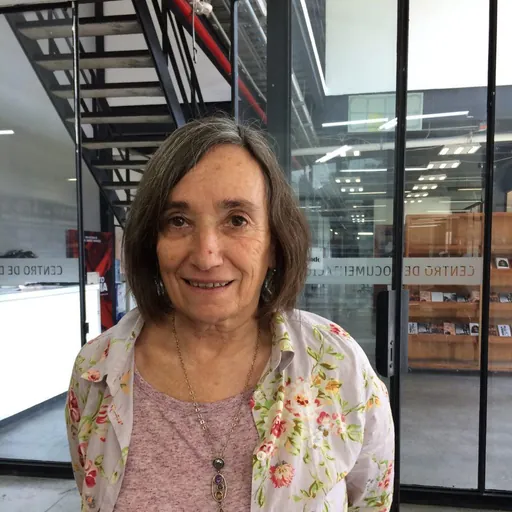
About Busi Cortés
Lived 1950 – 2024 (aged 73). Busi Cortés was a Mexican director, film director, screenwriter, documentarian, documentary filmmaker and filmmaker.
Luz Eugenia Cortés Rocha (June 28, 1950 – June 21, 2024), better known as Busi Cortés, was a Mexican filmmaker, screenwriter, documentarian and professor. Her work as a director and screenwriter had a significant impact on Mexican cinema, bringing in women's perspectives, particularly of women in Mexican politics.
She emerged as a filmmaker with 1988's El secreto de Romelia, which was the first film produced by the Centro de Capacitación Cinematográfica under its Óperas Primas initiative, which supports debut feature films by young artists. Cortés would go on to teach at the CCC.
Biography Luz Eugenia Cortés Rocha was born in Mexico City in 1950, to a family with roots in Guanajuato. She studied communications at the Universidad Iberoamericana, then enrolled in the Centro de Capacitación Cinematográfica in 1977. The film, based on Rosario Castellanos' novel El viudo Román, won various national and international prizes. She also wrote a children's program, Rogelio y los rollos velados, in 2014.
She was a Sistema Nacional de Creadores de Arte grant recipient, a member of the Academia Mexicana de Artes y Ciencias Cinematográficas, and a member of the Union of Cinema Production Workers. A strong activist for women working in film, she co-founded and served as president of Mexico's Women in Film and Television Association. In 2018, she obtained a master's degree from the University of Guadalajara and Cineteca Nacional's film studies program, examining the impact of her own film El secreto de Romelia over the previous three decades. She also taught at the CCC, her alma mater.
On June 19, 2024, it was announced that Cortés would be awarded the Golden Ariel, the highest honor in the Mexican film industry. She died two days later, at the age of 73.
Filmography
Feature films
1988 – El secreto de Romelia. 1991 – Serpientes y escaleras. 2005 – Hijas de su madre: Las Buenrostro.
Featurettes
1981 – Hotel Villa Goerne. 1983 – El lugar del corazón.
Short films
1978 – Las Buenromero. 1979 – Un frágil retorno. 1997 – Unidos.
Documentaries
1973 – La séptima filmación. 1992 – Déjalo ser. 2000 – Paco Chávez. 2010 – La escuela viva. 2011 – En trazos de vida. Son de Rina y Bustos.
TV series
1984–1985 – De la vida de las mujeres. 1993–1997 – Cultura en movimiento. 1994–1997 – El aula sin muros, medio siglo de tarea. 1994–1997 – Retos y respuestas. 1996–1997 – Pasando el siglo en el cine. 1998–2000 – ABC Discapacidad. 2002 – Santitos y santones. 2014 – Kipatla (screenwriter).
Don’t just read it —
keep it.
Full-length biographies made to live with: read them, listen on the way to work, watch them tonight.
- E-book
- Audio
- Video
Instant download · yours to keep · every purchase keeps this site free
Important facts
People in Busi Cortés's life
Named in this biography and alive at the same time

Related people
Same field, nearest in time





Contemporaries
People whose lives overlapped Busi Cortés's


Frequently asked questions
Who was Busi Cortés?
Mexican filmmaker (1950–2024)
When was Busi Cortés born?
Busi Cortés was born on 28 June 1950 in Mexico City.
When did Busi Cortés die?
Busi Cortés died on 21 June 2024.
What was Busi Cortés's occupation?
Busi Cortés was a director, film director, screenwriter, documentarian, documentary filmmaker and filmmaker.
What nationality was Busi Cortés?
Busi Cortés was Mexican.
Sources & further reading
Cite this page
APA: Biography.guide. (2026). Busi Cortés. https://biography.guide/busi-cortes/
MLA: "Busi Cortés." Biography.guide, https://biography.guide/busi-cortes/.
Chicago: "Busi Cortés." Biography.guide. https://biography.guide/busi-cortes/.
Data last updated: 2026-09-20 · Spot an error? Report a correction.
Portrait: Wikimedia Commons · author & licence
Page generated 2026-09-27 04:57 UTC