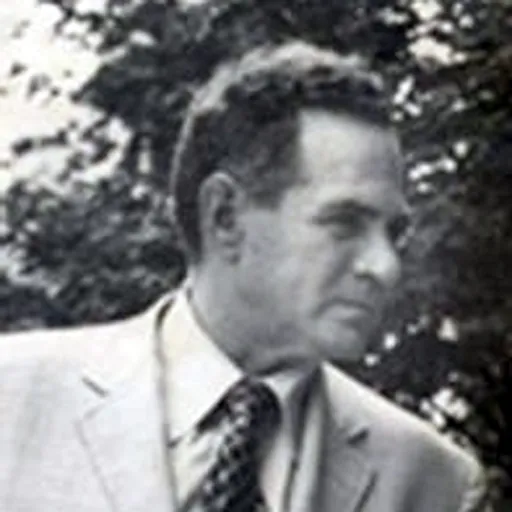
About Mario Romañach
Lived 1917 – 1984 (aged 66–67). Mario Romañach was a Cuban architect.
Mario Romañach (1917–1984) was a Cuban modernist architect, planner, and university professor.
Biography
Mario Romañach finished his higher studies at the University of Havana and, along with Max Borges Jr., Frank Martínez, Nicolás Quintana, Ricardo Porro, Antonio Quintana Simonetti and Emilio del Junco, was one of the architects students who participated in the "Burning of Vignola" event. They sought to rebel against the education system in force until then in Cuba. The event took place in the courtyard of the School of Architecture of the University of Havana in 1944, when a group of students and recent graduates burned several copies of the Practical Elemental Treaty of Architecture or Study of the Five Orders of Vignola (1507-1573), exponent of the teaching of classical architecture. From this date, Mario Romañach began his career as one of the most outstanding professionals of modern architecture in Cuba.
1956 Plan Piloto
Plan Piloto de la Habana. 1956. Mario Romañach, Gabriela Menéndez and Josep Lluís Sert's design for the new Presidential Palace near the Castle of San Carlos de La Cabaña.
"Fulgencio Batista in the modernity of the 50s hires the important Catalan architect Josep Lluis Sert who had worked with Le Corbusier in his atelier on Rue de Sevres 35 in Paris. Sert elaborates the Havana Master Plan in collaboration with Paul Lester Wiener and Paul Schulz in 1956. For the Republic of Cuba, the architects Nicolás Arroyo, Minister of Public Works of the Batista government and the talented architect Mario Romañach participate in its construction."
Mario Romañach, collaborated on the Plan Piloto under the auspices of the Minister of Public Works, and the National Planning Board of Cuba between 1955 and 1958, in the development of the Plan Piloto for Havana. The Town Planning Associates, a consulting firm from New York, led by the Catalan architect Josep Lluís Sert, and its partners Paul Lester Wiener and Paul Schulz, was hired by the Minister of Public Works with the intention of guiding the development of the continuous growth of the city of Havana during the next decade. The entire metropolitan area of Havana would have been affected by the Plan Piloto which included recommendations for the development of unbuilt areas and the distribution of the four functions of the Athens Charter as outlined by Le Corbusier's manifesto for urban planning published in 1943 for the Congrès Internationaux d'Architecture Moderne resulting in "The Functional City" through new, modernist zoning. The most significant element of the Pilot Plan was a comprehensive transportation system for Havana. The aim of the Plan was to contain the different efforts of the various historical periods within the city planning conceptual order. The Sert and Wiener Plan focused on providing improved accessibility for traffic to the heart of the old city. "Two major north-south dual carriageways were planned to cut through the center of the Old Havana on Calle Cuba and Calle Habana. A further dual carriageway was to cut through the center on an east-west axis along Calle Muralla, and alternate streets on the city grid in both directions were to be widened. In true ‘tabula rasa’ fashion the city blocks in the entire area enclosed by these dual carriageways were to be demolished and replaced with a series of classic modernist slab blocks." This residence is, perhaps, one of the main exponents of Cuban architecture of all times and one of the best examples of rationalism in Havana; it is an excellent modern interpretation of traditional Cuban residential architecture. The house is an elongated prism, the typical white box, to which a portion is subtracted, and thus creates a kind of "inner courtyard", like the Cuban colonial house. The volumes separated by this "patio" are joined by two galleries that connect them. It complies with the rationalist dictates to the letter: free floor plan, continuous windows, a free facade, pilotis, etc. The house is not only exceptional for its extraordinary visual values, but also for its amazing adaptation to the Cuban tropical climate.
Gallery
Don’t just read it —
keep it.
Full-length biographies made to live with: read them, listen on the way to work, watch them tonight.
- E-book
- Audio
- Video
Instant download · yours to keep · every purchase keeps this site free
Important facts
People in Mario Romañach's life
Named in this biography and alive at the same time




Related people
Same field, nearest in time

Contemporaries
People whose lives overlapped Mario Romañach's

Frequently asked questions
Who was Mario Romañach?
Cuban architect
When was Mario Romañach born?
Mario Romañach was born in 1917 in Havana.
When did Mario Romañach die?
Mario Romañach died on 8 March 1984 in Philadelphia.
What was Mario Romañach's occupation?
Mario Romañach was an architect.
What nationality was Mario Romañach?
Mario Romañach was Cuban.
Sources & further reading
Cite this page
APA: Biography.guide. (2026). Mario Romañach. https://biography.guide/mario-romanach/
MLA: "Mario Romañach." Biography.guide, https://biography.guide/mario-romanach/.
Chicago: "Mario Romañach." Biography.guide. https://biography.guide/mario-romanach/.
Data last updated: 2026-09-20 · Spot an error? Report a correction.
Page generated 2026-09-27 05:10 UTC