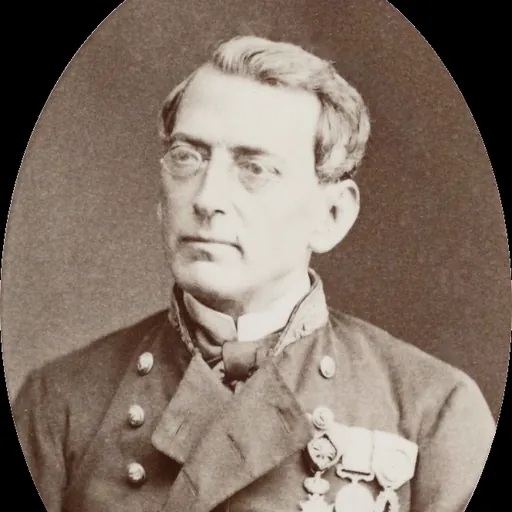
About Marie-Théophile Griffon du Bellay
Lived 1829 – 1908 (aged 79). Marie-Théophile Griffon du Bellay was a French physician, explorer, ethnobotanist and naval surgeon.
Griffonia simplicifolia: the genus Griffonia, a member of the legume family Fabaceae, is named in honour of Griffon du Bellay, who undertook an early study of the properties and uses of G. simplicifolia in Gabon.
Marie-Théophile Griffon du Bellay (14 August 1829 – 10 November 1908) was a French physician, naval surgeon, explorer and ethnobotanist.
Life Marie-Théophile was born at Rochefort, the middle child of the three sons of Joseph Jean Baptiste Alexandre Griffon du Bellay and Marie Elisabeth Claire de Nesmond. His father was one of the last remaining survivors of the infamous wreck of the Medusa (upon which he had served as secretary to the then governor of Senegal Colonel Julien-Désiré Schmaltz) and became a commissioner in the French Navy. Qualifying as a naval surgeon at the age of 20 in 1849, Marie-Théophile served on several French naval vessels between 1850 and 1861, his periods of service interspersed with time ashore in the port town of Rochefort. On the eighth of March 1856, he qualified as Doctor of Medicine, his doctoral thesis at the University of Montpellier being entitled Essai sur le Tétanos ("Essay upon Tetanus"). Surgeon first class of the ship Pionnier, under the command of Paul Augustin Serval, he twice attempted to reach the Ogooué River of Gabon in the year 1862. Stranded and unwell at the river delta, in July of that year, he was forced, in December, to give up his attempt and allow his companion to travel on alone up the valley of the river Remboué (now protected as part of Gabon's Pongara National Park).
From 25 December 1867, he was principal physician aboard the Caravane, a Hospital ship stationed in Gabon. During this time he undertook studies of Tabernanthe iboga and also of Griffonia simplicifolia (the genus Griffonia having been named in his honour by fellow physician and botanist Henri Baillon in 1865), and was among the earliest European physicians to describe sleeping sickness*. He wrote, in addition papers concerning the efficacy of quinine sulphate in his successful treatment of cases of malaria.
In 1871 he became director of the health service for the départements of la Vendée, Loire-Atlantique and Morbihan. Thereafter he worked in Guadeloupe from 1868 to 1871, (where he was confronted by an epidemic of yellow fever ) and then in Senegal from 1877 to 1878. He was for some years a member of the Société des archives historiques de la Saintonge et de l'Aunis. His name features on a monument commemorating the glorious African dead and fallen patriots of AOF in Dakar.
Note* : The French language website Bibliographies de l'Ecole Navale claims that Griffon du Bellay was the first European physician to describe sleeping sickness, but the Wikipedia page African trypanosomiasis does not support this claim, presenting evidence that British naval surgeon John Atkins described the disease on his return from West Africa in 1734, over a century earlier.
Siblings Two brothers: Frédéric Sylvestre Griffon du Bellay. Commissioner in the French navy. Born 11 October 1826 in Rochefort, Charente-Maritime. Died 27 May 1889 in Nantes (Loire-Atlantique). Officer of the Légion d'honneur. Alfred Honoré Ferdinand Griffon du Bellay. Officer of the 2nd infantry regiment of the French navy. Born 7 March 1841 in Martinique.
Ethnobotany In the course of his stay in Gabon, Griffon du Bellay collected 450 plant species, recording ethnobotanical information concerning their various uses. Most notable among these were the powerful stimulant and hallucinogen Tabernanthe iboga (family Apocynaceae), used in the indigenous Bwiti religion, and the legume Griffonia simplicifolia, which is rich in the serotonin precursor 5-HTP. He also encountered the use of Strophanthus hispidus (family Apocynaceae) as an arrow poison. He later displayed his plant collections in an exhibit at the Exposition universelle d'art et d'industrie de 1867, for which he won two medals.
Works Essai sur le Tétanos, ("Essay upon Tetanus" (doctoral thesis)) 1856 Exploration du fleuve Ogo-Way, côte occidentale d'Afrique (juillet-août 1862) ("Exploration of the River Ogo-Way (Ogooué), on the west coast of Africa (July–August 1862")), Revue maritime et coloniale, (Maritime and Colonial Review) vol. 9, 1863, et 296-309 Lettre sur l'Ogooué, ("Letter concerning the (River) Ogooué") Bulletin de la Société de Géographie (Bulletin of the Geographical Society), 1864, vol. 7, Le Gabon, Le Tour du monde, II, 1865,
Decorations Like his father before him, Griffon du Bellay rose to the second degree (officer) in the prestigious Légion d'honneur, France's highest order of merit for military and civil merits, established in 1802 by Napoleon Bonaparte and retained by all later French governments and régimes.
Awarded first degree: Chevalier de la Légion d'honneur, 13 August 1863. Awarded second degree: Officier de la Légion d’Honneur, 28 December 1869.
He was also made an Officier d'instruction publique, the second degree (insignia: golden palms) of the Ordre des Palmes académiques, a national order bestowed by the French Republic on distinguished academics and teachers and for valuable service to universities, education and science.
Gallery
Don’t just read it —
keep it.
Full-length biographies made to live with: read them, listen on the way to work, watch them tonight.
- E-book
- Audio
- Video
Instant download · yours to keep · every purchase keeps this site free
Important facts
People in Marie-Théophile Griffon du Bellay's life
Named in this biography and alive at the same time


Related people
Same field, nearest in time


Contemporaries
People whose lives overlapped Marie-Théophile Griffon du Bellay's




Frequently asked questions
Who was Marie-Théophile Griffon du Bellay?
French, physician, naval surgeon, explorer and ethnobotanist
When was Marie-Théophile Griffon du Bellay born?
Marie-Théophile Griffon du Bellay was born on 14 August 1829 in Rochefort.
When did Marie-Théophile Griffon du Bellay die?
Marie-Théophile Griffon du Bellay died on 10 November 1908 in Saint-Nazaire.
What was Marie-Théophile Griffon du Bellay's occupation?
Marie-Théophile Griffon du Bellay was a physician, explorer, ethnobotanist and naval surgeon.
What nationality was Marie-Théophile Griffon du Bellay?
Marie-Théophile Griffon du Bellay was French.
Sources & further reading
· Wikipedia: Marie-Théophile Griffon du Bellay
· DBpedia: Marie-Théophile Griffon du Bellay
Cite this page
APA: Biography.guide. (2026). Marie-Théophile Griffon du Bellay. https://biography.guide/marie-theophile-griffon-du-bellay/
MLA: "Marie-Théophile Griffon du Bellay." Biography.guide, https://biography.guide/marie-theophile-griffon-du-bellay/.
Chicago: "Marie-Théophile Griffon du Bellay." Biography.guide. https://biography.guide/marie-theophile-griffon-du-bellay/.
Data last updated: 2026-09-22 · Spot an error? Report a correction.
Portrait: Wikimedia Commons · author & licence
Page generated 2026-09-27 05:04 UTC