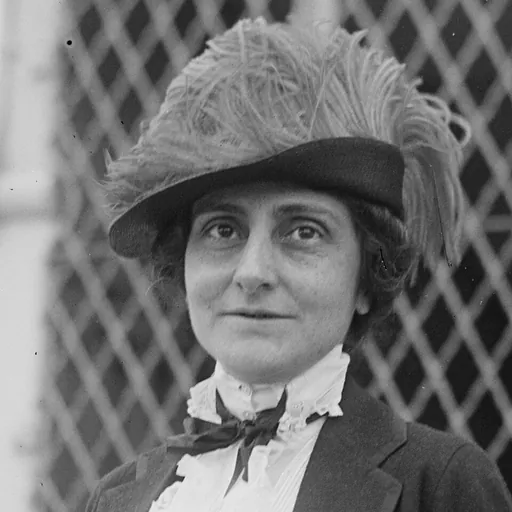
About Marie Mattingly Meloney
Lived 1878 – 1943 (aged 64). Marie Mattingly Meloney was an American journalist.
Marie Mattingly Meloney (December 8, 1878 – 1943), who used Mrs. William B. Meloney as her professional and social name, was "one of the leading woman journalists of the United States", a magazine editor and a socialite who in the 1920s organized a fund drive to buy radium for Marie Curie and began a movement for better housing. In the 1930s, nicknamed Missy, she was a friend and confidante of Eleanor Roosevelt.
Biography Personal life Marie Mattingly was born on December 8, 1878, in Bardstown, Kentucky, the daughter of Cyprian Peter Mattingly, a physician, and his third wife, the former Sarah Irwin (1852–1934), an educationist and journalist who was the founding editor of The Kentucky Magazine, "one of the first publications of literature and science to be edited by a woman". Sarah Irwin Mattingly joined the faculty of the Washington College for Girls in 1891, and later became the school's president, serving until the school closed in 1896.
Marie was educated privately at home
After a month-long bout of influenza, Marie Meloney died June 23, 1943, in the same house on South Quaker Hill in Pawling. After a procession from the residence of her son at 7 Washington Square North, New York City, a requiem mass was recited for her on June 25 in St. Patrick's Cathedral, by Monsignor John J. Casey. Former U.S. President Herbert Hoover was an honorary pallbearer, as were Owen D. Young, former head of the General Electric Company; James A. Farley, chairman of the New York State Democratic Committee, and David Sarnoff, president of the Radio Corporation of America. Among the five hundred mourners were Bishop John F. O'Hara, military delegate of the Armed Forces of the United States; Mrs. Hoover, playwright Channing Pollock and novelist Fannie Hurst. Burial followed in Woodlawn Cemetery in The Bronx, New York City.
Journalism Mattingly was just fifteen years old when she worked on The Washington Post, and at age sixteen "helped cover a Republican National Convention for the New York World". She was eighteen years old when she became a correspondent for The Denver Post in Washington, D.C. She was "one of the first women accredited to a seat in the Senate press gallery". In November 1899, she scored a journalistic coup when she discovered, quite by chance, the unannounced wedding of Admiral George Dewey.
She then joined the staff of The New York Sun, where she wrote the "Men About Town" column. She also worked for the New York World. She edited Woman's Magazine and was associate editor of Everybody's Magazine. In 1926, the magazine merged with another Butterick Publishing Company publication, The Designer, with Meloney continuing at the helm.
In 1927, Meloney was editor of the Sunday magazine of the New York Herald Tribune. Beginning in 1930, she was the organizer of the annual Herald Tribune Forum on Current Problems, which highlighted noted people as speakers. In 1935, she contributed a chapter to an antiwar book, Why Wars Must Cease, published by the Macmillan Company.
In 1935, she continued with the Herald Tribune as editor of the new This Week magazine, which took the place of the former Sunday supplement and was eventually syndicated across the United States to a total of six million readers.
As a journalist, Meloney traveled widely in search of news and ... interviewed Benito Mussolini four times and once turned down an interview with Adolf Hitler. The German dictator had broken an interview appointment with Mrs. Meloney. When an emissary attempted to arrange another, she sent word to the Fuehrer that she was no longer interested.
Summary of her magazine career Reporter, Washington Post, 1895 Editor, This Week magazine, 1934–1943
Radium campaign In 1920, as editor of The Delineator, Meloney was granted a rare interview with radium pioneer Marie Curie in her laboratory in Paris.
The door opened and I saw a pale, timid little woman [Curie] in a black cotton dress, with the saddest face I had ever looked upon. Her kind, patient, beautiful face had the detached expression of a scholar. Suddenly I felt like an intruder. My timidity exceeded her own. I had been a trained interrogator for twenty years, but I could not ask a single question of this gentle woman in a black cotton dress. I tried to explain that American women were interested in her great work, and found myself apologising for intruding upon her precious time.
Dr. Ann M. Lewicki, who called Meloney a "trailblazing woman in a man's world of journalism", wrote in Radiology magazine:
During this first meeting, Mrs. Meloney learned that what Marie wanted most at this point in her life was some additional radium so that she could continue her laboratory research. She who had discovered radium, who had freely shared all information about the extraction process, and who had given radium away so that cancer patients could be treated, found herself without the financial means to acquire the expensive substance. Mrs. Meloney made a promise to Marie . . . to correct this injustice and to obtain for her the 1 g of radium that Marie requested.
In October 1929, Curie returned to the United States for another tour and, accompanied by Meloney, for a few days in the White House with President Herbert Hoover, She stayed with Meloney when she was in New York and was ill part of this time.
Meloney also "arranged for Curie to write an autobiographical work for an American publisher. The book would provide royalty income over the years". Researcher Lewicki opined that the retiring Curie and the outgoing Meloney "were rather different in temperament. Yet, they were able to connect even at their first meeting and forge a friendship for the remainder of their lives. . . . [Meloney's] boundless energy and selfless desire to help personified to the Curies [Marie and her daughters] the best of the American spirit".
In 1930, she financed the awarding of three gold medals yearly through the American Institute of Architects "to architects deemed to have designed the best small houses erected anywhere in the United States during the preceding year".
Meloney, as chairman of the New York City Better Homes committee in 1934, was instrumental in having a "Georgian-style" model home built on a vacant lot at Park Avenue and 39th Street in Manhattan "to serve as a demonstration for the average American family of beautiful and convenient housing which can be duplicated out of town at from $6,000 to $8,000". Eleanor Roosevelt and Meloney spoke over a national radio hookup at the dedication of what was called "America's Little House" on September 25, 1934.
Health and nutrition Meloney was the instigator of a conference on food habits sponsored by the U.S. Department of Agriculture and held in April 1926 in Washington, D.C., and attended by twenty-five "nutrition and dietary experts". She asked for the conference after her magazine, The Delineator, discovered that there were no official standards to assess the weight of adults in the United States, "except some United States Army charts, formulated after the Civil War and corrected after the Spanish–American War".
More than 20,000 women wrote to The Delineator. . . asking for advice on questions of weight, many of the resulting inquiries resulting from unfortunate attempts to conform to the fashionably slim outline. They showed that women were doing almost anything to get thin, regardless of the effect their efforts might have on their health. . . . Dr. [Wendell C.Phillips and Dr. Samuel Brown, President of the New York Academy of Medicine, agreed to call the conference so as to make up a table similar to that for children, based on weight, height and age, and to discuss the danger of unscientific weight reduction and determine, if possible, safe ways to increase and reduce weight. and in 1931, as editor of the New York Herald Tribune Sunday Magazine, she established an Institute for Women, with an Institute Kitchen, about which she wrote:
Whatever else happens in the family, it must be fed. In no home is it a simple project. America spends millions daily on food. It is one of the costly items of life, and with unwise handling one of the biggest leaks in the family pocket-book — not only in money but in health and family peace. For this reason we have not only set up a model kitchen to simplify the labor of feeding the family, but we have also made it a joy to labor therein.
Society and community In February 1925, Meloney was a member of the building fund committee of the Knickerbocker Hospital, which was to be erected at 130th Street and Convent Avenue. In 1929, she spoke at the dedication of a bust of the late Dr. Virgil Pendleton Gibney at the Hospital for Ruptured and Crippled at 321 East 42nd Street, giving tribute as a former patient of his.
For many years she was a member and board member of the Carroll Club, "an organization of 1,400 young Catholic business women of New York and vicinity". She was also a member of the American Centre of P.E.N. Clubs, and in May 1933 she joined a radio symposium on "Literary Freedom and Nationalism", with Dr. Henry Goddard Leach, editor of Forum magazine; Will Irwin, president of the American Centre; and Alfred Dashiell, managing editor of Scribner's Magazine, attacking the recent actions by the governing Nazi party in Germany in "banning of some German authors and the burning of their books and the books of other writers". "Asserting that bigotry had no place in a nation of intelligent people, she said the only weapon with which to fight ... was 'the courage to establish before the civilized world a standard of right thinking and right living and then persistently to support that standard.'"
In April 1934, Meloney gave a studio party for Donna Margherita Sarfatti, Italian writer and art critic, in the studio of Leonebel Jacobs, One W. 67th Street. Guests included the Fiorello H. LaGuardias, Condé Nast, the Sinclair Lewises, the Norman Bel Geddeses, the Roy Howards, Dr. John H. Finley, the Ogden Reids, Dr. John Erskine, Nicholas Roosevelt, the Gutzon Borglums, Dr. and Mrs. Harry Woodburn Chase, the John O'Haras, the Brock Pembertons, the Joseph Auslanders, Mr. and Mrs. Robert Moses, Mrs. Helen Leavitt, Roy Chapman Andrews, Fannie Hurst and Louis Seibold.
Meloney was elected first vice president of the New York Newspaper Women's Club in May 1935, and in June of that year she presided over a festive gathering on the East Side when Mayor LaGuardia officially renamed Exterior Street as Marie Curie Avenue.
Her addresses while in Manhattan, New York City:
Eleanor Roosevelt
Meloney was a friend and confidante of Eleanor Roosevelt, wife of President Franklin D. Roosevelt. In her "My Day" column of November 18, 1938, Mrs. Roosevelt wrote:
We arrived in New York City yesterday afternoon and I went at once to see Mrs. William Brown Meloney. Here is a woman who, in spite of months of illness, has managed to keep her guiding hand on the production of a weekly magazine, has given her thought to the arrangements of one of the best known forums in the country, has worked on a book and talked to innumerable people. Her spirit has remained an outgoing spirit in spite of all the limitations of pain and weakness. There is something very stimulating in talking with this gallant woman.
After Meloney's death, Mrs. Roosevelt's June 29, 1943, column read, in part:
One never came away depressed from seeing "Missy" Meloney. . . . if I am sometimes weary and think that perhaps there is no use in fighting for things in which I believe against overwhelming opposition, the thought of what she would say, will keep me from being a slacker. She believed that women had an important part to play in the future. She not only helped such women as Marie Curie, who were great women, but she helped many little people like myself to feel that we had a contribution and an obligation to try to grow.
Awards and honors Belgium Medaille de Charleroi for service on behalf of children Médaille d'honneur des Assurances sociales
Poland Order of Polonia Restituta,
United States
Honorary L.H.D. (doctor of humane letters) degree, Russell Sage College, Troy, New York, June 1936 Launching of a Liberty ship named after her from the Bethlehem-Fairfield shipyard in Baltimore, Maryland, August 1943
Biographies Julie Des Jardins, American Queenmaker: How Missy Maloney Brought Women into Politics (Basic Books, 2020)
Correspondence The Marie Mattingly Meloney correspondence file in the archival collections of the Columbia University Library includes letters from Sherwood Anderson, Irving Bacheller, James M. Barrie, Max Beerbohm, Arnold Bennett, Gutzon Borglum, Willa Cather, Jo Davidson, Walter de la Mare, Alfred Douglas, Lord Dunsany, Robert Frost, John Galsworthy, Rudyard Kipling, D. H. Lawrence, Sinclair Lewis, Wyndham Lewis, Walter Lippmann, Somerset Maugham, A. A. Milne, Charles and Kathleen Norris, Alfred Noyes, Frances Perkins, Edwin Arlington Robinson, Bertrand Russell, Eleanor Roosevelt, Carlo Sforza, Booth Tarkington, Ernst Toller, H. M. Tomlinson and H. G. Wells. "In addition to Mrs. Meloney's manuscripts of her own writings, the collection contains manuscripts of Louis Bromfield, G. K. Chesterton, Walter de la Mare, John Drinkwater, Havelock Ellis, Richard Le Gallienne, Mrs. Belloc Lowndes and Leo Tolstoy".
Don’t just read it —
keep it.
Full-length biographies made to live with: read them, listen on the way to work, watch them tonight.
- E-book
- Audio
- Video
Instant download · yours to keep · every purchase keeps this site free
Important facts
People in Marie Mattingly Meloney's life
Named in this biography and alive at the same time






Related people
Same field, nearest in time

Contemporaries
People whose lives overlapped Marie Mattingly Meloney's



Frequently asked questions
Who was Marie Mattingly Meloney?
American journalist
When was Marie Mattingly Meloney born?
Marie Mattingly Meloney was born on 8 December 1878 in Bardstown.
When did Marie Mattingly Meloney die?
Marie Mattingly Meloney died on 23 June 1943 in Quaker Hill.
What was Marie Mattingly Meloney's occupation?
Marie Mattingly Meloney was a journalist.
What nationality was Marie Mattingly Meloney?
Marie Mattingly Meloney was American.
Sources & further reading
· Wikipedia: Marie Mattingly Meloney
· DBpedia: Marie Mattingly Meloney
Cite this page
APA: Biography.guide. (2026). Marie Mattingly Meloney. https://biography.guide/marie-mattingly-meloney/
MLA: "Marie Mattingly Meloney." Biography.guide, https://biography.guide/marie-mattingly-meloney/.
Chicago: "Marie Mattingly Meloney." Biography.guide. https://biography.guide/marie-mattingly-meloney/.
Data last updated: 2026-09-20 · Spot an error? Report a correction.
Page generated 2026-09-27 05:10 UTC