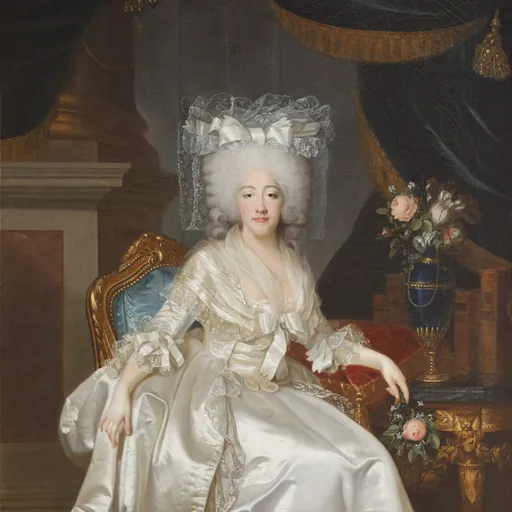
About Marie Joséphine of Savoy
Lived 1753 – 1810 (aged 57). Marie Joséphine of Savoy was an aristocrat.
Marie Joséphine of Savoy (; 2 September 1753 – 13 November 1810) was a princess of France and Countess of Provence by marriage to the future King Louis XVIII of France. She was regarded by Bourbon royalist Legitimists as the titular 'Queen of France' when her husband assumed the title of king in 1795 upon the death of his nephew, the titular King Louis XVII of France, until her death. She was never practically queen, as she died before her husband actually became king in 1814.
Early life and marriage (1753–1773)
Marie Joséphine was born at the Royal Palace of Turin on 2 September 1753 as the third child and second daughter of Prince Victor Amadeus of Savoy and Infanta Maria Antonia Ferdinanda of Spain. At the time of her birth, her paternal grandfather, Charles Emmanuel III, was the King of Sardinia, thus her parents were styled Duke and Duchess of Savoy. Her brothers included the last three kings of Sardinia from the senior line of the House of Savoy: the future Charles Emmanuel IV, Victor Emmanuel I, and Charles Felix.
Marriage Marie Joséphine was engaged to the French prince Louis Stanislas, the Count of Provence. Her aunts, Maria Luisa of Savoy and Eleonora of Savoy, were once proposed as brides for Louis Stanislas's father Louis Ferdinand.
Marie Joséphine was by view of rank and connections deemed very suitable for a marriage to a French prince, and she had been regarded as a suitable bride of the dauphin prior to his marriage in 1770. The marriage was supported by Madame du Barry, who wished to create an ally within the royal family and who the king allowed to form the household of the new princess with her allies, notably the Countess de Valentinois as the principal lady-in-waiting. A ball followed the wedding on 20 May.
The marriage was arranged as a part of a series of Franco-Sardinian dynastic marriages taking place in a time span of eight years: after the wedding between her first cousin the Princesse de Lamballe and Louis Alexandre de Bourbon, Prince of Lamballe,
She did not make a good impression upon her arrival in France, and was described as small, plain, with sallow skin and what Louis XV called “a villainous nose”, and as a person as timid, gauche and "ill educated in all those graces considered so important at Versailles", coming from the more strict Sardinian court, where rouge was found repugnant. In order to rectify the bad impression of her appearance, the ambassador to France from Sardinia was required to ask her father to tell her about the necessity for a careful toilette, in particular with regard to her teeth and hair: “It is embarrassing for me to discuss such things, but these mere details to us are vital matters in this country”. Years later the Sardinian ambassador to France reported that there was never a question of a physical union between them. Marie Joséphine herself reported in February 1772 that she was quite sure she was not pregnant “and it’s not my fault.” A second pregnancy in 1781 also miscarried, and the marriage remained childless.
During her first years in France, the three royal couples - the count and countess of Provence, the count and countess of Artois, the Dauphin and Dauphine - as well as the princesse de Lamballe, who was the favorite of Marie Antoinette, formed a circle of friends and acted in amateur theater plays together, before an audience only consisting of the dauphin. As the second lady of the French court after the queen, she alternated with the Mesdames de France in accompanying Marie Antoinette on official representational assignments. thumb Portrait of Marie Joséphine in 1777, pointing to a bust of her husbandThe seemingly good relationship between the four couples somewhat deteriorated, however, after the succession of Louis XVI to the throne in 1774. Louis XVI and Louis Stanislas did not enjoy a harmonious relationship. They often quarreled, as did their wives. The Count of Provence actually challenged the legitimacy of Marie Antoinette's first child, and until the birth of a male heir by Marie Antoinette, he did everything in his power to promote himself and his wife as better fitted to be next-in-line for the throne. Without children or political influence, Marie Joséphine intrigued against the Queen, but without much success, while her spouse orchestrated a true country-wide opposition against her. She was well educated in literature - she had her own library installed in her apartments - and was estimated to have been of no small intelligence and with a good ability to accustom to court intrigues. They regularly attended court in the Tuileries and were also present at the evening family suppers, where Marie Joséphine was described as humorous and entertained with character reading of people's faces. On the 20 June, Marie Joséphine attended a dinner with the royal family at the Tuileries with her spouse. On that night, she was awoken in her bed by Gourbillon who announced that she was ordered by the king and her husband to leave the country at once, and swiftly taken to her designed rented carriage by Gourbillon, while Louis Stanislas left with d'Avaray to a different carriage. She was asked to come without her spouse, as her father was already in a difficult diplomatic situation with the French government due to the great number of aristocratic émigrés in Sardinia. She was duly welcomed in her former home country in early 1792. On 8 June 1795, the only surviving son of Louis XVI and Marie Antoinette, referred to by the legitimists as 'Louis XVII of France', died while imprisoned in the Temple, and on 16 June, the exiled French royalists proclaimed the count of Provence king of France as Louis XVIII. Thus, Marie Joséphine became regarded as titular queen consort of France by the legitimists. In the court of Turin, Marie Joséphine came to be regarded as queen and her sister Maria Theresa as 'Madame', but to avoid provocation of the diplomatic relations between France and Sardinia, she officially stayed in Turin incognito as 'countess of Lille'. while others have named Louis Stanislas' relationship with Anne de Balbi. Surrounded in her final days by most of the French court, she begged for forgiveness for any wrongs she might have done them, especially Louis; she assured him that she harboured no ill will toward him. Her funeral was a magnificent occasion attended by all the members of the court-in-exile, whose names were recorded by police spies and reported back to Napoleon.
After her death, Louis Stanislas in several letters, talks of the fact he loves and misses his recently departed wife. He wrote this in his private letters to his close companion Duke d’Avray, so the letters were not meant for public effect, but are regarded by some historians as true to his feelings.
Her body was removed a year later on Louis's orders and buried in the Kingdom of Sardinia; today it lies in Cagliari Cathedral. There, her brother King Charles Felix of Sardinia had an imposing monument erected over her grave, whereon she is described personally as "sapiens, prudens, pientissima" ("wise, prudent, kindest") and as "Galliarum Regina", literally "Queen of the Gauls", i.e. of France. title=Ancestors of Marie Joséphine of Savoy boxstyle_1=background-color: #fcc; boxstyle_2=background-color: #fb9; boxstyle_3=background-color: #ffc; boxstyle_4=background-color: #bfc; boxstyle_5=background-color: #9fe; 1= 1. Marie Joséphine of Savoy 2= 2. Victor Amadeus III of Sardinia 3= 3. Maria Antonia Ferdinanda of Spain 4= 4. Charles Emmanuel III of Sardinia 5= 5. Polyxena of Hesse-Rotenburg 6= 6. Philip V of Spain 7= 7. Elisabeth Farnese 8= 8. Victor Amadeus II of Sardinia 9= 9. Anne Marie of Orléans 10= 10. Ernest Leopold, Landgrave of Hesse-Rotenburg 11= 11. Eleonore of Löwenstein-Wertheim-Rochefort 12= 12. Louis, Dauphin of France 13= 13. Maria Anna Victoria of Bavaria 14= 14. Odoardo Farnese, Hereditary Prince of Parma 15= 15. Dorothea Sophie of the Palatinate
In fiction and film
The Countess of Provence was played by French actress Clémentine Poidatz in the 2006 motion picture Marie Antoinette directed by Sofia Coppola. The film portrays her as the mother of the Duke of Angoulême (Louis XIX), who was really the son of her sister Princess Maria Theresa of Savoy.
In the 2022 TV series Marie Antoinette, she is portrayed by Roxane Duran.
Don’t just read it —
keep it.
Full-length biographies made to live with: read them, listen on the way to work, watch them tonight.
- E-book
- Audio
- Video
Instant download · yours to keep · every purchase keeps this site free
Important facts
Family & relationships
People in Marie Joséphine of Savoy's life
Named in this biography and alive at the same time
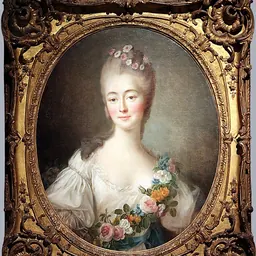

Related people
Same field, nearest in time

Contemporaries
People whose lives overlapped Marie Joséphine of Savoy's






Frequently asked questions
Who was Marie Joséphine of Savoy?
princess
When was Marie Joséphine of Savoy born?
Marie Joséphine of Savoy was born on 2 September 1753 in Royal Palace of Turin.
When did Marie Joséphine of Savoy die?
Marie Joséphine of Savoy died on 13 November 1810 in Hartwell.
What was Marie Joséphine of Savoy's occupation?
Marie Joséphine of Savoy was an aristocrat.
Sources & further reading
· Wikipedia: Marie Joséphine of Savoy
· DBpedia: Marie Joséphine of Savoy
Cite this page
APA: Biography.guide. (2026). Marie Joséphine of Savoy. https://biography.guide/marie-josephine-of-savoy/
MLA: "Marie Joséphine of Savoy." Biography.guide, https://biography.guide/marie-josephine-of-savoy/.
Chicago: "Marie Joséphine of Savoy." Biography.guide. https://biography.guide/marie-josephine-of-savoy/.
Data last updated: 2026-09-20 · Spot an error? Report a correction.
Portrait: Wikimedia Commons · author & licence
Page generated 2026-09-27 04:58 UTC