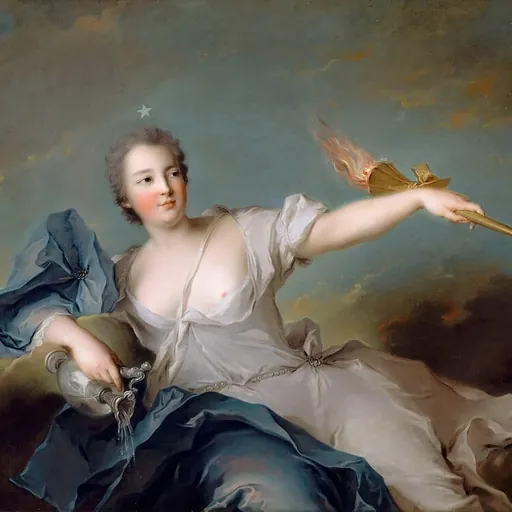
About Marie Anne de Mailly
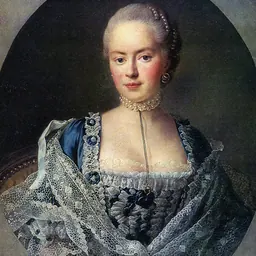
Lived 1717 – 1744 (aged 27). Marie Anne de Mailly was a French lady-in-waiting and royal mistress.
Marie Anne de Mailly-Nesle, duchesse de Châteauroux (; 5 October 1717 – 8 December 1744) was the youngest of five famous de Nesle sisters, four of whom would become mistress es of King Louis XV of France. Marie Anne was the King's mistress from 1742 until 1744. Marie Anne had four older full sisters:
Louise Julie de Mailly, Mademoiselle de Mailly, comtesse de Mailly (1710 - 1751), Pauline Félicité de Mailly, Mademoiselle de Nesle, marquise de Vintimille (1712 - 1741), Diane Adélaïde de Mailly, Mademoiselle de Montcavrel, duchesse de Lauraguais (1714 - 1769), Hortense Félicité de Mailly, Mademoiselle de Chalon, marquise de Flavacourt (1715 - 1799).
The only one of the de Nesle sisters not to become a mistress of Louis XV's was the Marquise de Flavacourt. Louise Julie was the first sister to attract the king followed by Pauline Félicité, but it was Marie Anne who was the most successful in manipulating him and becoming politically powerful.
Marie Anne also had a younger half-sister, Henriette de Bourbon (1725 - 1780), Mademoiselle de Verneuil, from her mother's relationship with the duc de Bourbon, the chief minister of Louis XV from 1723 to 1726.
In her youth, Marie Anne was known as Mademoiselle de Monchy. On 19 June 1734, she married Jean Baptiste Louis, marquis de La Tournelle (1708-1740).
She was a friend of Charlotte Aglaé d'Orléans, granddaughter of Louis XIV and Madame de Montespan.
Royal Mistress
Introduction In 1732, Marie Anne's oldest sister Louise Julie, who had succeeded their mother as lady-in-waiting to the queen, caught the attention of King Louis XV, and, with her husband's consent, become a royal mistress. Although she became the king's mistress in 1732, Louise Julie was not officially recognized as his maîtresse en titre until 1738, and did not use her new position at court to enrich herself or to interfere in politics.
Louise Julie was devoted to her family, and it was said that she was "a loving, sincere little creature with all the qualities of an easy dupe, and she was happy to Introduce her sisters at Court for the sole reason that it gave them pleasure". and by the mediation of d'Argenson, Marie Anne secured the king's approval for her candidacy to this office as dame du palais. It was rumoured at the time that one of the methods by which Marie Anne kept the interest of the king was to periodically offer him a ménage à trois with her sister, Diane Adélaïde de Lauraguais. That Lauraguais actually began sleeping with the king at this point is debatable. Nevertheless, the widespread rumors made the two sisters' visit to the king in Metz a national scandal. During the notorious visit of the sisters in Metz, the king suddenly fell gravely ill on 8 August. Fearing to be at his deathbed, Louis XV was afflicted by a religious crisis; he confessed to François de Fitz-James and announced his wish to renounce his adultery and mistresses and ask his wife for her forgiveness. The queen was called to Metz, and Marie Anne and Diane Adélaïde ordered to leave. During their journey back to Paris the sisters were taunted by mobs who threatened to lynch them and their coach was attacked with stones.
Death Louis XV recovered from his illness and upon his return from the battlefield made a triumphal entry into Paris. Missing Marie Anne, he visited her in secret on 14 November. On the 25th, minister Maurepas was obliged to recall Marie Anne to Versailles where she was restored in her former position as royal mistress. Her return to court was described as a triumph and there were fears that she would exact revenge upon her enemies. However, she had barely arrived at court before she fell sick with convulsive pains and cramp attacks. She died on 8 December 1744, convinced on her deathbed that she had been poisoned. She was swiftly buried without ceremony in the church of St Sulpice in Paris in 13 December.
After her death, the king for a short time consoled himself with her sister, Diane Adélaïde de Lauraguais. A few months later in 1745, however, the king already had a new mistress, Madame de Pompadour.
Depiction in fiction Marie Anne is one of the central characters in Sally Christie's The Sisters of Versailles (Simon&Schuster 2015), a novel about Louis XV and the notorious Mailly-Nesle sisters.
Marie Anne is also the mistress on the King's arm depicted in Season 2, Episode 2 of Outlander.
Don’t just read it —
keep it.
Full-length biographies made to live with: read them, listen on the way to work, watch them tonight.
- E-book
- Audio
- Video
Instant download · yours to keep · every purchase keeps this site free
Important facts
People in Marie Anne de Mailly's life
Named in this biography and alive at the same time




Related people
Same field, nearest in time


Contemporaries
People whose lives overlapped Marie Anne de Mailly's





Frequently asked questions
Who was Marie Anne de Mailly?
French noblewoman (1717-1744)
When was Marie Anne de Mailly born?
Marie Anne de Mailly was born on 5 October 1717 in Paris.
When did Marie Anne de Mailly die?
Marie Anne de Mailly died on 8 December 1744 in Paris.
What was Marie Anne de Mailly's occupation?
Marie Anne de Mailly was a lady-in-waiting and royal mistress.
What nationality was Marie Anne de Mailly?
Marie Anne de Mailly was French.
Sources & further reading
· Wikipedia: Marie Anne de Mailly
· DBpedia: Marie Anne de Mailly-Nesle
Cite this page
APA: Biography.guide. (2026). Marie Anne de Mailly. https://biography.guide/marie-anne-de-mailly/
MLA: "Marie Anne de Mailly." Biography.guide, https://biography.guide/marie-anne-de-mailly/.
Chicago: "Marie Anne de Mailly." Biography.guide. https://biography.guide/marie-anne-de-mailly/.
Data last updated: 2026-09-22 · Spot an error? Report a correction.
Portrait: Wikimedia Commons · author & licence
Page generated 2026-09-27 05:04 UTC