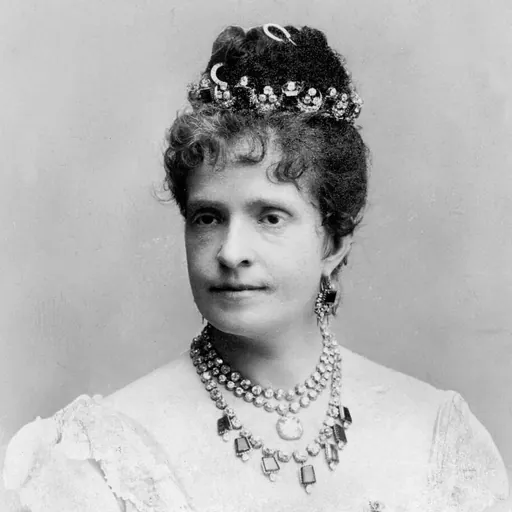
About Maria Pia of Savoy
Lived 1847 – 1911 (aged 63). Maria Pia of Savoy was an Italian and Portuguese politician and photographer.
Dona Maria Pia (16 October 1847 – 5 July 1911) was by birth an Italian princess of the House of Savoy and by marriage Queen of Portugal as the wife of King Luís I of Portugal. On the day of her baptism, Pope Pius IX, her godfather, gave her a Golden Rose. Maria Pia was married to Luís on 6 October 1862 in Lisbon. She was the grand mistress of the Order of Saint Isabel. She was the third queen of the House of Savoy on the Portuguese throne after Mafalda and Marie-Françoise of Savoy-Nemours.
Early life
Maria Pia was born on 16 October 1847 in Turin, the youngest daughter of Victor Emmanuel II, the first King of Italy, by his wife Adelaide of Austria. Her godfather was Pope Pius IX, represented by proxy by the Papal nuncio, taking from him the name Pia. Her sister Maria Clotilde was the "princesse Napoléon" as the wife of Napoléon Joseph Charles Paul Bonaparte, and her brothers were King Umberto I of Italy and King Amadeo of Spain. Additionally, she had paternal half-siblings born out of wedlock who were never recognized as royalty despite their rich heritage.
Maria Pia married King Luís I of Portugal on 6 October 1862 at the age of 14 in the São Domingos Church in Lisbon, therefore she instantly became Queen consort of Portugal. A proxy wedding took place about a week before, on 27 September 1862, with her cousin Prince Eugene of Savoy taking the role of the groom. On the 29th, Maria boarded a ship at Genoa to visit her new homeland. The ship sailed into Lisbon on 5 October. Obviously Maria was smitten with Luís, as she later wrote "I like him more than his picture."
One year after the wedding, at age 15, Maria Pia gave birth to her first son and heir, Carlos, Duke of Braganza. In 1865, she had another son, Afonso, Duke of Porto.
Despite her health problems both physical and mental, the queen was known to romp around with her sons and help with their studies, sometimes even studying alongside them.
Queen consort As Queen, Maria Pia was considered by some as extravagant, but far more for her many charitable works in aid of the Portuguese people. She was known by the Portuguese people as an "angel of charity" and "mother of the poor" for her compassion and work on social causes. At a masquerade ball in 1865, she changed her costume three times. When the Portuguese parliament discussed her expenses, she replied saying "if you want a Queen, you have to pay for her." As Queen, she was largely responsible for the interiors of the Ajuda Royal Palace in Lisbon, still used to this day for banquets during state visits by foreign heads of state.
Maria Pia did not involve herself in politics, but in a conflict with João Carlos Saldanha de Oliveira Daun, 1st Duke of Saldanha, in 1870, she stated: "If I were the king, I would have you shot!" but her husband's infidelity caused her a great deal of depression. It is speculated that she too had an affair with Tomás de Sousa Rosa but this was never confirmed, and may have just been some mean-spirited gossip most likely out of the mouth of Infanta Antónia of Portugal, her sister-in-law. The rumors got around to the queen and she responded indignantly "They can talk until they explode."
Maria Pia and Antónia both disliked each other. This hatred grew to the point where Antónia would refer to the penultimate queen of Portugal as 'x' in her letters to Luís. Antónia strongly believed that Maria Pia was having an affair and urged Luís to pursue a divorce, which was quite a double-standard as she was well aware of Luís' affairs. Maria Pia also maintained a rocky relationship with her father-in-law Ferdinand II of Portugal, disapproving of his morganatic marriage to an opera singer.
Her son Carlos and his wife, Amélie, had a son named Luís Filipe, who was very close to his grandmother. Tragically they also conceived a premature daughter named Maria Ana who lived for only a few hours. She expressed her sympathy, describing her lost granddaughter as "Very small, but perfect and beautiful, with well-defined features."
King Luís died on 19 October 1889 and Maria Pia became queen dowager. She remained very active and continued with her social projects while holding a dominating position at court. She served as regent during the absence of the king and queen abroad. The queen dowager was devastated after the assassination of her son King Carlos I of Portugal and grandson Crown Prince Luís Filipe, Duke of Braganza, on 1 February 1908 on the Praça do Comércio in Lisbon. During her last years in Portugal, she withdrew from the public eye. She was deeply saddened when her remaining grandson, King Manuel II of Portugal, was deposed by the 5 October 1910 Revolution.
Due to the 1910 coup that deposed Maria Pia's grandson, Manuel II, and established the republic in Portugal, the whole Portuguese royal family was exiled. King Manuel and Queen Amélie went to England, while Maria Pia and Infante Afonso went to her native Italy. She died there on 5 July the following year, in Stupinigi, and was interred in the Basilica of Superga.
Gallery
Issue NameBirthDeathNotesDom Carlos, Prince Royal of Portugal 28 September 18631 February 1908Who succeeded his father as Carlos I, King of Portugal, murdered in 1908 by the Carbonária.Dom Afonso, Prince Royal of Portugal 31 July 186521 February 1920 Infante of Portugal, Duke of Porto, Viceroy of Portuguese India, and after 1908 Prince Royal.
Ancestry
Don’t just read it —
keep it.
Full-length biographies made to live with: read them, listen on the way to work, watch them tonight.
- E-book
- Audio
- Video
Instant download · yours to keep · every purchase keeps this site free
Important facts
People in Maria Pia of Savoy's life
Named in this biography and alive at the same time

Related people
Same field, nearest in time




Contemporaries
People whose lives overlapped Maria Pia of Savoy's

Frequently asked questions
Who was Maria Pia of Savoy?
Queen of Portugal from 1862 to 1889
When was Maria Pia of Savoy born?
Maria Pia of Savoy was born on 16 October 1847 in Turin.
When did Maria Pia of Savoy die?
Maria Pia of Savoy died on 5 July 1911 in Palazzina di caccia of Stupinigi.
What was Maria Pia of Savoy's occupation?
Maria Pia of Savoy was a politician and photographer.
What nationality was Maria Pia of Savoy?
Maria Pia of Savoy was Italian and Portuguese.
Sources & further reading
· Wikipedia: Maria Pia of Savoy
Cite this page
APA: Biography.guide. (2026). Maria Pia of Savoy. https://biography.guide/maria-pia-of-savoy/
MLA: "Maria Pia of Savoy." Biography.guide, https://biography.guide/maria-pia-of-savoy/.
Chicago: "Maria Pia of Savoy." Biography.guide. https://biography.guide/maria-pia-of-savoy/.
Data last updated: 2026-10-01 · Spot an error? Report a correction.
Portrait: Wikimedia Commons · author & licence
Page generated 2026-10-05 02:55 UTC