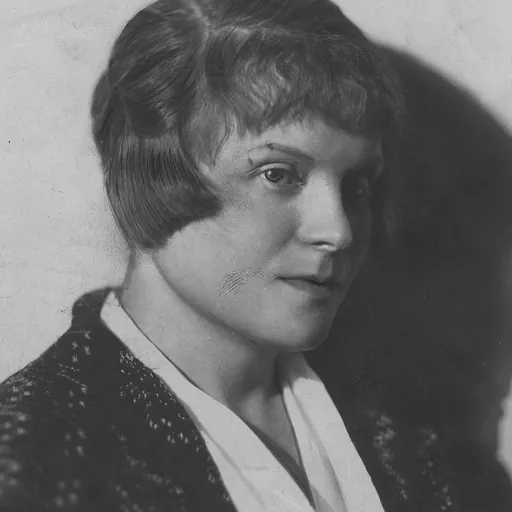
About Maria Dąbrowska
Lived 1889 – 1965 (aged 75). Maria Dąbrowska was a Polish novelist, diarist, translator, journalist, writer and dramaturge.
Maria Dąbrowska (; born Maria Szumska; 6 October 1889 – 19 May 1965) was a Polish writer, novelist, essayist, journalist and playwright, author of the popular Polish historical novel Noce i dnie (Nights and Days) written between 1932 and 1934 in four separate volumes. The novel was made into a film by the same title in 1975 by Jerzy Antczak. Besides her own work, she was also known for translating Samuel Pepys' Diary into Polish. In addition, Dąbrowska was awarded the Golden Laurel of the Polish Academy of Literature in 1935, and she was nominated for the Nobel Prize in Literature eleven times between 1939 and 1965.
Biography
Dąbrowska was born Maria Szumska in Russów near Kalisz, Congress Poland, under Tsarist military control.
Politics When Dąbrowska first met her husband Marian Dąbrowski, he was a political refugee and an active member of the Polish Socialist Party. This, along with rising tensions in Poland during her formative years, launched her into activism herself. One example of this is through two protest articles she wrote for Wiadomosci Literackie Nos. 3 & 4 in 1931: "Rozmova z przyjaciolmi" ("A Talk with Friends") & "Na ciezkiej drodze" ("On a Difficult Road"). These articles spoke out against the holding of the leaders of an initiative that opposed Polish government. These leaders were being held in the fortress of Brzesc under Józef Piłsudski's rule. Dąbrowska thought that this was unjust, and she aimed to contribute to the opposition through her articles.
Writing style
Dąbrowska was known for having a very socially aware voice that seemed to be dependent on her surrounding world. This gave her a very mature and extroverted point of view. At the time she first started writing, there was a huge amount of historical events that were happening, since it was around the time of World War I. Historical events shaped her writing to the point that, sometimes, her writing was less about creativity and more about conveying information in a concise way (especially in her diaries).
In addition, Dąbrowska wrote a novel – that was not published until after her death – that used a particular device. In Przygody człowieka myślącego (Adventures of a Thinking Man), she transposed her own life experiences onto two characters: Ewa Radgoska and Józef Tomyski. Notably, Józef was a male character. This is a technique that many queer female authors of the early twentieth century used; they would transpose their lives onto male characters in a way to make their lives more digestible to readers at the time.
Don’t just read it —
keep it.
Full-length biographies made to live with: read them, listen on the way to work, watch them tonight.
- E-book
- Audio
- Video
Instant download · yours to keep · every purchase keeps this site free
Important facts
People in Maria Dąbrowska's life
Named in this biography and alive at the same time

Related people
Same field, nearest in time




Contemporaries
People whose lives overlapped Maria Dąbrowska's


Frequently asked questions
Who was Maria Dąbrowska?
Polish writer (1889–1965)
When was Maria Dąbrowska born?
Maria Dąbrowska was born on 6 October 1889 in Russów.
When did Maria Dąbrowska die?
Maria Dąbrowska died on 19 May 1965 in Warsaw.
What was Maria Dąbrowska's occupation?
Maria Dąbrowska was a novelist, diarist, translator, journalist, writer and dramaturge.
What nationality was Maria Dąbrowska?
Maria Dąbrowska was Polish.
Sources & further reading
Cite this page
APA: Biography.guide. (2026). Maria Dąbrowska. https://biography.guide/maria-dabrowska/
MLA: "Maria Dąbrowska." Biography.guide, https://biography.guide/maria-dabrowska/.
Chicago: "Maria Dąbrowska." Biography.guide. https://biography.guide/maria-dabrowska/.
Data last updated: 2026-09-20 · Spot an error? Report a correction.
Page generated 2026-09-27 05:09 UTC