About Margaret Schenke
Lived 1888 – 1973 (aged 84–85). Margaret Schenke was a German and British suffragette.
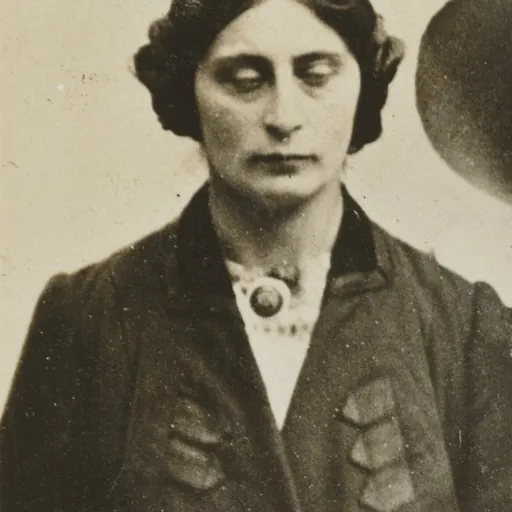
Gretel Schenke, Margaret Schenke or Margaret Scott (1888 – 1983) was a UK based suffragette who was born in Germany. She was arrested after two agent provocateurs encouraged her to break a window. The authorities secretly photographed her and identified her as a person who should be kept under surveillance.
Life Gretel Schenke was born in Zwickau in 1888. She resulted from her father's second marriage and a family row led to her emigrating to Britain with the name of Margot Schenke in about 1908. She took lodging in Chelsea and fell in with suffragettes and spent her time selling The Suffragette newspapers. She reported how the police saved her at Hyde Park Corner. Youths, who made her task difficult with sexual remarks became physical' seizing her banner and trying to seize her. She was grateful when two mounted policemen dispersed the youths and others escorted her away and placed her on a bus to go home.
The authorities were not so supportive when Schenke was demonstrating against Emmeline Pankhurst's arrest in 1913. She chatted to two other demonstrators and suggested that a stone should be thrown at the Home Office. These two strangers arranged for her to make a telephone call to explain that she may not be home on time. It turned out that the two strangers were agent provocateurs and they tipped off a detective who was ready to arrest her. The pictures were taken from a concealed car during prisoners' exercise using an 11-inch powerful lens which had only recently been made in Britain. It was required because the suffragettes would distort their faces when conventional mug shots were being taken and the Home Office was worried by the impact of their arson and vandal attacks.
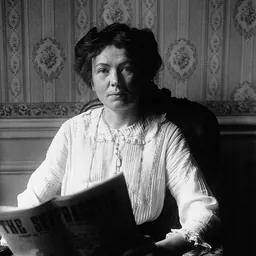
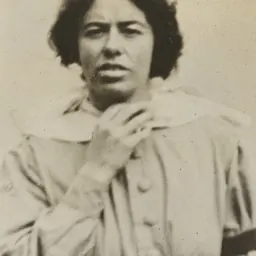
Schenke married Richard Dixon in July 1914 and supported the suffragettes until the outbreak of war. Emmeline and Christabel Pankhurst had declared a truce for their suffragettes and Schenke believed that the fight for the vote was more or less won. She did not mention this episode in her life until she saw, for the first time, her photograph in the Sunday Times. She reported that she considered herself as unimportant in the suffragette movement, although she had met Olive Hockin (Number 2), Margaret Macfarlane (Number 3) and Jane Short (Number 6). Her story became a source of pride to her descendants.
Schenke died in Ealing in 1983.
Don’t just read it —
keep it.
Full-length biographies made to live with: read them, listen on the way to work, watch them tonight.
- E-book
- Audio
- Video
Instant download · yours to keep · every purchase keeps this site free
Important facts
People in Margaret Schenke's life
Named in this biography and alive at the same time




Related people
Same field, nearest in time

Contemporaries
People whose lives overlapped Margaret Schenke's


Frequently asked questions
Who was Margaret Schenke?
German born UK suffragette
When was Margaret Schenke born?
Margaret Schenke was born in 1888 in Zwickau.
When did Margaret Schenke die?
Margaret Schenke died in 1973 in London Borough of Ealing.
What was Margaret Schenke's occupation?
Margaret Schenke was a suffragette.
What nationality was Margaret Schenke?
Margaret Schenke was German and British.
Sources & further reading
· DBpedia: Margaret Scott (suffragette)
Cite this page
APA: Biography.guide. (2026). Margaret Schenke. https://biography.guide/margaret-schenke/
MLA: "Margaret Schenke." Biography.guide, https://biography.guide/margaret-schenke/.
Chicago: "Margaret Schenke." Biography.guide. https://biography.guide/margaret-schenke/.
Data last updated: 2026-09-20 · Spot an error? Report a correction.
Portrait: Wikimedia Commons · author & licence
Page generated 2026-09-27 04:57 UTC