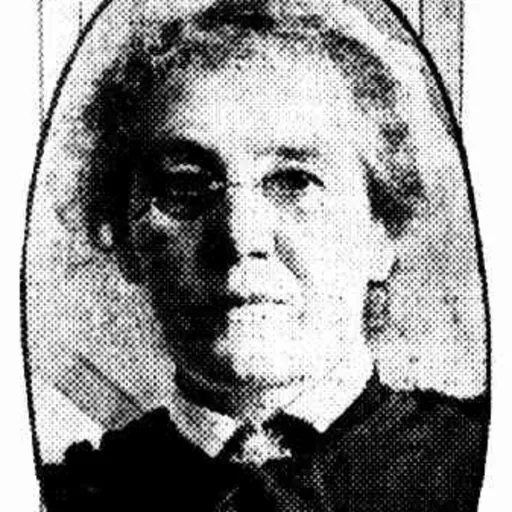
Margaret Graham
(1860-1942) nursing sister and army matron
About Margaret Graham
Lived 1860 – 1942 (aged 81–82). Margaret Graham was an Australian matron and royal Adelaide Hospital.
Margaret Graham, RRC (15 February 1860 – 4 July 1942) was a nurse at the centre of a dispute dubbed the "Adelaide Hospital Row" at the (later Royal) Adelaide Hospital in 1894. She overcame this dubious distinction to become the highly regarded matron of the hospital, then one of the first Australian nursing matrons to serve at the front during the First World War.
Early life and nursing career Graham was born in Carlisle, Cumberland, England, on 15 February 1860, daughter of Margaret Graham (née Farrer) and her husband, house painter John Graham. Nothing further is known of her early life until she emigrated to South Australia in 1886 aboard the steam ship Austral, and on 2 April 1891 she enrolled as a probationary nurse at the Adelaide Hospital. In March 1894 she was appointed acting charge nurse in charge of Adelaide ward, Graham became embroiled in controversy when nurse Ann Hannah Gordon, a sister of the Chief Secretary (later Sir) John Gordon, was promoted to Superintendent of Night Nurses, the second highest nursing rank. Many nurses thought the position should have gone to the more senior charge nurse Louise Hawkins, and that this was a case of favouritism. Six nurses, Graham among them, sent a petition to Premier Charles Kingston requesting an independent enquiry. A committee of twelve, including Drs. Edward Willis Way (who was instrumental in her promotion), Edward Charles Stirling and Anstey Giles, and Sir John Colton, met to consider the premier's request for a review of the appointment. This they endorsed on the grounds that Gordon's selection was on her leadership potential, not her nursing ability (an analogy with officers and "men" was made). Further, they regarded the letter as insulting and impertinent, and recommended suspension of the signatories. Under pressure, five of the nurses withdrew their support for Hawkins, but Graham refused to retract and was urged by her superior, Matron McLeod, to resign, and Dr. Way suggested she take a position at the Port Adelaide Hospital.
A Royal Commission found that Graham's protest was justified, but insulting terms had been used against the government and the hospital board, and if these were retracted Graham should be reinstated. The government dissolved the hospital board, and in the interval between their sacking and appointment of the new one, reinstated Graham. The medical superintendent Dr. Robert H. Perks, who had originally recommended Gordon's promotion to Way, resigned in September 1895 after Graham's return. Matron McLeod, a personal friend of Perks, also resigned. On 8 April 1896 the honorary medical staff and surgical staff resigned en masse, but continued attending to their patients until their contracts expired or replacements were appointed. Professional rivalry between surgeons (such as Leith Napier and Thomas Wilson Corbin) was so intense that the welfare of patients suffered.
Graham was appointed charge nurse and put in charge of Wyatt ward on 4 March 1896. She soon lived down her reputation as a rebel by dedication to her profession, and was appointed matron on 1 January 1898. When the Duchess of Cornwall, married to the future George V, visited the Adelaide Hospital on 10 July 1901, Graham served as her guide, showing her over Albert, Victoria, Alexandra, Alfred, Hope, and Flinders wards.
In November 1911, in an echo of 1895, three nurses were sacked by the board for complaining about the conduct of one Sister Dunstan, who was responsible to Graham. Subsequently 81 nurses refused to work under her; Graham informed the medical superintendent, Dr. C. T. C. de Crespigny, who individually ordered them to work in Victoria ward under Dunstan, and all but two probationers refused and were suspended. Graham smoothed the way for the nurses to return to work, advising them they would not be required to serve under Dunstan. Dunstan was an efficient and conscientious nurse and might have had better relations with her juniors had Graham been more accepting, tactful and accommodating.
Graham was an enthusiastic teacher but avoided paperwork wherever possible, leaving it for her night charge nurse. but was again exonerated.
Army service Army records originally had Graham aboard Ascanius, amended to 5 December embarkation aboard Kyarra. In 1904 Graham enlisted with the Australian Army Nursing Service, a newly formed volunteer body of 108 (14 in SA) women nurses attached to the Australian Army Medical Corps, and was appointed the State's Lady Superintendent, with Mary Knowles as matron. Graham enlisted for active service with the Australian Imperial Force on 19 or 28 September 1914 (later army documents have 21 November); arrived in Fremantle on 25 October, and in Colombo on 14 November, destined for Malta where she joined the hospital ship Guildford Castle. Among the 20 nursing volunteers from Adelaide was Matron Margaret Graham. This accords with the handwritten correction on the record card pictured here and by Merrilyn Lincoln's assertion in the Australian Dictionary of Biography that Graham "embarked at Melbourne in December". Matron Margaret Graham RRCGraham reported for duty at No. 2 Australian General Hospital, Mena House, Heliopolis, on 27 April 1915, Her last posting was No. 2 Australian General Hospital in England, before in January 1918 reporting to the medical offices at AIF Headquarters, London. On 27 January 1921 Graham boarded the Benalla for England where she died in Carlisle. She never married.
Recognition She was Mentioned in Despatches on 13 October 1916 by General Archibald Murray. In December 1916 she was awarded the Royal Red Cross, 1st Class, so was entitled to the post-nominal letters RRC. The award was personally presented by King George V. She was in 1900 the founder of the SA branch of the Royal British Nurses' Association and awarded the title of Lady Consul by the parent body. She was awarded the Honorary Diploma of the Royal British Nurses' Association, a rare honour. The Adelaide Hospital Nurses' Quarters, a four-storey building at the former RAH site close to Frome Road, was built in 1911, later repurposed as an administrative centre and in 1954 named Margaret Graham Building for her. A plaque on North Terrace, Adelaide was laid in her honour as part of the Jubilee 150 Walkway.
Don’t just read it —
keep it.
Full-length biographies made to live with: read them, listen on the way to work, watch them tonight.
- E-book
- Audio
- Video
Instant download · yours to keep · every purchase keeps this site free
Important facts
People in Margaret Graham's life
Named in this biography and alive at the same time







Related people
Same field, nearest in time


Contemporaries
People whose lives overlapped Margaret Graham's


Frequently asked questions
Who was Margaret Graham?
(1860-1942) nursing sister and army matron
When was Margaret Graham born?
Margaret Graham was born on 15 February 1860 in Carlisle.
When did Margaret Graham die?
Margaret Graham died in 1942 in United Kingdom.
What was Margaret Graham's occupation?
Margaret Graham was a matron and royal Adelaide Hospital.
What nationality was Margaret Graham?
Margaret Graham was Australian.
Sources & further reading
· DBpedia: Margaret Graham (matron)
Cite this page
APA: Biography.guide. (2026). Margaret Graham. https://biography.guide/margaret-graham-matron/
MLA: "Margaret Graham." Biography.guide, https://biography.guide/margaret-graham-matron/.
Chicago: "Margaret Graham." Biography.guide. https://biography.guide/margaret-graham-matron/.
Data last updated: 2026-09-21 · Spot an error? Report a correction.
Portrait: Wikimedia Commons · author & licence
Page generated 2026-09-27 05:00 UTC