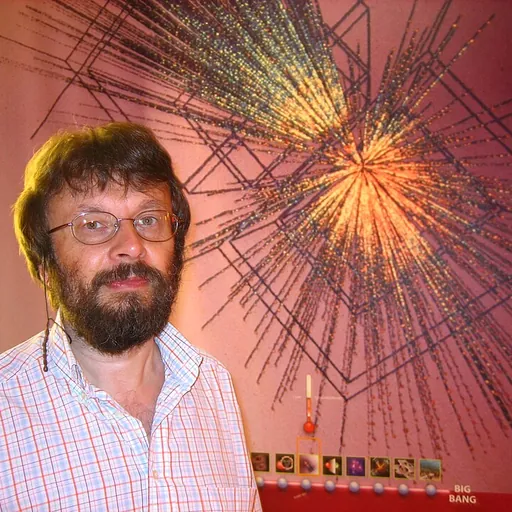
About Marek Gaździcki
Born 1956. Marek Gaździcki is a Polish physicist and nuclear physicist, known for Onset of deconfinement.
Marek Gaździcki (born 9 June 1956) is a Polish high-energy nuclear physicist, and the initiator and spokesperson of the NA61/SHINE experiment at the CERN Super Proton Synchrotron (SPS).
1986–1992: Collisions of light nuclei at 200A GeV (Frankfurt/Main, Heidelberg and Warsaw)
Subsequently, (1986–1992) he took part in the NA35 experiment at the CERN SPS, where he studied hadron production in (, )+(S–Pb) collisions at 200A GeV using a large volume streamer chamber. Here, a first observation of the enhancement of strange hadron production in A+A collisions at the SPS energies constituted the cardinal outcome of this experiment. This result constituted the main part of Gazdzicki's habilitation.
1992–1996: Pb+Pb collisions at 158A GeV (CERN and Frankfurt/Main)
In 1992, Gaździcki began working on the NA49 experiment, which was based on time projection chambers, the time of flight detectors and calorimeters. The study of central Pb+Pb collisions at the top SPS energy confirmed the main result from the study of S+S interactions: the enhancement of strange hadron production in nucleus–nucleus collisions.
1994–1999: Predictions of the threshold for quark–gluon plasma production (Frankfurt/Main)
Gaździcki's further work (1994–1999) was focused on the compilation, analysis and the interpretation of experimental results on system size and energy dependence of pion and strangeness production in A+A collisions, as well as the development of statistical models of strong interactions. Based upon these testings, Gaździcki observed the anomaly in energy dependence of pion and strange hadron yields in A+A collisions.
Furthermore, he suggested that this anomaly is due to the transition to deconfinement matter occurring between top AGS (15A GeV) and top SPS (158A GeV) energies. Lastly, along with Mark Gorenstein, he formulated the statistical model of the early stage which is a basis for the quantitative description of the observed effects, and further predictions concerning the threshold for the quark–gluon plasma production.
1997-2007: Evidence for the threshold at the low SPS energies (CERN and Frankfurt/Main)
Based upon these results in 1997 Gaździcki, together with Peter Seyboth, initiated the energy scan with Pb+Pb collisions at the CERN SPS which was performed by NA49 from 1998 to 2002. The main results of this programme are: the observation of the onset of the steepening of energy dependence of pion yield at about 30A GeV (kink), the observation of the non-monotonic energy dependence of positively charged kaon to pion ratio with the maximum located close to 30A GeV (horn), and the observation of the anomaly in energy dependence of the transverse mass spectra of kaons (step) located in the SPS energy range. These observations serve as evidence for the onset of deconfinement at the CERN SPS energies.
Since 1992: Event-by-event fluctuations (Warsaw, Frankfurt/Main and CERN)
In 1992 he started along with his collaborators the work on the development of statistical methods for the study of event-by-event fluctuations, as well as the study of physics of event-by-event fluctuations in A+A collisions. The most important results are the introduction of the commonly used measure of event-by-event fluctuations, and the cumulative variable for the correlation/fluctuation study, as well as the study of fluctuations and statistical models with conserved quantities.
Since 1998: Quarkonium production and high pT phenomena (CERN and Frankfurt/Main)
Since 1998, Gaździcki, together with Mark Gorenstein, has been aiming at the compilation and interpretation of the data on the production of high (transverse) mass mesons, and at the development of the statistical model of strong interactions for high (transverse) mass domain. As a result, they discovered the independence of the to the pion ratio of the system size in A+A collisions at 158A GeV. Moreover, they formulated the hypothesis of the statistical production of mesons, and they found the mT power-law scaling in high mT domain in proton-proton interactions at high energies. Conclusively, the statistical interpretation of the scaling was formulated.
Since 2003: NA61/SHINE experiment at the CERN SPS (Frankfurt/Main and Kielce)
Motivated by the discovery of the threshold of the quark–gluon plasma production in 2003 Gaździcki initiated and became spokesperson of the NA61/SHINE experiment. The principal goals of this experiment are: the search of the critical point of strongly interacting matter, the study of the properties of the onset of deconfinement in nucleus-nucleus collisions and precision measurements of hadron production in nuclear interactions for neutrino (T2K) and cosmic-ray (Pierre Auger Observatory and KASCADE) experiments.
Don’t just read it —
keep it.
Full-length biographies made to live with: read them, listen on the way to work, watch them tonight.
- E-book
- Audio
- Video
Instant download · yours to keep · every purchase keeps this site free
Important facts
People in Marek Gaździcki's life
Named in this biography and alive at the same time


Related people
Same field, nearest in time




Contemporaries
People whose lives overlapped Marek Gaździcki's

Frequently asked questions
Who is Marek Gaździcki?
Polish physicist
When was Marek Gaździcki born?
Marek Gaździcki was born on 9 June 1956 in Warsaw.
What is Marek Gaździcki's occupation?
Marek Gaździcki is a physicist and nuclear physicist.
What is Marek Gaździcki known for?
Marek Gaździcki is known for Onset of deconfinement.
What nationality is Marek Gaździcki?
Marek Gaździcki is Polish.
Sources & further reading
Cite this page
APA: Biography.guide. (2026). Marek Gaździcki. https://biography.guide/marek-gazdzicki/
MLA: "Marek Gaździcki." Biography.guide, https://biography.guide/marek-gazdzicki/.
Chicago: "Marek Gaździcki." Biography.guide. https://biography.guide/marek-gazdzicki/.
Data last updated: 2026-09-20 · Spot an error? Report a correction.
Portrait: Wikimedia Commons · author & licence
Page generated 2026-09-27 04:57 UTC